

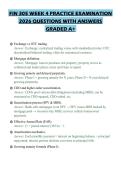
FIN 305 WEEK 4 PRACTICE EXAMINATION
2026 QUESTIONS WITH ANSWERS
GRADED A+
◍ Exchange vs OTC trading.
Answer: Exchange: centralized trading venue with standardized rules; OTC:
decentralized bilateral trading, often for customized contracts.
◍ Mortgage definition.
Answer: Mortgage: loan to purchase real property; property serves as
collateral and lender places a lien until loan is repaid.
◍ Growing annuity and delayed perpetuity.
Answer: Phase I = growing annuity for N years; Phase II = N-year delayed
growing perpetuity.
◍ CDO and higher-order securitization.
Answer: CDOs pool various debt obligations (including MBS); can be
structured as CDO-squared, CDO-cubed, etc.
◍ Securitization process (SPV & MBS).
Answer: Bank sells mortgages to an SPV → SPV issues MBS backed by
mortgage pool → investors buy MBS; servicer collects homeowner
payments.
◍ Effective Annual Rate (EAR).
Answer: (1 + period return)^(365/n) − 1.
◍ Amortization mechanics.
Answer: Each monthly payment = interest on beginning balance + principal
repayment; interest portion declines over time as principal falls.
◍ Growing annuity formula (Phase I).
, Answer: Phase I PV (growing annuity):
\(PV=\frac{D_1}{r-g_1}\left[1-\left(\frac{1+g_1}{1+r}\right)^N\right]\)
when \(r\neq g_1\).
◍ Debt Instruments.
Answer: Securities that promise fixed payments (e.g., loans and bonds).
◍ General Obligation Bond.
Answer: A municipal bond backed by the full faith and credit of the issuer.
◍ Bank licensing and resolution.
Answer: Bank must obtain a license to operate; regulators require capital
and liquidity; orderly resolution and deposit insurance mitigate failures.
◍ Eurodollars.
Answer: US dollar deposits held outside the United States.
◍ Example differential growth.
Answer: Example: dividends grow 18% for 5 years then 10%; discount rate
15%; compute PV of each phase and sum.
◍ Bulldog Bonds.
Answer: Foreign bonds issued in the United Kingdom by non-UK entities.
◍ Bond Sells at Par.
Answer: A bond sells at par (P = F) when YTM equals the coupon rate.
◍ Eurobond.
Answer: A bond denominated in one currency but issued in a different
country.
◍ Growth from retention and ROE.
Answer: Growth rate \(g = b \times ROE\) where \(b\) is the plowback
(retention) ratio.
◍ Ginnie Mae role.
Answer: Ginnie Mae guarantees MBS backed by federally insured loans;
guarantees carry full faith and credit of the U.S. government.
, ◍ Competitive Bid.
Answer: Bid specifying quantity and discount yield.
◍ Amortization.
Answer: Each fixed monthly payment includes interest (on remaining
balance) and principal; interest portion declines over time.
◍ Inflation Risk.
Answer: The risk that inflation reduces purchasing power of bond payments.
◍ Treasury Bond.
Answer: US government debt with maturity between 10 and 30 years.
◍ Ginnie Mae role.
Answer: Ginnie Mae guarantees MBS backed by federally insured loans;
guarantees carry full faith and credit of US government.
◍ Typical mortgage example (inputs).
Answer: Example: $150,000 house, $30,000 down, $120,000 loan, 30-year
term, 6% APR.
◍ Convertible Bond.
Answer: A bond that can be converted into a specified number of common
shares; lowers issuer's funding cost.
◍ Eurocurrency.
Answer: Deposits denominated in a currency but held outside the home
country of that currency.
◍ Exchange-traded funds (ETFs).
Answer: ETFs trade like stocks and track indices or strategies (e.g., SPY
tracks S&P 500); can be passive or active; include leveraged/inverse ETFs.
◍ Spread definition.
Answer: Spread = (Interest income / Earning assets) − (Interest expense /
Interest-bearing liabilities); measures lending vs borrowing return gap.
◍ Return on equity components.
Answer: Return on a share comes from dividend yield and capital gains
2026 QUESTIONS WITH ANSWERS
GRADED A+
◍ Exchange vs OTC trading.
Answer: Exchange: centralized trading venue with standardized rules; OTC:
decentralized bilateral trading, often for customized contracts.
◍ Mortgage definition.
Answer: Mortgage: loan to purchase real property; property serves as
collateral and lender places a lien until loan is repaid.
◍ Growing annuity and delayed perpetuity.
Answer: Phase I = growing annuity for N years; Phase II = N-year delayed
growing perpetuity.
◍ CDO and higher-order securitization.
Answer: CDOs pool various debt obligations (including MBS); can be
structured as CDO-squared, CDO-cubed, etc.
◍ Securitization process (SPV & MBS).
Answer: Bank sells mortgages to an SPV → SPV issues MBS backed by
mortgage pool → investors buy MBS; servicer collects homeowner
payments.
◍ Effective Annual Rate (EAR).
Answer: (1 + period return)^(365/n) − 1.
◍ Amortization mechanics.
Answer: Each monthly payment = interest on beginning balance + principal
repayment; interest portion declines over time as principal falls.
◍ Growing annuity formula (Phase I).
, Answer: Phase I PV (growing annuity):
\(PV=\frac{D_1}{r-g_1}\left[1-\left(\frac{1+g_1}{1+r}\right)^N\right]\)
when \(r\neq g_1\).
◍ Debt Instruments.
Answer: Securities that promise fixed payments (e.g., loans and bonds).
◍ General Obligation Bond.
Answer: A municipal bond backed by the full faith and credit of the issuer.
◍ Bank licensing and resolution.
Answer: Bank must obtain a license to operate; regulators require capital
and liquidity; orderly resolution and deposit insurance mitigate failures.
◍ Eurodollars.
Answer: US dollar deposits held outside the United States.
◍ Example differential growth.
Answer: Example: dividends grow 18% for 5 years then 10%; discount rate
15%; compute PV of each phase and sum.
◍ Bulldog Bonds.
Answer: Foreign bonds issued in the United Kingdom by non-UK entities.
◍ Bond Sells at Par.
Answer: A bond sells at par (P = F) when YTM equals the coupon rate.
◍ Eurobond.
Answer: A bond denominated in one currency but issued in a different
country.
◍ Growth from retention and ROE.
Answer: Growth rate \(g = b \times ROE\) where \(b\) is the plowback
(retention) ratio.
◍ Ginnie Mae role.
Answer: Ginnie Mae guarantees MBS backed by federally insured loans;
guarantees carry full faith and credit of the U.S. government.
, ◍ Competitive Bid.
Answer: Bid specifying quantity and discount yield.
◍ Amortization.
Answer: Each fixed monthly payment includes interest (on remaining
balance) and principal; interest portion declines over time.
◍ Inflation Risk.
Answer: The risk that inflation reduces purchasing power of bond payments.
◍ Treasury Bond.
Answer: US government debt with maturity between 10 and 30 years.
◍ Ginnie Mae role.
Answer: Ginnie Mae guarantees MBS backed by federally insured loans;
guarantees carry full faith and credit of US government.
◍ Typical mortgage example (inputs).
Answer: Example: $150,000 house, $30,000 down, $120,000 loan, 30-year
term, 6% APR.
◍ Convertible Bond.
Answer: A bond that can be converted into a specified number of common
shares; lowers issuer's funding cost.
◍ Eurocurrency.
Answer: Deposits denominated in a currency but held outside the home
country of that currency.
◍ Exchange-traded funds (ETFs).
Answer: ETFs trade like stocks and track indices or strategies (e.g., SPY
tracks S&P 500); can be passive or active; include leveraged/inverse ETFs.
◍ Spread definition.
Answer: Spread = (Interest income / Earning assets) − (Interest expense /
Interest-bearing liabilities); measures lending vs borrowing return gap.
◍ Return on equity components.
Answer: Return on a share comes from dividend yield and capital gains


