
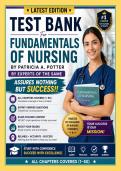
,Fundamentals oF nursing latest edition by
experts oF the same (masters in the Field!!) –
Comprehensive praCtiCe Questions with answers
that are well explained through useFul
rationales
Question 1: Infection Control
A nurse is caring for a client diagnosed with Clostridioides difficile infection. The client has severe
diarrhea and abdominal cramping. Which action by the nurse is MOST appropriate to prevent
transmission of infection to other clients?
Choices
Option Answer Choice
A Wear a surgical mask when entering the room
B Perform hand hygiene using alcohol-based sanitizer only
C Wash hands with soap and water after client contact
D Place the client in a room with positive airflow
Correct Answer
C. Wash hands with soap and water after client contact
Rationale
Clostridioides difficile spores are resistant to alcohol-based hand sanitizers. Proper handwashing with
soap and water is essential to prevent transmission.
Question 2: Maslow’s Hierarchy of Needs
A nurse is prioritizing care for four clients. Which client should the nurse assess FIRST according to
Maslow’s hierarchy of needs?
Choices
,Option Answer Choice
A A client requesting assistance with bathing
B A client reporting severe shortness of breath
C A client worried about financial problems
D A client requesting discharge instructions
Correct Answer
B. A client reporting severe shortness of breath
Rationale
Physiological needs such as oxygenation take highest priority according to Maslow’s hierarchy.
Question 3: Delegation
A registered nurse (RN) is supervising assistive personnel (AP) on a medical-surgical unit. Which task is
appropriate for the RN to delegate to the AP?
Choices
Option Answer Choice
A Assess pain level after medication administration
B Teach a client how to use an incentive spirometer
C Obtain routine vital signs for stable clients
D Develop a nursing care plan
Correct Answer
C. Obtain routine vital signs for stable clients
Rationale
Assistive personnel may perform routine, noninvasive tasks for stable clients under RN supervision.
Question 4: Therapeutic Communication
A hospitalized client states, “I feel like my condition is getting worse every day.” Which therapeutic
response by the nurse is BEST?
Choices
, Option Answer Choice
A “You shouldn’t think negatively.”
B “Everything will be fine soon.”
C “Tell me more about how you are feeling.”
D “Other clients are much sicker than you.”
Correct Answer
C. “Tell me more about how you are feeling.”
Rationale
Open-ended responses encourage clients to express emotions and promote therapeutic communication.
Question 5: Safety and Fall Prevention
A nurse is caring for an older adult client at high risk for falls. Which intervention is MOST appropriate to
reduce fall risk?
Choices
Option Answer Choice
A Raise all four side rails at all times
B Keep the client’s bed in the lowest position
C Place the call light outside the client’s reach
D Encourage the client to walk without assistance
Correct Answer
B. Keep the client’s bed in the lowest position
Rationale
Keeping the bed low helps prevent injury from falls and improves client safety.
Question 6: Medication Administration
Before administering digoxin to a client, the nurse checks the apical pulse and notes it is 54/min. Which
action should the nurse take?
Choices
experts oF the same (masters in the Field!!) –
Comprehensive praCtiCe Questions with answers
that are well explained through useFul
rationales
Question 1: Infection Control
A nurse is caring for a client diagnosed with Clostridioides difficile infection. The client has severe
diarrhea and abdominal cramping. Which action by the nurse is MOST appropriate to prevent
transmission of infection to other clients?
Choices
Option Answer Choice
A Wear a surgical mask when entering the room
B Perform hand hygiene using alcohol-based sanitizer only
C Wash hands with soap and water after client contact
D Place the client in a room with positive airflow
Correct Answer
C. Wash hands with soap and water after client contact
Rationale
Clostridioides difficile spores are resistant to alcohol-based hand sanitizers. Proper handwashing with
soap and water is essential to prevent transmission.
Question 2: Maslow’s Hierarchy of Needs
A nurse is prioritizing care for four clients. Which client should the nurse assess FIRST according to
Maslow’s hierarchy of needs?
Choices
,Option Answer Choice
A A client requesting assistance with bathing
B A client reporting severe shortness of breath
C A client worried about financial problems
D A client requesting discharge instructions
Correct Answer
B. A client reporting severe shortness of breath
Rationale
Physiological needs such as oxygenation take highest priority according to Maslow’s hierarchy.
Question 3: Delegation
A registered nurse (RN) is supervising assistive personnel (AP) on a medical-surgical unit. Which task is
appropriate for the RN to delegate to the AP?
Choices
Option Answer Choice
A Assess pain level after medication administration
B Teach a client how to use an incentive spirometer
C Obtain routine vital signs for stable clients
D Develop a nursing care plan
Correct Answer
C. Obtain routine vital signs for stable clients
Rationale
Assistive personnel may perform routine, noninvasive tasks for stable clients under RN supervision.
Question 4: Therapeutic Communication
A hospitalized client states, “I feel like my condition is getting worse every day.” Which therapeutic
response by the nurse is BEST?
Choices
, Option Answer Choice
A “You shouldn’t think negatively.”
B “Everything will be fine soon.”
C “Tell me more about how you are feeling.”
D “Other clients are much sicker than you.”
Correct Answer
C. “Tell me more about how you are feeling.”
Rationale
Open-ended responses encourage clients to express emotions and promote therapeutic communication.
Question 5: Safety and Fall Prevention
A nurse is caring for an older adult client at high risk for falls. Which intervention is MOST appropriate to
reduce fall risk?
Choices
Option Answer Choice
A Raise all four side rails at all times
B Keep the client’s bed in the lowest position
C Place the call light outside the client’s reach
D Encourage the client to walk without assistance
Correct Answer
B. Keep the client’s bed in the lowest position
Rationale
Keeping the bed low helps prevent injury from falls and improves client safety.
Question 6: Medication Administration
Before administering digoxin to a client, the nurse checks the apical pulse and notes it is 54/min. Which
action should the nurse take?
Choices


