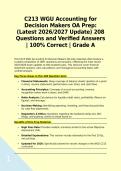
C213 WGU Accounting for
Decision Makers OA Prep:
(Latest 2026/2027 Update) 208
Questions and Verified Answers
| 100% Correct | Grade A
This C213 WGU Accounting for Decision Makers OA prep materials often feature a
curated compilation of 208+ questions and answers, reflecting the most recent
2025/2026 exam updates to help students pass. This resource cover financial
statement analysis, ratio calculations, and managerial accounting topics with
verified answers.
Key Focus Areas in this 208 Question Sets:
Financial Statements: Deep coverage of balance sheets (position at a point
in time), income statements (performance over time), and cash flows.
Accounting Principles: Coverage of accrual accounting, revenue
recognition (when work is done), and GAAP.
Ratio Analysis: Calculations for liquidity (debt ratio), profitability (Return on
Equity), and leverage.
Decision-Making: Identifying operating, investing, and financing activities
for cash flow statements.
Regulatory & Ethics: Questions regarding the Sarbanes-Oxley Act, SEC
filings, and auditing, similar to those found on
Benefits of this Prep Material:
High Pass Rate: Provides realistic scenarios similar to the actual Objective
Assessment (OA).
Detailed Explanations: This version include rationales for the First 20 Qs,
not just keys.
Updated for 2026: Specifically tailored for recent changes in the WGU C213
curriculum.
1
, Q1. Explain what is meant by a company's liquidity and why it matters for short-term
creditors. [Short Answer]
Answer: Liquidity is a company’s ability to pay its short-term debts; it indicates whether the firm
has enough current assets or cash flow to meet obligations coming due in the near term.
Explanation: Liquidity refers specifically to short-term solvency — the capacity to meet obligations as they
fall due. A clear answer defines liquidity and links it to cash or near-cash resources and short-term
obligations so learners understand why liquidity matters for creditors and day-to-day operations.
Q2. Explain the effect the Sarbanes–Oxley Act had on federal oversight of the audit process.
[Short Answer]
Answer: The Sarbanes–Oxley Act led to increased federal oversight of the audit process in the
United States, meaning stronger regulatory supervision of auditors and auditing procedures to
improve reliability of financial reporting.
Explanation: Linking Sarbanes–Oxley to increased federal oversight shows cause and effect: the Act
prompted regulators to tighten audit oversight to restore investor confidence and reduce accounting
failures. A concise answer notes the Act’s role in strengthening oversight of audits.
Q3. Which act of Congress increased federal oversight of the audit process? [Multiple Choice]
A) Sarbanes-Oxley Act
B) Internal Revenue Code
C) Securities Act of 1933
D) Dodd-Frank Wall Street Reform Act
Answer: Sarbanes-Oxley Act
Explanation: The Sarbanes-Oxley Act strengthened federal oversight of the audit process in response to
high-profile accounting scandals, increasing requirements for audit independence and corporate
disclosures. Distractors: The Internal Revenue Code governs taxes, not audit oversight; The Securities Act of
1933 focuses on securities registration and disclosure for public offerings, not the specific post-scandal
audit oversight reforms; The Dodd-Frank Act addresses financial regulatory reform after the financial crisis
but is not the key act cited for increased audit oversight in this context.
Q4. Based on the source, state whether the Financial Accounting Standards Board (FASB) is a
government agency or a private-sector standard-setter, and briefly explain the correct
classification. [Short Answer]
Answer: According to the source, the FASB is not a government agency; it is the current
standard-setting board for accounting in the private sector (a private-sector standards body).
Explanation: The source contrasts the false statement that FASB is a government agency with the factual
role of the FASB as the private-sector standard-setter. Understanding this distinction clarifies that
accounting standards are set by an independent private board rather than by a government department.
2
, Q5. Explain why management is identified as the primary internal group that uses accounting
information. [Short Answer]
Answer: Management is the primary internal user of accounting information because managers
use internal and financial reports to plan, control operations, and make decisions about the
business.
Explanation: Internal users need detailed, timely information to run the company. Identifying
management as the main internal user clarifies that internal reports support operational and strategic
decision-making distinct from external reporting needs.
Q6. Explain how the debt ratio measures a firm's leverage and what the ratio compares. [Short
Answer]
Answer: The debt ratio compares a firm’s total liabilities to its total assets (liabilities ÷ assets); a
higher debt ratio means a larger portion of assets is financed by debt, so the firm is more
leveraged.
Explanation: Debt ratio is a leverage measure because it quantifies how much of the company’s asset base
is funded by creditors rather than owners. Explaining the numerator and denominator and the implication
of a higher value teaches why the ratio signals financial risk.
Q7. Which ratio measures the profit earned on each dollar invested in a firm? [Multiple Choice]
A) Return on equity
B) Return on assets
C) Profit margin
D) Debt ratio
Answer: Return on equity
Explanation: Return on equity (ROE) measures the profit earned for each dollar of shareholders' equity —
essentially how effectively a company uses owners' capital to generate profit. Distractors: Return on assets
measures profit per dollar of total assets, not specifically per dollar invested by owners; Profit margin
measures profit per dollar of sales; Debt ratio measures leverage and does not express profit per invested
dollar.
Q8. What term describes a company's ability to pay its debts in the short run? [Multiple Choice]
A) Liquidity
B) Solvency
C) Profitability
D) Marketability
Answer: Liquidity
3
, Explanation: Liquidity is a company's ability to meet short-term obligations using its short-term assets. It
focuses on whether the firm can convert assets into cash quickly to pay debts due soon. Distractors:
Solvency refers to long-term ability to meet obligations, not short-run payments; Profitability measures
earnings and returns, not immediate payment capacity; Marketability concerns how easily an asset can be
sold in the market, which is related but not the same as the firm-wide ability to pay short-term debts.
Q9. What name is given to the standards established by the International Accounting
Standards Board (IASB)? [Short Answer]
Answer: Standards established by the International Accounting Standards Board are called
International Financial Reporting Standards (IFRS).
Explanation: Naming IFRS as the standards of the IASB links the international standard-setter to its
published framework; learners should remember IASB produces IFRS, which are used as worldwide
accounting standards.
Q10. Explain why financial accounting places emphasis on investors and creditors as external
users. [Short Answer]
Answer: Financial accounting emphasizes external users such as investors and creditors because
they rely on standardized financial reports to make decisions about buying, selling, or lending to
the company.
Explanation: Investors and creditors make economic decisions that depend on comparable, reliable
external financial information; emphasizing these users explains why financial accounting focuses on
externally distributed statements rather than internal day-to-day details.
Q11. Why is "making management decisions" not a typical service provided by large public
accounting firms? [Short Answer]
Answer: Large public accounting firms do not typically make management decisions for their
clients; their services focus on auditing, tax, and advisory work, and making management
decisions would conflict with independence.
Explanation: Separating audit/advisory services from management decisions preserves auditor
independence and avoids conflicts of interest. Explaining this distinction helps learners understand
professional boundaries between advisors and a company's management.
Q12. Which organization develops worldwide accounting standards? [Multiple Choice]
A) International Accounting Standards Board (IASB)
B) Financial Accounting Standards Board (FASB)
C) Internal Revenue Service (IRS)
D) Public Company Accounting Oversight Board (PCAOB)
Answer: International Accounting Standards Board (IASB)
4
Decision Makers OA Prep:
(Latest 2026/2027 Update) 208
Questions and Verified Answers
| 100% Correct | Grade A
This C213 WGU Accounting for Decision Makers OA prep materials often feature a
curated compilation of 208+ questions and answers, reflecting the most recent
2025/2026 exam updates to help students pass. This resource cover financial
statement analysis, ratio calculations, and managerial accounting topics with
verified answers.
Key Focus Areas in this 208 Question Sets:
Financial Statements: Deep coverage of balance sheets (position at a point
in time), income statements (performance over time), and cash flows.
Accounting Principles: Coverage of accrual accounting, revenue
recognition (when work is done), and GAAP.
Ratio Analysis: Calculations for liquidity (debt ratio), profitability (Return on
Equity), and leverage.
Decision-Making: Identifying operating, investing, and financing activities
for cash flow statements.
Regulatory & Ethics: Questions regarding the Sarbanes-Oxley Act, SEC
filings, and auditing, similar to those found on
Benefits of this Prep Material:
High Pass Rate: Provides realistic scenarios similar to the actual Objective
Assessment (OA).
Detailed Explanations: This version include rationales for the First 20 Qs,
not just keys.
Updated for 2026: Specifically tailored for recent changes in the WGU C213
curriculum.
1
, Q1. Explain what is meant by a company's liquidity and why it matters for short-term
creditors. [Short Answer]
Answer: Liquidity is a company’s ability to pay its short-term debts; it indicates whether the firm
has enough current assets or cash flow to meet obligations coming due in the near term.
Explanation: Liquidity refers specifically to short-term solvency — the capacity to meet obligations as they
fall due. A clear answer defines liquidity and links it to cash or near-cash resources and short-term
obligations so learners understand why liquidity matters for creditors and day-to-day operations.
Q2. Explain the effect the Sarbanes–Oxley Act had on federal oversight of the audit process.
[Short Answer]
Answer: The Sarbanes–Oxley Act led to increased federal oversight of the audit process in the
United States, meaning stronger regulatory supervision of auditors and auditing procedures to
improve reliability of financial reporting.
Explanation: Linking Sarbanes–Oxley to increased federal oversight shows cause and effect: the Act
prompted regulators to tighten audit oversight to restore investor confidence and reduce accounting
failures. A concise answer notes the Act’s role in strengthening oversight of audits.
Q3. Which act of Congress increased federal oversight of the audit process? [Multiple Choice]
A) Sarbanes-Oxley Act
B) Internal Revenue Code
C) Securities Act of 1933
D) Dodd-Frank Wall Street Reform Act
Answer: Sarbanes-Oxley Act
Explanation: The Sarbanes-Oxley Act strengthened federal oversight of the audit process in response to
high-profile accounting scandals, increasing requirements for audit independence and corporate
disclosures. Distractors: The Internal Revenue Code governs taxes, not audit oversight; The Securities Act of
1933 focuses on securities registration and disclosure for public offerings, not the specific post-scandal
audit oversight reforms; The Dodd-Frank Act addresses financial regulatory reform after the financial crisis
but is not the key act cited for increased audit oversight in this context.
Q4. Based on the source, state whether the Financial Accounting Standards Board (FASB) is a
government agency or a private-sector standard-setter, and briefly explain the correct
classification. [Short Answer]
Answer: According to the source, the FASB is not a government agency; it is the current
standard-setting board for accounting in the private sector (a private-sector standards body).
Explanation: The source contrasts the false statement that FASB is a government agency with the factual
role of the FASB as the private-sector standard-setter. Understanding this distinction clarifies that
accounting standards are set by an independent private board rather than by a government department.
2
, Q5. Explain why management is identified as the primary internal group that uses accounting
information. [Short Answer]
Answer: Management is the primary internal user of accounting information because managers
use internal and financial reports to plan, control operations, and make decisions about the
business.
Explanation: Internal users need detailed, timely information to run the company. Identifying
management as the main internal user clarifies that internal reports support operational and strategic
decision-making distinct from external reporting needs.
Q6. Explain how the debt ratio measures a firm's leverage and what the ratio compares. [Short
Answer]
Answer: The debt ratio compares a firm’s total liabilities to its total assets (liabilities ÷ assets); a
higher debt ratio means a larger portion of assets is financed by debt, so the firm is more
leveraged.
Explanation: Debt ratio is a leverage measure because it quantifies how much of the company’s asset base
is funded by creditors rather than owners. Explaining the numerator and denominator and the implication
of a higher value teaches why the ratio signals financial risk.
Q7. Which ratio measures the profit earned on each dollar invested in a firm? [Multiple Choice]
A) Return on equity
B) Return on assets
C) Profit margin
D) Debt ratio
Answer: Return on equity
Explanation: Return on equity (ROE) measures the profit earned for each dollar of shareholders' equity —
essentially how effectively a company uses owners' capital to generate profit. Distractors: Return on assets
measures profit per dollar of total assets, not specifically per dollar invested by owners; Profit margin
measures profit per dollar of sales; Debt ratio measures leverage and does not express profit per invested
dollar.
Q8. What term describes a company's ability to pay its debts in the short run? [Multiple Choice]
A) Liquidity
B) Solvency
C) Profitability
D) Marketability
Answer: Liquidity
3
, Explanation: Liquidity is a company's ability to meet short-term obligations using its short-term assets. It
focuses on whether the firm can convert assets into cash quickly to pay debts due soon. Distractors:
Solvency refers to long-term ability to meet obligations, not short-run payments; Profitability measures
earnings and returns, not immediate payment capacity; Marketability concerns how easily an asset can be
sold in the market, which is related but not the same as the firm-wide ability to pay short-term debts.
Q9. What name is given to the standards established by the International Accounting
Standards Board (IASB)? [Short Answer]
Answer: Standards established by the International Accounting Standards Board are called
International Financial Reporting Standards (IFRS).
Explanation: Naming IFRS as the standards of the IASB links the international standard-setter to its
published framework; learners should remember IASB produces IFRS, which are used as worldwide
accounting standards.
Q10. Explain why financial accounting places emphasis on investors and creditors as external
users. [Short Answer]
Answer: Financial accounting emphasizes external users such as investors and creditors because
they rely on standardized financial reports to make decisions about buying, selling, or lending to
the company.
Explanation: Investors and creditors make economic decisions that depend on comparable, reliable
external financial information; emphasizing these users explains why financial accounting focuses on
externally distributed statements rather than internal day-to-day details.
Q11. Why is "making management decisions" not a typical service provided by large public
accounting firms? [Short Answer]
Answer: Large public accounting firms do not typically make management decisions for their
clients; their services focus on auditing, tax, and advisory work, and making management
decisions would conflict with independence.
Explanation: Separating audit/advisory services from management decisions preserves auditor
independence and avoids conflicts of interest. Explaining this distinction helps learners understand
professional boundaries between advisors and a company's management.
Q12. Which organization develops worldwide accounting standards? [Multiple Choice]
A) International Accounting Standards Board (IASB)
B) Financial Accounting Standards Board (FASB)
C) Internal Revenue Service (IRS)
D) Public Company Accounting Oversight Board (PCAOB)
Answer: International Accounting Standards Board (IASB)
4