⋆
]]
⋆
=============================================================
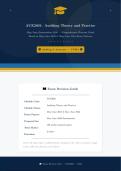
AUE2601: Auditing Theory and Practice
May/June Examination 2026 — Comprehensive Revision Guide
Based on May/June 2025 & May/June 2024 Exam Patterns
⋆ ⋄ ⋆ ⋄ ⋆ ⋄ ⋆ ⋄ ⋆
[ Auditing & Assurance — UNISA [
_ Exam Revision Guide
AUE2601
Module Code:
Auditing Theory and Practice
Module Name:
May/June 2025 & May/June 2024
Exam Papers:
May/June 2026 Examination
Prepared for:
100 marks (typical paper)
Total Marks:
2 hours
Duration:
Covers all major topics: auditing theory, Companies Act, ethics, assurance engage-
ments, audit risk, planning, and evidence.
Exam Revision Notes | AUE2601 | 2026
,AUE2601 | Exam Revision Auditing Theory & Practice
Question 1 [25] marks
(a) [10] marks
Question: In your auditing studies and practice you will frequently encounter the follow-
ing terms. Briefly explain each term as it applies to the external audit environment:
(i) Auditee
(ii) Audit independence
(iii) Professional scepticism
(iv) Professional competence
(v) Audit evidence
(vi) Reasonable assurance
(vii) Postulates of auditing
(viii) Audit committee
(ix) Registered auditor (RA)
(x) Expectation gap
Answer:
(i) Auditee: The entity that is subject to the audit. In external audit, it is the client
company; in internal audit, it may be a department or division within the organisa-
tion.
(ii) Audit independence: The defining characteristic of the audit function that gives
the audit opinion its value. The auditor must be independent in both fact (actual
independence) and appearance (perceived independence) from the auditee. Without
independence, the audit opinion carries no credibility.
(iii) Professional scepticism: An attitude requiring the auditor not to accept state-
ments at face value. The auditor maintains a questioning mind, critically assessing
evidence and remaining alert to conditions suggesting possible misstatement due to
error or fraud (ISA 200).
(iv) Professional competence: A fundamental ethical principle requiring auditors
to maintain their knowledge and skill at the level needed to deliver competent pro-
fessional services, applying current technical and professional standards diligently
(SAICA Code).
(v) Audit evidence: The information the auditor gathers to support the audit opinion.
Evidence must be both sufficient (enough quantity) and appropriate (relevant and
Page 2 of 21
, AUE2601 | Exam Revision Auditing Theory & Practice
reliable) to form a reasonable basis for the opinion (ISA 500).
(vi) Reasonable assurance: A high but not absolute level of assurance that the fi-
nancial statements are free from material misstatement. It is the level of assurance
provided by an external audit (ISA 200).
(vii) Postulates of auditing: The basic foundational assumptions on which the dis-
cipline of auditing rests. Examples include the assumption that financial data is
verifiable and that the auditor acts only in the capacity of an auditor.
(viii) Audit committee: A sub-committee of the board of directors, comprising in-
dependent non-executive directors, that oversees internal audit, external audit
appointments, financial reporting integrity, and risk management. Required for
public companies and certain state-owned entities under the Companies Act.
(ix) Registered auditor (RA): A person registered with the Independent Regulatory
Board for Auditors (IRBA) in terms of the Auditing Profession Act 26 of 2005, who
is authorised to perform statutory audits in South Africa.
(x) Expectation gap: The difference between what the public believes auditors do
(e.g., detect all fraud, guarantee accuracy) and what auditors actually do (provide
reasonable assurance on fair presentation). Closing this gap requires better public
education about the audit’s limitations.
(b) [8] marks
Question: Green-Harvest Ltd is a medium-sized agricultural company that sells vegeta-
bles locally and internationally. It has 45 employees, a turnover of R52 million, liabilities
to third parties of R8.5 million, and 6 shareholders. Calculate the company’s Public Inter-
est Score (PIS) and advise whether it is required to have its financial statements audited
or independently reviewed. Provide full reasons. (8)
Answer:
Public Interest Score (PIS) Calculation (Regulation 26, Companies Act 71 of
2008):
Page 3 of 21
]]
⋆
=============================================================
AUE2601: Auditing Theory and Practice
May/June Examination 2026 — Comprehensive Revision Guide
Based on May/June 2025 & May/June 2024 Exam Patterns
⋆ ⋄ ⋆ ⋄ ⋆ ⋄ ⋆ ⋄ ⋆
[ Auditing & Assurance — UNISA [
_ Exam Revision Guide
AUE2601
Module Code:
Auditing Theory and Practice
Module Name:
May/June 2025 & May/June 2024
Exam Papers:
May/June 2026 Examination
Prepared for:
100 marks (typical paper)
Total Marks:
2 hours
Duration:
Covers all major topics: auditing theory, Companies Act, ethics, assurance engage-
ments, audit risk, planning, and evidence.
Exam Revision Notes | AUE2601 | 2026
,AUE2601 | Exam Revision Auditing Theory & Practice
Question 1 [25] marks
(a) [10] marks
Question: In your auditing studies and practice you will frequently encounter the follow-
ing terms. Briefly explain each term as it applies to the external audit environment:
(i) Auditee
(ii) Audit independence
(iii) Professional scepticism
(iv) Professional competence
(v) Audit evidence
(vi) Reasonable assurance
(vii) Postulates of auditing
(viii) Audit committee
(ix) Registered auditor (RA)
(x) Expectation gap
Answer:
(i) Auditee: The entity that is subject to the audit. In external audit, it is the client
company; in internal audit, it may be a department or division within the organisa-
tion.
(ii) Audit independence: The defining characteristic of the audit function that gives
the audit opinion its value. The auditor must be independent in both fact (actual
independence) and appearance (perceived independence) from the auditee. Without
independence, the audit opinion carries no credibility.
(iii) Professional scepticism: An attitude requiring the auditor not to accept state-
ments at face value. The auditor maintains a questioning mind, critically assessing
evidence and remaining alert to conditions suggesting possible misstatement due to
error or fraud (ISA 200).
(iv) Professional competence: A fundamental ethical principle requiring auditors
to maintain their knowledge and skill at the level needed to deliver competent pro-
fessional services, applying current technical and professional standards diligently
(SAICA Code).
(v) Audit evidence: The information the auditor gathers to support the audit opinion.
Evidence must be both sufficient (enough quantity) and appropriate (relevant and
Page 2 of 21
, AUE2601 | Exam Revision Auditing Theory & Practice
reliable) to form a reasonable basis for the opinion (ISA 500).
(vi) Reasonable assurance: A high but not absolute level of assurance that the fi-
nancial statements are free from material misstatement. It is the level of assurance
provided by an external audit (ISA 200).
(vii) Postulates of auditing: The basic foundational assumptions on which the dis-
cipline of auditing rests. Examples include the assumption that financial data is
verifiable and that the auditor acts only in the capacity of an auditor.
(viii) Audit committee: A sub-committee of the board of directors, comprising in-
dependent non-executive directors, that oversees internal audit, external audit
appointments, financial reporting integrity, and risk management. Required for
public companies and certain state-owned entities under the Companies Act.
(ix) Registered auditor (RA): A person registered with the Independent Regulatory
Board for Auditors (IRBA) in terms of the Auditing Profession Act 26 of 2005, who
is authorised to perform statutory audits in South Africa.
(x) Expectation gap: The difference between what the public believes auditors do
(e.g., detect all fraud, guarantee accuracy) and what auditors actually do (provide
reasonable assurance on fair presentation). Closing this gap requires better public
education about the audit’s limitations.
(b) [8] marks
Question: Green-Harvest Ltd is a medium-sized agricultural company that sells vegeta-
bles locally and internationally. It has 45 employees, a turnover of R52 million, liabilities
to third parties of R8.5 million, and 6 shareholders. Calculate the company’s Public Inter-
est Score (PIS) and advise whether it is required to have its financial statements audited
or independently reviewed. Provide full reasons. (8)
Answer:
Public Interest Score (PIS) Calculation (Regulation 26, Companies Act 71 of
2008):
Page 3 of 21