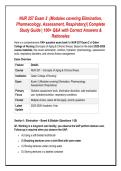
NUR 257 Exam 2 (Modules covering Elimination,
Pharmacology, Assessment, Respiratory)| Complete
Study Guide | 100+ Q&A with Correct Answers &
Rationales
Here is a comprehensive 100+ question exam bank for NUR 257 Exam 2 at Galen
College of Nursing (Concepts of Aging & Chronic Illness). Based on the latest 2025-2026
course materials, this covers elimination, nutrition, hydration, pharmacology, assessment
tools, respiratory disorders, and chronic illness management .
Exam Overview
Feature Details
Course NUR 257 – Concepts of Aging & Chronic Illness
Institution Galen College of Nursing
Exam Exam 2 (Modules covering Elimination, Pharmacology,
Assessment, Respiratory)
Primary Geriatric assessment tools, elimination disorders, safe medication
Focus use, hydration/nutrition, respiratory conditions
Format Multiple choice, select all that apply, priority questions
Latest 2025-2026 Academic Year
Update
Section 1: Elimination – Bowel & Bladder (Questions 1-20)
Q1. Working in a long-term care facility, you observe the UAP perform denture care.
Follow-up is required when you observe the UAP:
A) Using a soft-bristled toothbrush
B) Brushing dentures over a sink filled with warm water
C) Rinsing dentures under running water
D) Storing dentures in a labeled container
,Brushing dentures over a sink filled with water creates a drowning risk if the dentures are
dropped or if water is aspirated. Denture care should be performed over a towel or basin
with minimal standing water.
Q2. A patient reports that they haven't had a bowel movement in 2 days. The priority
intervention is to:
A) Administer a laxative immediately
B) Increase dietary fiber
C) Assess the client's bowel pattern
D) Encourage increased fluid intake
Assessment always precedes intervention. The nurse must first gather data about normal
bowel patterns, stool consistency, abdominal assessment, and contributing factors before
implementing any treatment .
Q3. A patient is diagnosed with urge incontinence related to a UTI. This is evidenced
by:
A) Constant dribbling of urine
B) Sudden leakage of urine when unable to get to the toilet in time
C) Leakage with coughing or sneezing
D) No sensation of bladder fullness
Urge incontinence (overactive bladder) presents with a sudden, intense urge to urinate
followed by involuntary leakage. UTI can cause or exacerbate urge incontinence due to
bladder irritation .
Q4. When caring for a patient with urinary incontinence, which statement is most
concerning?
A) "I've had to wake up twice at night to urinate."
B) "I leak a little when I laugh or cough."
, C) "I have never had urinary incontinence before this week."
D) "I use a pad to manage occasional leaks."
Sudden-onset incontinence is NOT normal aging. New incontinence requires immediate
evaluation for underlying causes such as UTI, medications, impaction, or neurologic
changes .
Q5. A patient complains of abdominal pain, urine retention, and frequent liquid
stools. What is the priority action?
A) Administer an antidiarrheal
B) Increase dietary fiber
C) Assess for fecal impaction
D) Insert a urinary catheter
Liquid stool passing around a hard fecal mass (overflow incontinence) with abdominal pain
and urinary retention are classic signs of fecal impaction. Digital rectal examination is
indicated .
Q6. An older patient is suspected of having dysphagia and/or aspiration when the
nurse observes: (Select all that apply)
A) Hiccups
B) Drooling
C) Excessive throat clearing
D) Normal speech
E) Coughing during meals
Hiccups (irritation of vagus nerve), drooling (inability to manage secretions), excessive
throat clearing (sensation of food/fluid in airway), and coughing during meals are all red
flags for dysphagia and aspiration risk .
, Q7. You are caring for a client with a history of dementia who is incontinent of stool
but cannot communicate the need to defecate. What intervention is a priority to
include in the plan of care?
A) Administer daily laxatives
B) Schedule a prompted toileting program
C) Place an indwelling catheter
D) Restrict fluid intake
Prompted toileting involves taking the patient to the bathroom at regular intervals, which can
facilitate bowel continence even when communication is impaired. This is preferred over
chemical or invasive management .
Q8. A 70-year-old presents with mild memory impairment related to a recent
diagnosis of dementia. A family member reports episodes of urine incontinence.
Which order by the physician would you question?
A) Bladder training schedule
B) Indwelling catheter
C) Timed voiding every 2 hours
D) Incontinence briefs at night
Indwelling catheters should be avoided in dementia when possible due to infection risk,
trauma risk, and contribution to functional decline. Less restrictive measures should be tried
first .
Q9. A patient is prescribed an anticholinergic medication for overactive bladder.
Which side effect is most concerning for an older adult?
A) Dry mouth
B) Urinary retention
C) Confusion and cognitive decline
D) Constipation
Pharmacology, Assessment, Respiratory)| Complete
Study Guide | 100+ Q&A with Correct Answers &
Rationales
Here is a comprehensive 100+ question exam bank for NUR 257 Exam 2 at Galen
College of Nursing (Concepts of Aging & Chronic Illness). Based on the latest 2025-2026
course materials, this covers elimination, nutrition, hydration, pharmacology, assessment
tools, respiratory disorders, and chronic illness management .
Exam Overview
Feature Details
Course NUR 257 – Concepts of Aging & Chronic Illness
Institution Galen College of Nursing
Exam Exam 2 (Modules covering Elimination, Pharmacology,
Assessment, Respiratory)
Primary Geriatric assessment tools, elimination disorders, safe medication
Focus use, hydration/nutrition, respiratory conditions
Format Multiple choice, select all that apply, priority questions
Latest 2025-2026 Academic Year
Update
Section 1: Elimination – Bowel & Bladder (Questions 1-20)
Q1. Working in a long-term care facility, you observe the UAP perform denture care.
Follow-up is required when you observe the UAP:
A) Using a soft-bristled toothbrush
B) Brushing dentures over a sink filled with warm water
C) Rinsing dentures under running water
D) Storing dentures in a labeled container
,Brushing dentures over a sink filled with water creates a drowning risk if the dentures are
dropped or if water is aspirated. Denture care should be performed over a towel or basin
with minimal standing water.
Q2. A patient reports that they haven't had a bowel movement in 2 days. The priority
intervention is to:
A) Administer a laxative immediately
B) Increase dietary fiber
C) Assess the client's bowel pattern
D) Encourage increased fluid intake
Assessment always precedes intervention. The nurse must first gather data about normal
bowel patterns, stool consistency, abdominal assessment, and contributing factors before
implementing any treatment .
Q3. A patient is diagnosed with urge incontinence related to a UTI. This is evidenced
by:
A) Constant dribbling of urine
B) Sudden leakage of urine when unable to get to the toilet in time
C) Leakage with coughing or sneezing
D) No sensation of bladder fullness
Urge incontinence (overactive bladder) presents with a sudden, intense urge to urinate
followed by involuntary leakage. UTI can cause or exacerbate urge incontinence due to
bladder irritation .
Q4. When caring for a patient with urinary incontinence, which statement is most
concerning?
A) "I've had to wake up twice at night to urinate."
B) "I leak a little when I laugh or cough."
, C) "I have never had urinary incontinence before this week."
D) "I use a pad to manage occasional leaks."
Sudden-onset incontinence is NOT normal aging. New incontinence requires immediate
evaluation for underlying causes such as UTI, medications, impaction, or neurologic
changes .
Q5. A patient complains of abdominal pain, urine retention, and frequent liquid
stools. What is the priority action?
A) Administer an antidiarrheal
B) Increase dietary fiber
C) Assess for fecal impaction
D) Insert a urinary catheter
Liquid stool passing around a hard fecal mass (overflow incontinence) with abdominal pain
and urinary retention are classic signs of fecal impaction. Digital rectal examination is
indicated .
Q6. An older patient is suspected of having dysphagia and/or aspiration when the
nurse observes: (Select all that apply)
A) Hiccups
B) Drooling
C) Excessive throat clearing
D) Normal speech
E) Coughing during meals
Hiccups (irritation of vagus nerve), drooling (inability to manage secretions), excessive
throat clearing (sensation of food/fluid in airway), and coughing during meals are all red
flags for dysphagia and aspiration risk .
, Q7. You are caring for a client with a history of dementia who is incontinent of stool
but cannot communicate the need to defecate. What intervention is a priority to
include in the plan of care?
A) Administer daily laxatives
B) Schedule a prompted toileting program
C) Place an indwelling catheter
D) Restrict fluid intake
Prompted toileting involves taking the patient to the bathroom at regular intervals, which can
facilitate bowel continence even when communication is impaired. This is preferred over
chemical or invasive management .
Q8. A 70-year-old presents with mild memory impairment related to a recent
diagnosis of dementia. A family member reports episodes of urine incontinence.
Which order by the physician would you question?
A) Bladder training schedule
B) Indwelling catheter
C) Timed voiding every 2 hours
D) Incontinence briefs at night
Indwelling catheters should be avoided in dementia when possible due to infection risk,
trauma risk, and contribution to functional decline. Less restrictive measures should be tried
first .
Q9. A patient is prescribed an anticholinergic medication for overactive bladder.
Which side effect is most concerning for an older adult?
A) Dry mouth
B) Urinary retention
C) Confusion and cognitive decline
D) Constipation