

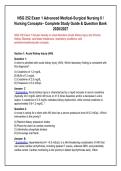
NSG 252 Exam 1 Advanced Medical-Surgical Nursing II /
Nursing Concepts– Complete Study Guide & Question Bank
2026/2027
NSG 252 Exam 1 focuses heavily on renal disorders (Acute Kidney Injury and Chronic
Kidney Disease), acid-base imbalances, respiratory conditions, and
perfusion/cardiovascular concepts .
Section 1: Acute Kidney Injury (AKI)
Question 1:
A client is admitted with acute kidney injury (AKI). Which laboratory finding is consistent with
this diagnosis?
A) Creatinine of 1.2 mg/dL
B) BUN of 12 mg/dL
C) Creatinine of 2.5 mg/dL
D) Potassium of 3.2 mEq/L
Answer: C
* Explanation: Acute kidney injury is characterized by a rapid increase in serum creatinine
(typically ≥0.3 mg/dL within 48 hours or ≥1.5 times baseline) and/or a decrease in urine
output. A creatinine of 2.5 mg/dL indicates kidney dysfunction, while normal creatinine is
approximately 0.6-1.2 mg/dL .*
Question 2:
A nurse is caring for a client with AKI who has a serum potassium level of 6.2 mEq/L. Which
intervention is the priority?
A) Restrict dietary potassium intake
B) Place the client on cardiac monitoring
C) Administer phosphate binders
D) Encourage oral fluids
Answer: B
* Explanation: Hyperkalemia (K+ >5.0 mEq/L) is a life-threatening complication of AKI that
can cause cardiac arrhythmias, including peaked T waves, widened QRS, and potentially
cardiac arrest. Cardiac monitoring is the priority to detect dysrhythmias early. Other
,interventions (dietary restriction, IV insulin/glucose, calcium gluconate, kayexalate) follow
after establishing monitoring .*
Question 3:
Which of the following can contribute to the development of postrenal acute kidney injury?
A) Sepsis
B) Benign Prostatic Hyperplasia (BPH)
C) Drug toxicity
D) Hypovolemia
Answer: B
Explanation: Postrenal AKI results from obstruction of urine flow distal to the kidneys.
Benign Prostatic Hyperplasia (BPH) can cause bladder outlet obstruction, leading to
backpressure on the ureters and kidneys. Other causes include kidney stones, tumors, or
strictures. Sepsis and hypovolemia cause prerenal AKI; drug toxicity causes intrarenal AKI .
Question 4:
A client with AKI is in the oliguric phase. Which assessment finding would the nurse expect?
A) Urine output of 750 mL/24 hours
B) Urine output of 200 mL/24 hours
C) Weight loss of 2 kg in 24 hours
D) Serum potassium of 3.8 mEq/L
Answer: B
* Explanation: The oliguric phase of AKI is defined by urine output less than 400 mL/24
hours (or less than 0.5 mL/kg/hour). This phase is characterized by fluid retention,
electrolyte imbalances (especially hyperkalemia), and accumulation of waste products
(elevated BUN and creatinine) .*
Question 5:
What are the three phases of Acute Kidney Injury?
A) Mild, Moderate, Severe
B) Oliguric, Diuretic, Recovery
C) Acute, Chronic, End-Stage
D) Prerenal, Intrarenal, Postrenal
Answer: B
Explanation: The three phases of AKI are: (1) Oliguric phase – decreased urine output, fluid
retention, electrolyte imbalances; (2) Diuretic phase – gradual increase in urine output, risk
, of dehydration and electrolyte loss; (3) Recovery phase – gradual return of kidney function
over weeks to months .
Question 6:
The nurse is caring for a client with prerenal AKI. Which finding is most consistent with this
diagnosis?
A) History of glomerulonephritis
B) Blood pressure 88/50 mm Hg
C) Urine output 1,200 mL in 24 hours
D) History of kidney stones
Answer: B
* Explanation: Prerenal AKI is caused by decreased blood flow to the kidneys
(hypoperfusion), which can result from hypotension, hypovolemia, heart failure, or sepsis. A
blood pressure of 88/50 mm Hg indicates hypotension that can reduce renal perfusion
pressure. Glomerulonephritis causes intrarenal AKI; kidney stones cause postrenal AKI .*
📚 Section 2: Chronic Kidney Disease (CKD)
Question 7:
Which statement best describes Chronic Kidney Disease (CKD)?
A) Sudden decline in kidney function over hours to days; often reversible
B) Progressive, irreversible loss of kidney function over months to years
C) Temporary inflammation of the glomeruli
D) Acute obstruction of urine flow
Answer: B
Explanation: CKD is characterized by progressive, irreversible loss of kidney function over
months to years. It is staged based on glomerular filtration rate (GFR) from Stage 1 (GFR
>90) to Stage 5 (GFR <15). Unlike AKI, CKD is not reversible .
Question 8:
A client with stage 4 CKD asks why they are prescribed epoetin alfa. Which response is
most accurate?
A) "It helps remove excess potassium from your body."
B) "It stimulates your body to produce more red blood cells."
C) "It improves your kidney function."
D) "It helps lower your blood pressure."
Nursing Concepts– Complete Study Guide & Question Bank
2026/2027
NSG 252 Exam 1 focuses heavily on renal disorders (Acute Kidney Injury and Chronic
Kidney Disease), acid-base imbalances, respiratory conditions, and
perfusion/cardiovascular concepts .
Section 1: Acute Kidney Injury (AKI)
Question 1:
A client is admitted with acute kidney injury (AKI). Which laboratory finding is consistent with
this diagnosis?
A) Creatinine of 1.2 mg/dL
B) BUN of 12 mg/dL
C) Creatinine of 2.5 mg/dL
D) Potassium of 3.2 mEq/L
Answer: C
* Explanation: Acute kidney injury is characterized by a rapid increase in serum creatinine
(typically ≥0.3 mg/dL within 48 hours or ≥1.5 times baseline) and/or a decrease in urine
output. A creatinine of 2.5 mg/dL indicates kidney dysfunction, while normal creatinine is
approximately 0.6-1.2 mg/dL .*
Question 2:
A nurse is caring for a client with AKI who has a serum potassium level of 6.2 mEq/L. Which
intervention is the priority?
A) Restrict dietary potassium intake
B) Place the client on cardiac monitoring
C) Administer phosphate binders
D) Encourage oral fluids
Answer: B
* Explanation: Hyperkalemia (K+ >5.0 mEq/L) is a life-threatening complication of AKI that
can cause cardiac arrhythmias, including peaked T waves, widened QRS, and potentially
cardiac arrest. Cardiac monitoring is the priority to detect dysrhythmias early. Other
,interventions (dietary restriction, IV insulin/glucose, calcium gluconate, kayexalate) follow
after establishing monitoring .*
Question 3:
Which of the following can contribute to the development of postrenal acute kidney injury?
A) Sepsis
B) Benign Prostatic Hyperplasia (BPH)
C) Drug toxicity
D) Hypovolemia
Answer: B
Explanation: Postrenal AKI results from obstruction of urine flow distal to the kidneys.
Benign Prostatic Hyperplasia (BPH) can cause bladder outlet obstruction, leading to
backpressure on the ureters and kidneys. Other causes include kidney stones, tumors, or
strictures. Sepsis and hypovolemia cause prerenal AKI; drug toxicity causes intrarenal AKI .
Question 4:
A client with AKI is in the oliguric phase. Which assessment finding would the nurse expect?
A) Urine output of 750 mL/24 hours
B) Urine output of 200 mL/24 hours
C) Weight loss of 2 kg in 24 hours
D) Serum potassium of 3.8 mEq/L
Answer: B
* Explanation: The oliguric phase of AKI is defined by urine output less than 400 mL/24
hours (or less than 0.5 mL/kg/hour). This phase is characterized by fluid retention,
electrolyte imbalances (especially hyperkalemia), and accumulation of waste products
(elevated BUN and creatinine) .*
Question 5:
What are the three phases of Acute Kidney Injury?
A) Mild, Moderate, Severe
B) Oliguric, Diuretic, Recovery
C) Acute, Chronic, End-Stage
D) Prerenal, Intrarenal, Postrenal
Answer: B
Explanation: The three phases of AKI are: (1) Oliguric phase – decreased urine output, fluid
retention, electrolyte imbalances; (2) Diuretic phase – gradual increase in urine output, risk
, of dehydration and electrolyte loss; (3) Recovery phase – gradual return of kidney function
over weeks to months .
Question 6:
The nurse is caring for a client with prerenal AKI. Which finding is most consistent with this
diagnosis?
A) History of glomerulonephritis
B) Blood pressure 88/50 mm Hg
C) Urine output 1,200 mL in 24 hours
D) History of kidney stones
Answer: B
* Explanation: Prerenal AKI is caused by decreased blood flow to the kidneys
(hypoperfusion), which can result from hypotension, hypovolemia, heart failure, or sepsis. A
blood pressure of 88/50 mm Hg indicates hypotension that can reduce renal perfusion
pressure. Glomerulonephritis causes intrarenal AKI; kidney stones cause postrenal AKI .*
📚 Section 2: Chronic Kidney Disease (CKD)
Question 7:
Which statement best describes Chronic Kidney Disease (CKD)?
A) Sudden decline in kidney function over hours to days; often reversible
B) Progressive, irreversible loss of kidney function over months to years
C) Temporary inflammation of the glomeruli
D) Acute obstruction of urine flow
Answer: B
Explanation: CKD is characterized by progressive, irreversible loss of kidney function over
months to years. It is staged based on glomerular filtration rate (GFR) from Stage 1 (GFR
>90) to Stage 5 (GFR <15). Unlike AKI, CKD is not reversible .
Question 8:
A client with stage 4 CKD asks why they are prescribed epoetin alfa. Which response is
most accurate?
A) "It helps remove excess potassium from your body."
B) "It stimulates your body to produce more red blood cells."
C) "It improves your kidney function."
D) "It helps lower your blood pressure."


