
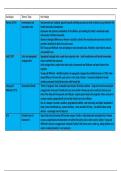
Sociologist Theory/ Topic Key findings
Parsons (1955) Instrumental and Instrumental role: husband, geared towards achieving successes at work so that he can provide for the
expressive roles family financially. Breadwinner.
Expressive role: primary socialisation of the children, and meeting the family’s emotional needs.
Homemaker, full-time housewife.
Based on biological differences. Women ‘naturally’ suited to the nurturing role and mean to that of
provider. Beneficial to both men and women.
BUT Young and Willmott- men are taking on more domestic tasks. Feminists- reject that its natural,
only benefits men.
Bott (1957) Joint and segregated Segregated conjugal roles: couple have separate roles – male breadwinner and female homemaker.
conjugal roles Leisure activities also separate.
Joint conjugal roles: couple share tasks such as housework and childcare and spent leisure time
together.
Young and Willmott – identified pattern of segregated conjugal roles in Bethnal Green in 1950s. Men –
played little part in home life, pubs and w/c men clubs. Women – housework helped by female
relatives and spent limited leisure time with female kin.
Young and Symmetrical family ‘March of progress’ view. Gradually improving for all family members – long-term trend towards joint
Willmott (1973) conjugal roles. Role aren’t identical but are more similar. Women go out to work (but may be part-
time). Men help with housework and childcare. Couples spent leisure time together. More common in
younger couples, geographically and socially isolated and more affluent.
Due to: changes in women’s position, geographical mobility, new technology and higher standards of
living. Factors interlinked e.g. women working – raises standard of living – can afford labour saving
devices – encourages men to help out.
N/A Feminist view of Argue that men and women still remain unequal. Family = male dominated and patriarchal. Women
housework occupy a subordinate and dependent role within the family and in wider society. Oakley- Young and
Willmott’s claims are exaggerated. Husbands ‘helped’ their wives once a week e.g. taking children on a
walk or making breakfast = not symmetry.
Parsons (1955) Instrumental and Instrumental role: husband, geared towards achieving successes at work so that he can provide for the
expressive roles family financially. Breadwinner.
Expressive role: primary socialisation of the children, and meeting the family’s emotional needs.
Homemaker, full-time housewife.
Based on biological differences. Women ‘naturally’ suited to the nurturing role and mean to that of
provider. Beneficial to both men and women.
BUT Young and Willmott- men are taking on more domestic tasks. Feminists- reject that its natural,
only benefits men.
Bott (1957) Joint and segregated Segregated conjugal roles: couple have separate roles – male breadwinner and female homemaker.
conjugal roles Leisure activities also separate.
Joint conjugal roles: couple share tasks such as housework and childcare and spent leisure time
together.
Young and Willmott – identified pattern of segregated conjugal roles in Bethnal Green in 1950s. Men –
played little part in home life, pubs and w/c men clubs. Women – housework helped by female
relatives and spent limited leisure time with female kin.
Young and Symmetrical family ‘March of progress’ view. Gradually improving for all family members – long-term trend towards joint
Willmott (1973) conjugal roles. Role aren’t identical but are more similar. Women go out to work (but may be part-
time). Men help with housework and childcare. Couples spent leisure time together. More common in
younger couples, geographically and socially isolated and more affluent.
Due to: changes in women’s position, geographical mobility, new technology and higher standards of
living. Factors interlinked e.g. women working – raises standard of living – can afford labour saving
devices – encourages men to help out.
N/A Feminist view of Argue that men and women still remain unequal. Family = male dominated and patriarchal. Women
housework occupy a subordinate and dependent role within the family and in wider society. Oakley- Young and
Willmott’s claims are exaggerated. Husbands ‘helped’ their wives once a week e.g. taking children on a
walk or making breakfast = not symmetry.


