

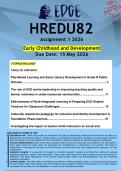
HREDU82
Assignment 1 2026
Early Childhood and Development
Due Date: 15 May 2026
5 TOPICS INCLUDED
TABLE OF CONTENTS
Play-Based Learning and Early Literacy Development in Grade R Public
Schools ........................................................................................................ 3
The role of ECD centre leadership in improving teaching quality and
learner outcomes in under-resourced communities............................... 11
Effectiveness of Work-Integrated Learning in Preparing ECD Student
Teachers for Classroom Challenges ........................................................ 19
Culturally responsive pedagogy for inclusion and identity development in
Foundation Phase learners ....................................................................... 27
Investigating the impact of teacher-child interaction on social and
DISCLAIMER & TERMS OF USE
Educational Aid: These study notes are intended to be used as educational resources and should not be seen as a
replacement for individual research, critical analysis, or professional consultation. Students are encouraged to perform
their own research and seek advice from their instructors or academic advisors for specific assignment guidelines.
Personal Responsibility: While every effort has been made to ensure the accuracy and reliability of the information in
these study notes, the seller does not guarantee the completeness or correctness of all content. The buyer is
responsible for verifying the accuracy of the information and exercising their own judgment when applying it to their
assignments.
Academic Integrity: It is essential for students to maintain academic integrity and follow their institution's policies
regarding plagiarism, citation, and referencing. These study notes should be used as learning tools and sources of
inspiration. Any direct reproduction of the content without proper citation and acknowledgment may be considered
academic misconduct.
Limited Liability: The seller shall not be liable for any direct or indirect damages, losses, or consequences arising from
the use of these notes. This includes, but is not limited to, poor academic performance, penalties, or any other negative
consequences resulting from the application or misuse of the information provided.
, For additional support +27 81 278 3372
5 TOPICS INCLUDED
TABLE OF CONTENTS
Play-Based Learning and Early Literacy Development in Grade R
Public Schools ............................................................................................. 3
The role of ECD centre leadership in improving teaching quality
and learner outcomes in under-resourced communities ........................ 11
Effectiveness of Work-Integrated Learning in Preparing ECD
Student Teachers for Classroom Challenges .......................................... 19
Culturally responsive pedagogy for inclusion and identity
development in Foundation Phase learners ............................................ 27
Investigating the impact of teacher-child interaction on social and
emotional development in children aged 3 to 6 years ............................ 35
, For additional support +27 81 278 3372
Play-Based Learning and Early Literacy Development in Grade R Public
Schools
1. Introduction and Background
Early literacy development forms the foundation for later academic success,
especially in the first year of formal schooling such as Grade R in South Africa. Early
literacy includes skills such as listening, speaking, phonological awareness,
vocabulary development, and early reading and writing behaviours. These skills
begin developing before formal schooling and are shaped by children’s interactions
with their environment, including classroom practices. The object of this study is to
explore how play-based learning influences early literacy development among Grade
R learners in public schools.
The study is situated within the South African public school context, where Grade R
serves as a critical transition phase between home or early childhood care settings
and formal schooling. The Department of Basic Education introduced Grade R as
part of its efforts to strengthen early childhood education and improve literacy
outcomes. The Curriculum and Assessment Policy Statement emphasises learner-
centred approaches and encourages the use of play as a teaching strategy in early
childhood classrooms. CAPS highlights that young learners develop best through
active engagement and meaningful experiences rather than through rigid formal
instruction (Department of Basic Education, 2015).
Play-based learning refers to structured or guided play activities that support learning
outcomes while allowing children to explore, imagine, and interact. In early childhood
classrooms, play can include storytelling, role play, games, drawing, and interaction
with print-rich materials. These activities create opportunities for learners to engage
with language in natural and meaningful ways. Play supports the development of oral
language, which is a key predictor of later reading ability. It also encourages
participation and confidence, especially among young learners who may not yet be
comfortable with formal instruction methods.
Gender dynamics and classroom interaction patterns also influence how learners
engage with play-based activities. For example, differences in participation and
, For additional support +27 81 278 3372
confidence can emerge in early childhood settings due to social expectations and
classroom practices. Alan, Ertac, and Mumcu (2018) identify that classroom
environments can reinforce differences in participation and achievement when
learners are exposed to limiting expectations. These patterns can influence how
boys and girls engage with literacy-related activities during play. McGuire, Mulvey,
and Rizzo (2020) indicate that children begin forming ideas about abilities and roles
during early childhood, which affects their engagement in learning activities such as
storytelling and language use.
Play itself is not neutral. It often reflects social norms and expectations present in the
wider society. Tzannetis (2022) explains that classroom play can be shaped by
social roles that learners observe and internalise, which influences how they interact
with learning materials and peers. In literacy development, this means that some
learners may participate more actively in language-rich activities while others may
withdraw or engage less. Singh (2024) highlights that classroom practices can either
challenge or reinforce these patterns, depending on how teachers structure learning
opportunities.
Within the South African context, challenges such as overcrowded classrooms,
limited resources, and varying teacher training levels affect how play-based learning
is implemented. Mahadew and Hlalele (2022) describe how early childhood
classrooms often struggle to balance curriculum demands with learner-centred
approaches. Teachers may rely on traditional teaching methods due to pressure to
meet literacy benchmarks, even though play-based approaches are encouraged.
This creates tension between policy expectations and classroom realities.
Despite these challenges, play-based learning remains a valuable approach for
supporting early literacy. Baker et al. (2021) emphasise that early classroom
environments influence how children develop attitudes towards learning and
participation. When learners are given opportunities to explore language through
play, they are more likely to develop positive attitudes towards reading and writing.
This is particularly important in multilingual contexts such as South Africa, where
learners may be developing literacy in a language that is not their home language.
Assignment 1 2026
Early Childhood and Development
Due Date: 15 May 2026
5 TOPICS INCLUDED
TABLE OF CONTENTS
Play-Based Learning and Early Literacy Development in Grade R Public
Schools ........................................................................................................ 3
The role of ECD centre leadership in improving teaching quality and
learner outcomes in under-resourced communities............................... 11
Effectiveness of Work-Integrated Learning in Preparing ECD Student
Teachers for Classroom Challenges ........................................................ 19
Culturally responsive pedagogy for inclusion and identity development in
Foundation Phase learners ....................................................................... 27
Investigating the impact of teacher-child interaction on social and
DISCLAIMER & TERMS OF USE
Educational Aid: These study notes are intended to be used as educational resources and should not be seen as a
replacement for individual research, critical analysis, or professional consultation. Students are encouraged to perform
their own research and seek advice from their instructors or academic advisors for specific assignment guidelines.
Personal Responsibility: While every effort has been made to ensure the accuracy and reliability of the information in
these study notes, the seller does not guarantee the completeness or correctness of all content. The buyer is
responsible for verifying the accuracy of the information and exercising their own judgment when applying it to their
assignments.
Academic Integrity: It is essential for students to maintain academic integrity and follow their institution's policies
regarding plagiarism, citation, and referencing. These study notes should be used as learning tools and sources of
inspiration. Any direct reproduction of the content without proper citation and acknowledgment may be considered
academic misconduct.
Limited Liability: The seller shall not be liable for any direct or indirect damages, losses, or consequences arising from
the use of these notes. This includes, but is not limited to, poor academic performance, penalties, or any other negative
consequences resulting from the application or misuse of the information provided.
, For additional support +27 81 278 3372
5 TOPICS INCLUDED
TABLE OF CONTENTS
Play-Based Learning and Early Literacy Development in Grade R
Public Schools ............................................................................................. 3
The role of ECD centre leadership in improving teaching quality
and learner outcomes in under-resourced communities ........................ 11
Effectiveness of Work-Integrated Learning in Preparing ECD
Student Teachers for Classroom Challenges .......................................... 19
Culturally responsive pedagogy for inclusion and identity
development in Foundation Phase learners ............................................ 27
Investigating the impact of teacher-child interaction on social and
emotional development in children aged 3 to 6 years ............................ 35
, For additional support +27 81 278 3372
Play-Based Learning and Early Literacy Development in Grade R Public
Schools
1. Introduction and Background
Early literacy development forms the foundation for later academic success,
especially in the first year of formal schooling such as Grade R in South Africa. Early
literacy includes skills such as listening, speaking, phonological awareness,
vocabulary development, and early reading and writing behaviours. These skills
begin developing before formal schooling and are shaped by children’s interactions
with their environment, including classroom practices. The object of this study is to
explore how play-based learning influences early literacy development among Grade
R learners in public schools.
The study is situated within the South African public school context, where Grade R
serves as a critical transition phase between home or early childhood care settings
and formal schooling. The Department of Basic Education introduced Grade R as
part of its efforts to strengthen early childhood education and improve literacy
outcomes. The Curriculum and Assessment Policy Statement emphasises learner-
centred approaches and encourages the use of play as a teaching strategy in early
childhood classrooms. CAPS highlights that young learners develop best through
active engagement and meaningful experiences rather than through rigid formal
instruction (Department of Basic Education, 2015).
Play-based learning refers to structured or guided play activities that support learning
outcomes while allowing children to explore, imagine, and interact. In early childhood
classrooms, play can include storytelling, role play, games, drawing, and interaction
with print-rich materials. These activities create opportunities for learners to engage
with language in natural and meaningful ways. Play supports the development of oral
language, which is a key predictor of later reading ability. It also encourages
participation and confidence, especially among young learners who may not yet be
comfortable with formal instruction methods.
Gender dynamics and classroom interaction patterns also influence how learners
engage with play-based activities. For example, differences in participation and
, For additional support +27 81 278 3372
confidence can emerge in early childhood settings due to social expectations and
classroom practices. Alan, Ertac, and Mumcu (2018) identify that classroom
environments can reinforce differences in participation and achievement when
learners are exposed to limiting expectations. These patterns can influence how
boys and girls engage with literacy-related activities during play. McGuire, Mulvey,
and Rizzo (2020) indicate that children begin forming ideas about abilities and roles
during early childhood, which affects their engagement in learning activities such as
storytelling and language use.
Play itself is not neutral. It often reflects social norms and expectations present in the
wider society. Tzannetis (2022) explains that classroom play can be shaped by
social roles that learners observe and internalise, which influences how they interact
with learning materials and peers. In literacy development, this means that some
learners may participate more actively in language-rich activities while others may
withdraw or engage less. Singh (2024) highlights that classroom practices can either
challenge or reinforce these patterns, depending on how teachers structure learning
opportunities.
Within the South African context, challenges such as overcrowded classrooms,
limited resources, and varying teacher training levels affect how play-based learning
is implemented. Mahadew and Hlalele (2022) describe how early childhood
classrooms often struggle to balance curriculum demands with learner-centred
approaches. Teachers may rely on traditional teaching methods due to pressure to
meet literacy benchmarks, even though play-based approaches are encouraged.
This creates tension between policy expectations and classroom realities.
Despite these challenges, play-based learning remains a valuable approach for
supporting early literacy. Baker et al. (2021) emphasise that early classroom
environments influence how children develop attitudes towards learning and
participation. When learners are given opportunities to explore language through
play, they are more likely to develop positive attitudes towards reading and writing.
This is particularly important in multilingual contexts such as South Africa, where
learners may be developing literacy in a language that is not their home language.


