
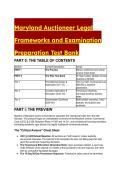
Maryland Auctioneer Legal
Frameworks and Examination
Preparation Test Bank
PART 0: THE TABLE OF CONTENTS
Section Content Description Scope
PART I The Preview Mission statement and critical
axioms cheat sheet.
PART II The Elite Test Bank 60 High-Caliber Multiple-Choice
Questions (MCQs).
Tier 1 Foundational Syntax & UCC § 2-328, Commercial Law
Application (Q1–15) definitions, baseline
parameters.
Tier 2 Complex Application & Foreclosure timelines,
Simulation (Q16–35) municipal bonding, distress
sales.
Tier 3 Grandmaster Synthesis Multivariable scenarios, fraud
(Q36–60) statutes, and judicial sale
synthesis.
PART I: THE PREVIEW
Mastery of Maryland auction jurisprudence separates the mechanical caller from the elite
fiduciary. This protocol forges an unshakeable command of the Maryland Uniform Commercial
Code (UCC) § 2-328, Maryland Rules 14-305 and 14-211, and jurisdictional licensing mandates,
translating academic rigor directly into legally bulletproof commercial practice.
The "Critical Axioms" Cheat Sheet
● UCC § 2-328 Default Baseline: All auctions are "with reserve" unless explicitly
announced otherwise. The hammer's fall completes the sale, but falling-hammer bids
grant the auctioneer reopening discretion.
● The Foreclosure Bifurcation (Greentree Rule): Upon purchaser default, a court may
order forfeiture of the deposit or a resale at the purchaser's risk and expense, but never
both as cumulative liquidated damages.
● The 15-Day/30-Day Foreclosure Sequence: Foreclosure sales cannot be advertised
, until 30 days post-final loss mitigation affidavit. Motions to stay under Rule 14-211 strictly
require filing within 15 days following post-file mediation events. Exceptions to the sale
under 14-305 must be filed within 30 days of the clerk's notice.
● The Forced Sale Exemption: Sellers are strictly prohibited from bidding without explicit
notice in voluntary sales, but the debtor/seller may bid in judicial or forced liquidations to
protect equity.
Maryland Jurisdictional Liability Matrix:
Jurisdiction License/Permit Type Bond Required Statutory Source
Baltimore City General Auctioneer $25,000 City Code Art. 2, § 1-3
Baltimore County General Auctioneer $5,000 County Code §
21-5-103
Prince George's Solicitor (Door-to-Door) $2,000 County Code § 5-206
PART II: THE ELITE TEST BANK
Tier 1: Foundational Syntax & Application
Q1: A Maryland auctioneer is accepting bids on a rare manuscript. Just as the hammer begins
to fall to accept a bid of $1,000, a new bidder loudly offers $1,100. Based on the principles of
UCC § 2-328, which action is the MOST ACCURATE? A) The auctioneer is legally mandated to
accept the $1,100 bid because the sale is not final until the hammer rests. B) The auctioneer
must reject the $1,100 bid as the falling of the hammer initiates an irrevocable binding contract.
C) The auctioneer may, at their discretion, reopen the bidding or declare the goods sold to the
$1,000 bidder. D) The auctioneer must pause the auction and seek the seller's permission to
accept the higher bid.
● The Answer: C (The auctioneer may, at their discretion, reopen the bidding or declare the
goods sold to the $1,000 bidder.)
● Distractor Analysis:
○ A is incorrect: The statute does not mandate acceptance of the late bid; it provides
discretionary authority.
○ B is incorrect: The contract is not irrevocable during the physical act of the hammer
falling; discretion remains.
○ D is incorrect: The auctioneer possesses the inherent statutory authority to make
this decision without consulting the consignor.
The Mentor's Analysis: The falling hammer represents the precise threshold of contract
formation. When a bid interrupts this microsecond, the immediate priority is maintaining auction
momentum without violating procedural fairness. By utilizing Auctioneer Discretion, you bypass
the common trap of mandated acceptance or rigid rejection. Professional/Academic Intuition:
The falling hammer is a discretionary zone, not a sealed vault.
Q2: Under Maryland Commercial Law, an auction is conducted regarding a consignment of
industrial machinery. No explicit terms are announced regarding reserve status. Which
conclusion is the MOST ACCURATE regarding the seller's rights? A) The auction is without
reserve by default, and the items must be sold to the highest bidder. B) The auction is with
reserve, permitting the auctioneer to withdraw the goods at any time before announcing
completion. C) The auction is absolute, meaning the seller cannot bid but may withdraw the item
before the first bid is accepted. D) The auction defaults to a conditional sale requiring court
ratification.
● The Answer: B (The auction is with reserve, permitting the auctioneer to withdraw the
, goods at any time before announcing completion.)
● Distractor Analysis:
○ A is incorrect: Maryland law defaults to "with reserve" unless explicit language
dictates otherwise.
○ C is incorrect: Absolute is synonymous with "without reserve," which is not the
default state.
○ D is incorrect: Court ratification is required for judicial/foreclosure sales under Rule
14-305, not standard commercial consignments.
The Mentor's Analysis: The default posture of any commercial auction protects the seller's
equity. When terms are silent, the immediate priority is recognizing the seller's retained right of
withdrawal. By utilizing the With Reserve Default Presumption, you bypass the common trap of
inadvertently conducting an absolute auction. Professional/Academic Intuition: Silence
always equals a reserve auction.
Q3: A Baltimore County resident seeks to operate as an independent auctioneer exclusively
within county limits. Based on Baltimore County Code 21-5-103, what is the FIRST financial
prerequisite required before license issuance? A) A $25,000 corporate surety bond. B) An
escrow account containing a minimum of $10,000. C) A $5,000 bond executed by a corporate
surety licensed by the insurance commissioner. D) A $180 fee paired with a real estate broker's
license.
● The Answer: C (A $5,000 bond executed by a corporate surety licensed by the insurance
commissioner.)
● Distractor Analysis:
○ A is incorrect: The $25,000 bond requirement applies to Baltimore City, not
Baltimore County.
○ B is incorrect: Escrow accounts are operational requirements for funds, not
prerequisites for the license application.
○ D is incorrect: A real estate license is not a baseline prerequisite for a general
auctioneer license in the county.
The Mentor's Analysis: Jurisdictional boundaries strictly define regulatory financial burdens.
When establishing a local practice, the immediate priority is satisfying the precise municipal
surety threshold. By utilizing Jurisdictional Bond Adherence, you bypass the common trap of
confusing City and County liability limits. Professional/Academic Intuition: County lines
dictate liability limits; Baltimore County is $5,000, Baltimore City is $25,000.
Q4: A licensed auctioneer establishes a specialized non-interest-bearing escrow account for an
upcoming estate liquidation. According to COMAR regulations regarding escrow accounts, what
action is IMMEDIATELY required? A) Notify the Commission in writing within 10 days of the
account's establishment. B) Deposit a matching surety bond into the account within 48 hours. C)
Provide the bank with a copy of the auctioneer's operating license. D) Submit a ledger of
expected buyers to the regulatory board.
● The Answer: A (Notify the Commission in writing within 10 days of the account's
establishment.)
● Distractor Analysis:
○ B is incorrect: Surety bonds are filed with the licensing authority, not deposited as
liquid capital into escrow.
○ C is incorrect: While banks verify identity, the legal reporting requirement is strictly
to the Commission.
○ D is incorrect: Buyer ledgers are transactional records, not prerequisites for account
formation.
Frameworks and Examination
Preparation Test Bank
PART 0: THE TABLE OF CONTENTS
Section Content Description Scope
PART I The Preview Mission statement and critical
axioms cheat sheet.
PART II The Elite Test Bank 60 High-Caliber Multiple-Choice
Questions (MCQs).
Tier 1 Foundational Syntax & UCC § 2-328, Commercial Law
Application (Q1–15) definitions, baseline
parameters.
Tier 2 Complex Application & Foreclosure timelines,
Simulation (Q16–35) municipal bonding, distress
sales.
Tier 3 Grandmaster Synthesis Multivariable scenarios, fraud
(Q36–60) statutes, and judicial sale
synthesis.
PART I: THE PREVIEW
Mastery of Maryland auction jurisprudence separates the mechanical caller from the elite
fiduciary. This protocol forges an unshakeable command of the Maryland Uniform Commercial
Code (UCC) § 2-328, Maryland Rules 14-305 and 14-211, and jurisdictional licensing mandates,
translating academic rigor directly into legally bulletproof commercial practice.
The "Critical Axioms" Cheat Sheet
● UCC § 2-328 Default Baseline: All auctions are "with reserve" unless explicitly
announced otherwise. The hammer's fall completes the sale, but falling-hammer bids
grant the auctioneer reopening discretion.
● The Foreclosure Bifurcation (Greentree Rule): Upon purchaser default, a court may
order forfeiture of the deposit or a resale at the purchaser's risk and expense, but never
both as cumulative liquidated damages.
● The 15-Day/30-Day Foreclosure Sequence: Foreclosure sales cannot be advertised
, until 30 days post-final loss mitigation affidavit. Motions to stay under Rule 14-211 strictly
require filing within 15 days following post-file mediation events. Exceptions to the sale
under 14-305 must be filed within 30 days of the clerk's notice.
● The Forced Sale Exemption: Sellers are strictly prohibited from bidding without explicit
notice in voluntary sales, but the debtor/seller may bid in judicial or forced liquidations to
protect equity.
Maryland Jurisdictional Liability Matrix:
Jurisdiction License/Permit Type Bond Required Statutory Source
Baltimore City General Auctioneer $25,000 City Code Art. 2, § 1-3
Baltimore County General Auctioneer $5,000 County Code §
21-5-103
Prince George's Solicitor (Door-to-Door) $2,000 County Code § 5-206
PART II: THE ELITE TEST BANK
Tier 1: Foundational Syntax & Application
Q1: A Maryland auctioneer is accepting bids on a rare manuscript. Just as the hammer begins
to fall to accept a bid of $1,000, a new bidder loudly offers $1,100. Based on the principles of
UCC § 2-328, which action is the MOST ACCURATE? A) The auctioneer is legally mandated to
accept the $1,100 bid because the sale is not final until the hammer rests. B) The auctioneer
must reject the $1,100 bid as the falling of the hammer initiates an irrevocable binding contract.
C) The auctioneer may, at their discretion, reopen the bidding or declare the goods sold to the
$1,000 bidder. D) The auctioneer must pause the auction and seek the seller's permission to
accept the higher bid.
● The Answer: C (The auctioneer may, at their discretion, reopen the bidding or declare the
goods sold to the $1,000 bidder.)
● Distractor Analysis:
○ A is incorrect: The statute does not mandate acceptance of the late bid; it provides
discretionary authority.
○ B is incorrect: The contract is not irrevocable during the physical act of the hammer
falling; discretion remains.
○ D is incorrect: The auctioneer possesses the inherent statutory authority to make
this decision without consulting the consignor.
The Mentor's Analysis: The falling hammer represents the precise threshold of contract
formation. When a bid interrupts this microsecond, the immediate priority is maintaining auction
momentum without violating procedural fairness. By utilizing Auctioneer Discretion, you bypass
the common trap of mandated acceptance or rigid rejection. Professional/Academic Intuition:
The falling hammer is a discretionary zone, not a sealed vault.
Q2: Under Maryland Commercial Law, an auction is conducted regarding a consignment of
industrial machinery. No explicit terms are announced regarding reserve status. Which
conclusion is the MOST ACCURATE regarding the seller's rights? A) The auction is without
reserve by default, and the items must be sold to the highest bidder. B) The auction is with
reserve, permitting the auctioneer to withdraw the goods at any time before announcing
completion. C) The auction is absolute, meaning the seller cannot bid but may withdraw the item
before the first bid is accepted. D) The auction defaults to a conditional sale requiring court
ratification.
● The Answer: B (The auction is with reserve, permitting the auctioneer to withdraw the
, goods at any time before announcing completion.)
● Distractor Analysis:
○ A is incorrect: Maryland law defaults to "with reserve" unless explicit language
dictates otherwise.
○ C is incorrect: Absolute is synonymous with "without reserve," which is not the
default state.
○ D is incorrect: Court ratification is required for judicial/foreclosure sales under Rule
14-305, not standard commercial consignments.
The Mentor's Analysis: The default posture of any commercial auction protects the seller's
equity. When terms are silent, the immediate priority is recognizing the seller's retained right of
withdrawal. By utilizing the With Reserve Default Presumption, you bypass the common trap of
inadvertently conducting an absolute auction. Professional/Academic Intuition: Silence
always equals a reserve auction.
Q3: A Baltimore County resident seeks to operate as an independent auctioneer exclusively
within county limits. Based on Baltimore County Code 21-5-103, what is the FIRST financial
prerequisite required before license issuance? A) A $25,000 corporate surety bond. B) An
escrow account containing a minimum of $10,000. C) A $5,000 bond executed by a corporate
surety licensed by the insurance commissioner. D) A $180 fee paired with a real estate broker's
license.
● The Answer: C (A $5,000 bond executed by a corporate surety licensed by the insurance
commissioner.)
● Distractor Analysis:
○ A is incorrect: The $25,000 bond requirement applies to Baltimore City, not
Baltimore County.
○ B is incorrect: Escrow accounts are operational requirements for funds, not
prerequisites for the license application.
○ D is incorrect: A real estate license is not a baseline prerequisite for a general
auctioneer license in the county.
The Mentor's Analysis: Jurisdictional boundaries strictly define regulatory financial burdens.
When establishing a local practice, the immediate priority is satisfying the precise municipal
surety threshold. By utilizing Jurisdictional Bond Adherence, you bypass the common trap of
confusing City and County liability limits. Professional/Academic Intuition: County lines
dictate liability limits; Baltimore County is $5,000, Baltimore City is $25,000.
Q4: A licensed auctioneer establishes a specialized non-interest-bearing escrow account for an
upcoming estate liquidation. According to COMAR regulations regarding escrow accounts, what
action is IMMEDIATELY required? A) Notify the Commission in writing within 10 days of the
account's establishment. B) Deposit a matching surety bond into the account within 48 hours. C)
Provide the bank with a copy of the auctioneer's operating license. D) Submit a ledger of
expected buyers to the regulatory board.
● The Answer: A (Notify the Commission in writing within 10 days of the account's
establishment.)
● Distractor Analysis:
○ B is incorrect: Surety bonds are filed with the licensing authority, not deposited as
liquid capital into escrow.
○ C is incorrect: While banks verify identity, the legal reporting requirement is strictly
to the Commission.
○ D is incorrect: Buyer ledgers are transactional records, not prerequisites for account
formation.


