
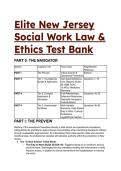
Elite New Jersey
Social Work Law &
Ethics Test Bank
PART 0: THE NAVIGATOR
Section Cognitive Tier Focus Area Page/Section
Reference
PART I The Preview Critical Axioms & Section I
Operational Framework
PART II Tier 1: Foundational Hard Deck Definitions, Questions 1–15
Syntax & Application Core Statutes (NJSA
45:15BB, NJAC
13:44G), Mandatory
Reporting
PART II Tier 2: Complex Dual Relationships, Questions 16–35
Application & Subpoena Responses,
Simulation Telehealth Navigation,
Custody Basics
PART II Tier 3: Grandmaster Multi-Variable Questions 36–60
Synthesis Scenarios, High-Stakes
Duty to Warn, Custody
Evaluations,
Legal/Ethical Clashes
PART I: THE PREVIEW
Mastery of this assessment translates directly to elite clinical and operational competence,
safeguarding the practitioner against severe civil penalties while maximizing therapeutic efficacy
through unassailable legal precision. By internalizing these state-specific codes and universal
bioethical laws, the professional operates with absolute authority within the jurisdiction of New
Jersey.
● The "Critical Axioms" Cheat Sheet:
○ The Duty to Warn (NJSA 2A:62A-16): Triggered strictly by an imminent, serious
physical threat. Discharging this duty mandates notifying law enforcement to verify
firearms access, in addition to clinical interventions like hospitalization or warning
the victim.
, ○ Record Retention (NJAC 13:44G-12.1): Permanent client records must be
retained for at least seven years from the date of the last entry. For minors, records
must be retained until the client reaches age 25.
○ Adolescent Consent: Under New Jersey law, minors aged 14 and older maintain
the statutory right to consent to temporary, outpatient behavioral health care
services without parental authorization, explicitly excluding medication
administration.
○ Subpoena Hierarchy: A subpoena from an attorney allows the assertion of
privilege to protect the written record. A court order from a judge compels the
release of the record, overriding standard privilege protections.
○ Telehealth Jurisdiction: The legal jurisdiction for clinical practice is determined by
the "originating site"—the physical location of the client at the exact moment the
service is rendered.
PART II: THE ELITE TEST BANK
Tier 1: Foundational Syntax & Application
Q1: A Licensed Clinical Social Worker (LCSW) terminates treatment with an adult client.
According to the New Jersey Administrative Code (NJAC 13:44G-12.1), what is the MINIMUM
duration the LCSW must retain the permanent client record? A) Five years from the date of the
initial intake assessment. B) Seven years from the date of the last entry. C) Ten years from the
date of the last entry. D) Seven years, unless the client requests immediate destruction of the
file.
● The Answer: B (Seven years from the date of the last entry)
● Distractor Analysis:
○ A is incorrect: Five years represents a common retention standard for general
community mental health agencies under different codes, but fails the Board of
Social Work Examiners' specific mandate.
○ C is incorrect: Ten years is a standard for certain medical records or contracts
under different statutes, but exceeds the social work baseline.
○ D is incorrect: A client cannot legally compel the destruction of a clinical record prior
to the statutory retention expiration.
The Mentor's Analysis: Statutory record retention is an absolute defense mechanism against
delayed malpractice claims. When facing file archival, the immediate priority is calculating the
exact timeline from the final clinical contact. By utilizing the seven-year statutory mandate , the
practitioner bypasses the common trap of premature document destruction.
Professional/Academic Intuition: The clock on record retention begins on the day of the
final clinical entry, never the day of intake.
Q2: Under New Jersey law (NJSA 2A:62A-16), a clinical social worker incurs a Duty to Warn
and Protect when a patient communicates a threat of violence. Which element is ABSOLUTELY
REQUIRED to trigger this specific legal mandate? A) The threat must be directed at a readily
identifiable individual and involve imminent, serious physical violence. B) The threat must
involve the potential for emotional or financial harm to a vulnerable adult. C) The patient must
have a documented history of severe physical violence and access to weapons. D) The threat
must be articulated during a face-to-face clinical session, rather than through electronic
communication.
, ● The Answer: A (The threat must be directed at a readily identifiable individual and
involve imminent, serious physical violence)
● Distractor Analysis:
○ B is incorrect: Emotional or financial harm, while clinically significant, does not meet
the statutory threshold for breaching confidentiality under the duty to warn.
○ C is incorrect: A past history of violence is an assessment risk factor, but it is not a
statutory prerequisite for triggering the mandate.
○ D is incorrect: The medium of the communication (telehealth, email, or in-person) is
irrelevant to the legal duty if the threat is credible and imminent.
The Mentor's Analysis: The breach of clinical confidentiality is legally protected only under
extreme, defined parameters. When facing a threatening patient, the immediate priority is
assessing for imminence, severity, and an identifiable target. By utilizing the imminent and
serious physical violence standard , the practitioner bypasses the common trap of unlawfully
breaching privilege for vague or non-physical threats. Professional/Academic Intuition:
Privilege dies where public peril begins, provided the peril is physically severe,
imminent, and targeted.
Q3: A minor client aged 15 seeks outpatient psychotherapeutic counseling for anxiety.
According to New Jersey consent laws regarding behavioral health, which action is the MOST
APPROPRIATE? A) The social worker must obtain written consent from at least one legal
guardian before beginning the intake. B) The social worker may provide temporary outpatient
treatment based solely on the minor's consent. C) The social worker may assess the minor but
must notify the parents within 48 hours of the first session. D) The social worker may treat the
minor independently only if the minor is legally emancipated or married.
● The Answer: B (The social worker may provide temporary outpatient treatment based
solely on the minor's consent)
● Distractor Analysis:
○ A is incorrect: Legislative updates explicitly lowered the age of consent for
outpatient behavioral health treatment to 14, removing the parental authorization
barrier.
○ C is incorrect: Mandating parental notification within 48 hours actively violates the
confidentiality protections granted to the minor under this specific statute.
○ D is incorrect: Emancipation is not required; age alone (14 and older) grants the
statutory right to consent to outpatient therapy.
The Mentor's Analysis: Legislative updates recognize the critical need for adolescent
autonomy in mental health access. When facing an adolescent seeking care, the immediate
priority is verifying statutory age eligibility. By utilizing the age of 14 consent threshold , the
practitioner bypasses the common trap of unlawfully turning away a minor seeking critical
behavioral health support. Professional/Academic Intuition: In New Jersey, a 14-year-old
possesses the exact same legal authority to consent to outpatient behavioral therapy as
an adult.
Q4: To maintain licensure, a Licensed Clinical Social Worker (LCSW) in New Jersey must
complete 40 hours of continuing education (CE) every two years. According to the State Board
of Social Work Examiners, what is the MANDATORY minimum breakdown for specific clinical
and ethical topics? A) 20 hours in clinical practice, 5 hours in ethics, 3 hours in social/cultural
competence, and 1 hour in prescription opioid addiction. B) 10 hours in clinical practice, 10
hours in ethics, and 5 hours in social/cultural competence. C) 30 hours in clinical practice, with
the remaining 10 hours dedicated strictly to domestic violence and ethics. D) 20 hours in clinical
practice, 3 hours in ethics, and 5 hours in prescription opioid addiction.
, ● The Answer: A (20 hours in clinical practice, 5 hours in ethics, 3 hours in social/cultural
competence, and 1 hour in prescription opioid addiction)
● Distractor Analysis:
○ B is incorrect: This calculates the ethical requirement too high and the clinical
requirement too low for an LCSW.
○ C is incorrect: This is a fabricated distribution that ignores statutory requirements for
opioid and cultural competence training.
○ D is incorrect: This flips the hour requirements, assigning too few hours to ethics
and too many to opioid training.
The Mentor's Analysis: Licensure maintenance relies on strict adherence to statutory
educational formulas. When facing biennial renewal, the immediate priority is auditing credit
distribution against state mandates. By utilizing the exact state-prescribed CE matrix , the
practitioner bypasses the common trap of facing administrative penalties or license suspension
due to technical credit deficiencies. Professional/Academic Intuition: Total hours mean
nothing if the sub-categorical mandates for ethics, clinical practice, cultural competence,
and opioid training are not precisely met.
Q5: An adult client terminates therapy, and the social worker prepares the final file for storage.
The client record MUST explicitly contain which of the following elements to comply with NJAC
13:44G-12.1? A) A signed waiver of liability protecting the social worker from future litigation. B)
The client's name on every single page of the record. C) A comprehensive summary of the
client's financial history and credit score. D) Audio recordings of all psychotherapeutic
interventions utilized.
● The Answer: B (The client's name on every single page of the record)
● Distractor Analysis:
○ A is incorrect: Waivers of liability are not a standard or required element of a clinical
record and cannot preemptively shield a practitioner from malpractice.
○ C is incorrect: While billing records are kept, a comprehensive financial
history/credit score is clinically irrelevant and not mandated.
○ D is incorrect: Written progress notes are required; audio recordings are not a
statutory requirement and introduce severe HIPAA vulnerabilities.
The Mentor's Analysis: Documentation standards are designed to prevent the catastrophic
commingling of protected health information. When facing record assembly, the immediate
priority is irrefutable identification. By utilizing universal page identification , the practitioner
bypasses the common trap of orphaned documents floating aimlessly during a legal audit.
Professional/Academic Intuition: A clinical document without the client's name is legally
meaningless and clinically dangerous.
Q6: Under the 2021 update to the NASW Code of Ethics, which conceptual framework was
explicitly emphasized regarding cultural competence, shifting the focus from simply acquiring
knowledge to engaging in ongoing self-reflection and recognizing power dynamics? A) Cultural
Humility B) Colorblind Practice C) Multicultural Assimilation D) Societal Trust
● The Answer: A (Cultural Humility)
● Distractor Analysis:
○ B is incorrect: "Colorblind" approaches are widely discredited in modern social work
as they invalidate the lived experiences of marginalized groups.
○ C is incorrect: Assimilation is an outdated sociological concept, directly conflicting
with the ethical mandate to honor diverse cultural identities.
○ D is incorrect: Societal trust is an outcome of ethical practice, but Cultural Humility
is the specific conceptual framework codified in the 2021 update.
Social Work Law &
Ethics Test Bank
PART 0: THE NAVIGATOR
Section Cognitive Tier Focus Area Page/Section
Reference
PART I The Preview Critical Axioms & Section I
Operational Framework
PART II Tier 1: Foundational Hard Deck Definitions, Questions 1–15
Syntax & Application Core Statutes (NJSA
45:15BB, NJAC
13:44G), Mandatory
Reporting
PART II Tier 2: Complex Dual Relationships, Questions 16–35
Application & Subpoena Responses,
Simulation Telehealth Navigation,
Custody Basics
PART II Tier 3: Grandmaster Multi-Variable Questions 36–60
Synthesis Scenarios, High-Stakes
Duty to Warn, Custody
Evaluations,
Legal/Ethical Clashes
PART I: THE PREVIEW
Mastery of this assessment translates directly to elite clinical and operational competence,
safeguarding the practitioner against severe civil penalties while maximizing therapeutic efficacy
through unassailable legal precision. By internalizing these state-specific codes and universal
bioethical laws, the professional operates with absolute authority within the jurisdiction of New
Jersey.
● The "Critical Axioms" Cheat Sheet:
○ The Duty to Warn (NJSA 2A:62A-16): Triggered strictly by an imminent, serious
physical threat. Discharging this duty mandates notifying law enforcement to verify
firearms access, in addition to clinical interventions like hospitalization or warning
the victim.
, ○ Record Retention (NJAC 13:44G-12.1): Permanent client records must be
retained for at least seven years from the date of the last entry. For minors, records
must be retained until the client reaches age 25.
○ Adolescent Consent: Under New Jersey law, minors aged 14 and older maintain
the statutory right to consent to temporary, outpatient behavioral health care
services without parental authorization, explicitly excluding medication
administration.
○ Subpoena Hierarchy: A subpoena from an attorney allows the assertion of
privilege to protect the written record. A court order from a judge compels the
release of the record, overriding standard privilege protections.
○ Telehealth Jurisdiction: The legal jurisdiction for clinical practice is determined by
the "originating site"—the physical location of the client at the exact moment the
service is rendered.
PART II: THE ELITE TEST BANK
Tier 1: Foundational Syntax & Application
Q1: A Licensed Clinical Social Worker (LCSW) terminates treatment with an adult client.
According to the New Jersey Administrative Code (NJAC 13:44G-12.1), what is the MINIMUM
duration the LCSW must retain the permanent client record? A) Five years from the date of the
initial intake assessment. B) Seven years from the date of the last entry. C) Ten years from the
date of the last entry. D) Seven years, unless the client requests immediate destruction of the
file.
● The Answer: B (Seven years from the date of the last entry)
● Distractor Analysis:
○ A is incorrect: Five years represents a common retention standard for general
community mental health agencies under different codes, but fails the Board of
Social Work Examiners' specific mandate.
○ C is incorrect: Ten years is a standard for certain medical records or contracts
under different statutes, but exceeds the social work baseline.
○ D is incorrect: A client cannot legally compel the destruction of a clinical record prior
to the statutory retention expiration.
The Mentor's Analysis: Statutory record retention is an absolute defense mechanism against
delayed malpractice claims. When facing file archival, the immediate priority is calculating the
exact timeline from the final clinical contact. By utilizing the seven-year statutory mandate , the
practitioner bypasses the common trap of premature document destruction.
Professional/Academic Intuition: The clock on record retention begins on the day of the
final clinical entry, never the day of intake.
Q2: Under New Jersey law (NJSA 2A:62A-16), a clinical social worker incurs a Duty to Warn
and Protect when a patient communicates a threat of violence. Which element is ABSOLUTELY
REQUIRED to trigger this specific legal mandate? A) The threat must be directed at a readily
identifiable individual and involve imminent, serious physical violence. B) The threat must
involve the potential for emotional or financial harm to a vulnerable adult. C) The patient must
have a documented history of severe physical violence and access to weapons. D) The threat
must be articulated during a face-to-face clinical session, rather than through electronic
communication.
, ● The Answer: A (The threat must be directed at a readily identifiable individual and
involve imminent, serious physical violence)
● Distractor Analysis:
○ B is incorrect: Emotional or financial harm, while clinically significant, does not meet
the statutory threshold for breaching confidentiality under the duty to warn.
○ C is incorrect: A past history of violence is an assessment risk factor, but it is not a
statutory prerequisite for triggering the mandate.
○ D is incorrect: The medium of the communication (telehealth, email, or in-person) is
irrelevant to the legal duty if the threat is credible and imminent.
The Mentor's Analysis: The breach of clinical confidentiality is legally protected only under
extreme, defined parameters. When facing a threatening patient, the immediate priority is
assessing for imminence, severity, and an identifiable target. By utilizing the imminent and
serious physical violence standard , the practitioner bypasses the common trap of unlawfully
breaching privilege for vague or non-physical threats. Professional/Academic Intuition:
Privilege dies where public peril begins, provided the peril is physically severe,
imminent, and targeted.
Q3: A minor client aged 15 seeks outpatient psychotherapeutic counseling for anxiety.
According to New Jersey consent laws regarding behavioral health, which action is the MOST
APPROPRIATE? A) The social worker must obtain written consent from at least one legal
guardian before beginning the intake. B) The social worker may provide temporary outpatient
treatment based solely on the minor's consent. C) The social worker may assess the minor but
must notify the parents within 48 hours of the first session. D) The social worker may treat the
minor independently only if the minor is legally emancipated or married.
● The Answer: B (The social worker may provide temporary outpatient treatment based
solely on the minor's consent)
● Distractor Analysis:
○ A is incorrect: Legislative updates explicitly lowered the age of consent for
outpatient behavioral health treatment to 14, removing the parental authorization
barrier.
○ C is incorrect: Mandating parental notification within 48 hours actively violates the
confidentiality protections granted to the minor under this specific statute.
○ D is incorrect: Emancipation is not required; age alone (14 and older) grants the
statutory right to consent to outpatient therapy.
The Mentor's Analysis: Legislative updates recognize the critical need for adolescent
autonomy in mental health access. When facing an adolescent seeking care, the immediate
priority is verifying statutory age eligibility. By utilizing the age of 14 consent threshold , the
practitioner bypasses the common trap of unlawfully turning away a minor seeking critical
behavioral health support. Professional/Academic Intuition: In New Jersey, a 14-year-old
possesses the exact same legal authority to consent to outpatient behavioral therapy as
an adult.
Q4: To maintain licensure, a Licensed Clinical Social Worker (LCSW) in New Jersey must
complete 40 hours of continuing education (CE) every two years. According to the State Board
of Social Work Examiners, what is the MANDATORY minimum breakdown for specific clinical
and ethical topics? A) 20 hours in clinical practice, 5 hours in ethics, 3 hours in social/cultural
competence, and 1 hour in prescription opioid addiction. B) 10 hours in clinical practice, 10
hours in ethics, and 5 hours in social/cultural competence. C) 30 hours in clinical practice, with
the remaining 10 hours dedicated strictly to domestic violence and ethics. D) 20 hours in clinical
practice, 3 hours in ethics, and 5 hours in prescription opioid addiction.
, ● The Answer: A (20 hours in clinical practice, 5 hours in ethics, 3 hours in social/cultural
competence, and 1 hour in prescription opioid addiction)
● Distractor Analysis:
○ B is incorrect: This calculates the ethical requirement too high and the clinical
requirement too low for an LCSW.
○ C is incorrect: This is a fabricated distribution that ignores statutory requirements for
opioid and cultural competence training.
○ D is incorrect: This flips the hour requirements, assigning too few hours to ethics
and too many to opioid training.
The Mentor's Analysis: Licensure maintenance relies on strict adherence to statutory
educational formulas. When facing biennial renewal, the immediate priority is auditing credit
distribution against state mandates. By utilizing the exact state-prescribed CE matrix , the
practitioner bypasses the common trap of facing administrative penalties or license suspension
due to technical credit deficiencies. Professional/Academic Intuition: Total hours mean
nothing if the sub-categorical mandates for ethics, clinical practice, cultural competence,
and opioid training are not precisely met.
Q5: An adult client terminates therapy, and the social worker prepares the final file for storage.
The client record MUST explicitly contain which of the following elements to comply with NJAC
13:44G-12.1? A) A signed waiver of liability protecting the social worker from future litigation. B)
The client's name on every single page of the record. C) A comprehensive summary of the
client's financial history and credit score. D) Audio recordings of all psychotherapeutic
interventions utilized.
● The Answer: B (The client's name on every single page of the record)
● Distractor Analysis:
○ A is incorrect: Waivers of liability are not a standard or required element of a clinical
record and cannot preemptively shield a practitioner from malpractice.
○ C is incorrect: While billing records are kept, a comprehensive financial
history/credit score is clinically irrelevant and not mandated.
○ D is incorrect: Written progress notes are required; audio recordings are not a
statutory requirement and introduce severe HIPAA vulnerabilities.
The Mentor's Analysis: Documentation standards are designed to prevent the catastrophic
commingling of protected health information. When facing record assembly, the immediate
priority is irrefutable identification. By utilizing universal page identification , the practitioner
bypasses the common trap of orphaned documents floating aimlessly during a legal audit.
Professional/Academic Intuition: A clinical document without the client's name is legally
meaningless and clinically dangerous.
Q6: Under the 2021 update to the NASW Code of Ethics, which conceptual framework was
explicitly emphasized regarding cultural competence, shifting the focus from simply acquiring
knowledge to engaging in ongoing self-reflection and recognizing power dynamics? A) Cultural
Humility B) Colorblind Practice C) Multicultural Assimilation D) Societal Trust
● The Answer: A (Cultural Humility)
● Distractor Analysis:
○ B is incorrect: "Colorblind" approaches are widely discredited in modern social work
as they invalidate the lived experiences of marginalized groups.
○ C is incorrect: Assimilation is an outdated sociological concept, directly conflicting
with the ethical mandate to honor diverse cultural identities.
○ D is incorrect: Societal trust is an outcome of ethical practice, but Cultural Humility
is the specific conceptual framework codified in the 2021 update.


