
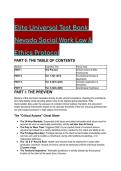
Elite Universal Test Bank:
Nevada Social Work Law &
Ethics Protocol
PART 0: THE TABLE OF CONTENTS
Section Cognitive Tier Focus Area
PART I The Preview Critical Axioms & Elite
Frameworks
PART II Tier 1 (Q1–Q15) Foundational Syntax &
Application
PART II Tier 2 (Q16–Q35) Complex Application &
Simulation
PART II Tier 3 (Q36–Q60) Grandmaster Synthesis
PART I: THE PREVIEW
Mastery of this test bank translates directly to elite clinical compliance, shielding the practitioner
from fatal liability while elevating patient care to the highest global standards. Rote
memorization fails under the pressure of complex clinical realities; therefore, this document
forges decisional frameworks based on the absolute threshold of the law, ensuring professionals
act with surgical precision in high-stakes environments.
The "Critical Axioms" Cheat Sheet
● The 24-Hour Mandate: Suspected child abuse and elder/vulnerable adult abuse must be
reported as soon as reasonably practicable, strictly not later than 24 hours.
● The Duty to Warn Triad: Triggered ONLY by an explicit threat of imminent serious
physical harm/death to a clearly identified person, backed by the intent and ability to act.
● The Privilege Boundary: Privilege belongs to the client but terminates immediately when
services are used to enable a crime/fraud, during child welfare proceedings, or in
malpractice defenses.
● The "23 & 5" Record Rule: Health care records must be retained for 5 years after
production. However, records of minors cannot be destroyed until the individual reaches
23 years of age.
● The Territorial Imperative: Telehealth jurisdiction is strictly dictated by the physical
location of the client at the exact time of service.
,PART II: THE ELITE TEST BANK
Tier 1: Foundational Syntax & Application
Q1: A clinical social worker suspects a 72-year-old client is being financially exploited by their
adult child. Based on the principles of NRS 200.5093, which action is the FIRST legally
mandated step? A) Confront the adult child to assess the validity of the suspicion. B) File a
report with the Aging and Disability Services Division within 48 hours. C) File a report with the
Aging and Disability Services Division or law enforcement not later than 24 hours. D) Obtain
explicit written consent from the client to breach confidentiality.
● The Answer: C (File a report with the Aging and Disability Services Division or law
enforcement not later than 24 hours.)
● Distractor Analysis:
○ A is incorrect: Confrontation compromises the investigation and endangers the
client.
○ B is incorrect: The statutory limit is strictly 24 hours , making 48 hours a compliance
failure.
○ D is incorrect: Mandatory reporting statutes inherently bypass client consent and
privilege.
The Mentor's Analysis: The threshold for elder abuse reporting relies on suspicion, not verified
proof. When facing vulnerable adult exploitation, the immediate priority is triggering state
intervention within the statutory 24-hour window. By utilizing mandatory reporting exceptions,
the clinician bypasses the common trap of prioritizing clinical rapport over legal mandates.
Professional/Academic Intuition: Statutory reporting deadlines supersede all clinical and
ethical confidentiality frameworks.
Q2: A client makes an explicit threat to kill their former employer the following morning and
possesses a firearm. Based on the principles of NRS 629.550 (Duty to Warn), which action is
the MOST APPROPRIATE? A) Schedule a follow-up appointment for the next day to monitor
ideation. B) Place the client on a mental health crisis hold or make reasonable efforts to
communicate the threat to the victim and law enforcement. C) Notify the employer immediately
but maintain confidentiality regarding law enforcement. D) Revoke the client's Second
Amendment rights via court order.
● The Answer: B (Place the client on a mental health crisis hold or make reasonable efforts
to communicate the threat to the victim and law enforcement.)
● Distractor Analysis:
○ A is incorrect: Passive monitoring fails the standard of care for imminent, lethal
threats.
○ C is incorrect: The statute requires communication to both the identified victim and
local law enforcement.
○ D is incorrect: Social workers lack the unilateral authority to revoke constitutional
rights.
The Mentor's Analysis: Duty to Warn is activated by an explicit, imminent threat to an
identifiable target. When facing homicidal intent, the immediate priority is neutralizing the threat
through institutional holds or direct warnings. By utilizing NRS 433A.160 crisis holds, the
clinician bypasses the common trap of under-reacting to lethal capability.
Professional/Academic Intuition: Imminence and capability dictate immediate structural
, intervention, not therapeutic exploration.
Q3: A 16-year-old client terminates therapy. Based on the principles of NRS 629.051 regarding
health care records, when is the EARLIEST the clinician may destroy these records? A) When
the client reaches 18 years of age. B) Exactly 5 years from the date of termination. C) When the
client reaches 23 years of age. D) Records of minors must be retained indefinitely.
● The Answer: C (When the client reaches 23 years of age.)
● Distractor Analysis:
○ A is incorrect: Age of majority (18) does not trigger the destruction authorization.
○ B is incorrect: The standard 5-year rule is overridden by the minor exception clause.
○ D is incorrect: Indefinite retention is a legacy practice not mandated by current
Nevada law.
The Mentor's Analysis: Record retention for minors requires a prolonged timeline to allow for
post-majority litigation or medical retrieval. When facing minor record management, the
immediate priority is calculating the 23rd birthday. By utilizing the "23 & 5" framework, the
clinician bypasses the common trap of premature record destruction. Professional/Academic
Intuition: Age dictates retention; the 23-year threshold is absolute for pediatric and
adolescent files.
Q4: A licensed clinical social worker (LCSW) in Nevada is preparing for license renewal. Based
on the principles of NAC 641B.187, what is the EXACT minimum continuing education
requirement for ethics? A) 2 hours every reporting period. B) 3 hours every reporting period. C)
4 hours every reporting period. D) 6 hours every reporting period.
● The Answer: C (4 hours every reporting period.)
● Distractor Analysis:
○ A is incorrect: 2 hours is the requirement for suicide prevention, not ethics.
○ B is incorrect: 3 hours is a common novice assumption from other jurisdictions.
○ D is incorrect: 6 hours is the requirement for cultural competency, equity, and
inclusion.
The Mentor's Analysis: Licensing renewal hinges on exact categorical compliance. When
facing CEU audits, the immediate priority is ensuring the 36-hour total includes the precise
subset allocations. By utilizing Board-approved categorical tracking, the clinician bypasses the
common trap of overall hour compliance with categorical deficiency. Professional/Academic
Intuition: CEU distribution is as legally binding as the total hour count.
Q5: During an intake session, an adult client reveals they served in the military. Based on the
principles of NRS 641B.350, what is the clinical social worker REQUIRED to do? A) Provide the
client with contact information for the Department of Veterans Services. B) Diagnose the client
with PTSD. C) Report the veteran status to the federal Veterans Administration. D) Waive all
clinical fees out of professional courtesy.
● The Answer: A (Provide the client with contact information for the Department of
Veterans Services.)
● Distractor Analysis:
○ B is incorrect: Diagnosis requires clinical justification, not merely military status.
○ C is incorrect: Unauthorized reporting breaches HIPAA and NRS 49.252 privilege.
○ D is incorrect: Fee waivers are discretionary business decisions, not legal
mandates.
The Mentor's Analysis: Nevada law mandates proactive resource bridging for specific
demographics. When facing a new adult intake, the immediate priority is veteran status inquiry
and resource provision. By utilizing mandated disclosures, the clinician bypasses the common
trap of ignoring statutory demographic protocols. Professional/Academic Intuition: Intake
Nevada Social Work Law &
Ethics Protocol
PART 0: THE TABLE OF CONTENTS
Section Cognitive Tier Focus Area
PART I The Preview Critical Axioms & Elite
Frameworks
PART II Tier 1 (Q1–Q15) Foundational Syntax &
Application
PART II Tier 2 (Q16–Q35) Complex Application &
Simulation
PART II Tier 3 (Q36–Q60) Grandmaster Synthesis
PART I: THE PREVIEW
Mastery of this test bank translates directly to elite clinical compliance, shielding the practitioner
from fatal liability while elevating patient care to the highest global standards. Rote
memorization fails under the pressure of complex clinical realities; therefore, this document
forges decisional frameworks based on the absolute threshold of the law, ensuring professionals
act with surgical precision in high-stakes environments.
The "Critical Axioms" Cheat Sheet
● The 24-Hour Mandate: Suspected child abuse and elder/vulnerable adult abuse must be
reported as soon as reasonably practicable, strictly not later than 24 hours.
● The Duty to Warn Triad: Triggered ONLY by an explicit threat of imminent serious
physical harm/death to a clearly identified person, backed by the intent and ability to act.
● The Privilege Boundary: Privilege belongs to the client but terminates immediately when
services are used to enable a crime/fraud, during child welfare proceedings, or in
malpractice defenses.
● The "23 & 5" Record Rule: Health care records must be retained for 5 years after
production. However, records of minors cannot be destroyed until the individual reaches
23 years of age.
● The Territorial Imperative: Telehealth jurisdiction is strictly dictated by the physical
location of the client at the exact time of service.
,PART II: THE ELITE TEST BANK
Tier 1: Foundational Syntax & Application
Q1: A clinical social worker suspects a 72-year-old client is being financially exploited by their
adult child. Based on the principles of NRS 200.5093, which action is the FIRST legally
mandated step? A) Confront the adult child to assess the validity of the suspicion. B) File a
report with the Aging and Disability Services Division within 48 hours. C) File a report with the
Aging and Disability Services Division or law enforcement not later than 24 hours. D) Obtain
explicit written consent from the client to breach confidentiality.
● The Answer: C (File a report with the Aging and Disability Services Division or law
enforcement not later than 24 hours.)
● Distractor Analysis:
○ A is incorrect: Confrontation compromises the investigation and endangers the
client.
○ B is incorrect: The statutory limit is strictly 24 hours , making 48 hours a compliance
failure.
○ D is incorrect: Mandatory reporting statutes inherently bypass client consent and
privilege.
The Mentor's Analysis: The threshold for elder abuse reporting relies on suspicion, not verified
proof. When facing vulnerable adult exploitation, the immediate priority is triggering state
intervention within the statutory 24-hour window. By utilizing mandatory reporting exceptions,
the clinician bypasses the common trap of prioritizing clinical rapport over legal mandates.
Professional/Academic Intuition: Statutory reporting deadlines supersede all clinical and
ethical confidentiality frameworks.
Q2: A client makes an explicit threat to kill their former employer the following morning and
possesses a firearm. Based on the principles of NRS 629.550 (Duty to Warn), which action is
the MOST APPROPRIATE? A) Schedule a follow-up appointment for the next day to monitor
ideation. B) Place the client on a mental health crisis hold or make reasonable efforts to
communicate the threat to the victim and law enforcement. C) Notify the employer immediately
but maintain confidentiality regarding law enforcement. D) Revoke the client's Second
Amendment rights via court order.
● The Answer: B (Place the client on a mental health crisis hold or make reasonable efforts
to communicate the threat to the victim and law enforcement.)
● Distractor Analysis:
○ A is incorrect: Passive monitoring fails the standard of care for imminent, lethal
threats.
○ C is incorrect: The statute requires communication to both the identified victim and
local law enforcement.
○ D is incorrect: Social workers lack the unilateral authority to revoke constitutional
rights.
The Mentor's Analysis: Duty to Warn is activated by an explicit, imminent threat to an
identifiable target. When facing homicidal intent, the immediate priority is neutralizing the threat
through institutional holds or direct warnings. By utilizing NRS 433A.160 crisis holds, the
clinician bypasses the common trap of under-reacting to lethal capability.
Professional/Academic Intuition: Imminence and capability dictate immediate structural
, intervention, not therapeutic exploration.
Q3: A 16-year-old client terminates therapy. Based on the principles of NRS 629.051 regarding
health care records, when is the EARLIEST the clinician may destroy these records? A) When
the client reaches 18 years of age. B) Exactly 5 years from the date of termination. C) When the
client reaches 23 years of age. D) Records of minors must be retained indefinitely.
● The Answer: C (When the client reaches 23 years of age.)
● Distractor Analysis:
○ A is incorrect: Age of majority (18) does not trigger the destruction authorization.
○ B is incorrect: The standard 5-year rule is overridden by the minor exception clause.
○ D is incorrect: Indefinite retention is a legacy practice not mandated by current
Nevada law.
The Mentor's Analysis: Record retention for minors requires a prolonged timeline to allow for
post-majority litigation or medical retrieval. When facing minor record management, the
immediate priority is calculating the 23rd birthday. By utilizing the "23 & 5" framework, the
clinician bypasses the common trap of premature record destruction. Professional/Academic
Intuition: Age dictates retention; the 23-year threshold is absolute for pediatric and
adolescent files.
Q4: A licensed clinical social worker (LCSW) in Nevada is preparing for license renewal. Based
on the principles of NAC 641B.187, what is the EXACT minimum continuing education
requirement for ethics? A) 2 hours every reporting period. B) 3 hours every reporting period. C)
4 hours every reporting period. D) 6 hours every reporting period.
● The Answer: C (4 hours every reporting period.)
● Distractor Analysis:
○ A is incorrect: 2 hours is the requirement for suicide prevention, not ethics.
○ B is incorrect: 3 hours is a common novice assumption from other jurisdictions.
○ D is incorrect: 6 hours is the requirement for cultural competency, equity, and
inclusion.
The Mentor's Analysis: Licensing renewal hinges on exact categorical compliance. When
facing CEU audits, the immediate priority is ensuring the 36-hour total includes the precise
subset allocations. By utilizing Board-approved categorical tracking, the clinician bypasses the
common trap of overall hour compliance with categorical deficiency. Professional/Academic
Intuition: CEU distribution is as legally binding as the total hour count.
Q5: During an intake session, an adult client reveals they served in the military. Based on the
principles of NRS 641B.350, what is the clinical social worker REQUIRED to do? A) Provide the
client with contact information for the Department of Veterans Services. B) Diagnose the client
with PTSD. C) Report the veteran status to the federal Veterans Administration. D) Waive all
clinical fees out of professional courtesy.
● The Answer: A (Provide the client with contact information for the Department of
Veterans Services.)
● Distractor Analysis:
○ B is incorrect: Diagnosis requires clinical justification, not merely military status.
○ C is incorrect: Unauthorized reporting breaches HIPAA and NRS 49.252 privilege.
○ D is incorrect: Fee waivers are discretionary business decisions, not legal
mandates.
The Mentor's Analysis: Nevada law mandates proactive resource bridging for specific
demographics. When facing a new adult intake, the immediate priority is veteran status inquiry
and resource provision. By utilizing mandated disclosures, the clinician bypasses the common
trap of ignoring statutory demographic protocols. Professional/Academic Intuition: Intake


