
ELITE UNIVERSAL TEST BANK:
NAB CORE LONG-TERM CARE
ADMINISTRATION (2026/2027)
PART 0: THE NAVIGATOR
*(#part-i-the-primer) *(#part-ii-the-elite-test-bank) *(#tier-1-foundational-syntax--application)
*(#tier-2-complex-application--simulation) *(#tier-3-grandmaster-synthesis)
PART I: THE PRIMER
This Elite Test Bank is engineered to forge candidates into A-level long-term care administrators
whose academic mastery translates directly into elite facility operations and regulatory
dominance. By mastering these 60 high-caliber scenarios, rote memorization is replaced with
the deep, systemic intuition required to manage top-tier nursing facilities under the rigorous
2026/2027 global and CMS standards.
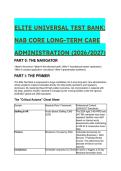
The "Critical Axioms" Cheat Sheet
Domain Absolute Rule / Framework Professional Context
(2026/2027 Standards)
Staffing & HR Acuity-Based Staffing (CMS The 2024 rigid 3.48 HPRD and
2026) 24/7 RN mandates have been
repealed; facilities must staff
based on internal acuity
assessments while maintaining
an RN for 8 consecutive hours
daily.
Finance Breakeven Occupancy Ratio Calculated exclusively as:
(Operating Expenses + Debt
Service) ÷ Potential Rental
Income. This determines the
absolute minimum survival
capacity.
Compliance Immediate Jeopardy (IJ) Clocks An active IJ triggers a 23-day
Medicare termination track.
,Domain Absolute Rule / Framework Professional Context
(2026/2027 Standards)
Abuse causing serious injury
mandates a 2-hour reporting
window; all others require
24-hour reporting.
Labor Law The FLSA "8/80" Exception Healthcare employers may
bypass standard 40-hour
weeks, paying overtime only for
hours worked over 8 per day
OR 80 per 14-day period.
Life Safety NFPA 101 Code Defenses Smoke barrier penetrations
must not exceed a 0.5-inch
gap. Fire drills must be
conducted quarterly on every
single operational shift.
PART II: THE ELITE TEST BANK
Tier 1: Foundational Syntax & Application
Q1: A nursing facility transitions to a new payroll system and implements the Fair Labor
Standards Act (FLSA) "8/80" rule for nursing staff. Under this specific framework, which
condition MUST be met for an employee to earn overtime pay? A) The employee exceeds 40
hours in a standard 7-day workweek. B) The employee works more than 12 hours in a single
shift, regardless of the 14-day total. C) The employee works more than 8 hours in a single day
or more than 80 hours in a 14-day period. D) The employee averages more than 80 hours
across two consecutive 7-day workweeks.
● The Answer: C (The employee works more than 8 hours in a single day or more than 80
hours in a 14-day period.)
● Distractor Analysis:
○ A is incorrect: This is the standard FLSA rule, which the 8/80 exception explicitly
overrides for qualifying healthcare institutions.
○ B is incorrect: While working over 12 hours qualifies for daily overtime under 8/80,
the rule is strictly defined by the 8-hour daily threshold, making 12 hours an
incomplete definition.
○ D is incorrect: The FLSA prohibits "averaging" hours across weeks to avoid
overtime liability. The 14-day period is a fixed, consecutive block.
The Mentor's Analysis: The 8/80 rule is an elite scheduling tool unique to 24/7 healthcare
environments, providing flexibility while capping excessive daily shifts. By utilizing the 8/80
method, the facility bypasses the common trap of accidental overtime clustering.
Professional/Academic Intuition: Always execute a prior written agreement with the
employee before utilizing the 8/80 overtime exception.
Q2: Following the 2026 repeal of the 2024 CMS minimum staffing rule (3.48 HPRD), a newly
appointed Administrator is restructuring the nursing department. To maintain federal compliance
under current 2026 regulations, the Administrator MUST ensure which of the following baseline
standards is met? A) An RN is physically on-site 24 hours a day, 7 days a week. B) Staffing is
strictly acuity-based, with an RN on duty for at least 8 consecutive hours a day, 7 days a week.
, C) A minimum of 2.45 HPRD of direct nurse aide care is provided. D) The facility maintains a
fixed ratio of 1 CNA to every 8 residents during the day shift.
● The Answer: B (Staffing is strictly acuity-based, with an RN on duty for at least 8
consecutive hours a day, 7 days a week.)
● Distractor Analysis:
○ A is incorrect: The 24/7 RN mandate was repealed in the 2026 rollback.
○ C is incorrect: The 2.45 HPRD for CNAs was part of the 2024 CMS rule that has
since been rescinded.
○ D is incorrect: Federal guidelines do not utilize fixed staff-to-patient ratios, but rather
mandate sufficient staff based on the facility's dynamic acuity assessment.
The Mentor's Analysis: Regulatory environments are highly volatile. The 2026 landscape shifts
the burden from arbitrary numerical quotas back to actual clinical acuity and comprehensive
facility assessments. Professional/Academic Intuition: Acuity drives staffing; federal
minimums are merely the absolute floor, not the operational target.
Q3: A Certified Nursing Assistant (CNA) witnesses a resident strike another resident, resulting
in a deep laceration that requires immediate medical suturing. According to federal reporting
requirements for alleged abuse resulting in serious bodily injury, the facility must notify the State
Survey Agency NO LATER THAN: A) 2 hours after forming the suspicion. B) 24 hours after the
incident occurred. C) 5 working days following an internal investigation. D) The end of the
current operational shift.
● The Answer: A (2 hours after forming the suspicion.)
● Distractor Analysis:
○ B is incorrect: The 24-hour timeframe applies exclusively to incidents of abuse or
violations that do not result in serious bodily injury.
○ C is incorrect: Five working days is the deadline for submitting the written results of
the internal investigation, not the initial report.
○ D is incorrect: Shift-end is an internal operational benchmark, not a recognized
federal regulatory timeline.
The Mentor's Analysis: Time is the ultimate enemy during an abuse allegation. Delays in
reporting transition a facility from a controlled incident to an Immediate Jeopardy (IJ) citation for
failure to report. Professional/Academic Intuition: If blood is drawn or bones are broken
(serious bodily injury), the 2-hour reporting clock starts the second the facility knows.
Q4: A facility is cited for Immediate Jeopardy (IJ) due to a failure to secure a wander-prone
resident. The State Survey Agency accepts the facility's abatement plan. If the facility fails to
completely remove the jeopardy, the Centers for Medicare & Medicaid Services (CMS) will
terminate the provider agreement within what maximum timeframe? A) 10 calendar days. B) 23
calendar days. C) 30 working days. D) 90 calendar days.
● The Answer: B (23 calendar days.)
● Distractor Analysis:
○ A is incorrect: 10 days is typically the timeframe required to submit a standard Plan
of Correction (PoC), not the termination track for an IJ.
○ C is incorrect: 30 days has no specific relevance to the rapid IJ termination track.
○ D is incorrect: 90 to 180 days is the standard enforcement track for non-IJ
deficiencies.
The Mentor's Analysis: Immediate Jeopardy represents a catastrophic breakdown in systems
causing actual or likely serious harm. The 23-day termination track is designed to force
immediate abatement or shut the facility down. Professional/Academic Intuition: Abatement
of the immediate risk must occur instantly; the 23-day clock is a statutory death sentence
NAB CORE LONG-TERM CARE
ADMINISTRATION (2026/2027)
PART 0: THE NAVIGATOR
*(#part-i-the-primer) *(#part-ii-the-elite-test-bank) *(#tier-1-foundational-syntax--application)
*(#tier-2-complex-application--simulation) *(#tier-3-grandmaster-synthesis)
PART I: THE PRIMER
This Elite Test Bank is engineered to forge candidates into A-level long-term care administrators
whose academic mastery translates directly into elite facility operations and regulatory
dominance. By mastering these 60 high-caliber scenarios, rote memorization is replaced with
the deep, systemic intuition required to manage top-tier nursing facilities under the rigorous
2026/2027 global and CMS standards.
The "Critical Axioms" Cheat Sheet
Domain Absolute Rule / Framework Professional Context
(2026/2027 Standards)
Staffing & HR Acuity-Based Staffing (CMS The 2024 rigid 3.48 HPRD and
2026) 24/7 RN mandates have been
repealed; facilities must staff
based on internal acuity
assessments while maintaining
an RN for 8 consecutive hours
daily.
Finance Breakeven Occupancy Ratio Calculated exclusively as:
(Operating Expenses + Debt
Service) ÷ Potential Rental
Income. This determines the
absolute minimum survival
capacity.
Compliance Immediate Jeopardy (IJ) Clocks An active IJ triggers a 23-day
Medicare termination track.
,Domain Absolute Rule / Framework Professional Context
(2026/2027 Standards)
Abuse causing serious injury
mandates a 2-hour reporting
window; all others require
24-hour reporting.
Labor Law The FLSA "8/80" Exception Healthcare employers may
bypass standard 40-hour
weeks, paying overtime only for
hours worked over 8 per day
OR 80 per 14-day period.
Life Safety NFPA 101 Code Defenses Smoke barrier penetrations
must not exceed a 0.5-inch
gap. Fire drills must be
conducted quarterly on every
single operational shift.
PART II: THE ELITE TEST BANK
Tier 1: Foundational Syntax & Application
Q1: A nursing facility transitions to a new payroll system and implements the Fair Labor
Standards Act (FLSA) "8/80" rule for nursing staff. Under this specific framework, which
condition MUST be met for an employee to earn overtime pay? A) The employee exceeds 40
hours in a standard 7-day workweek. B) The employee works more than 12 hours in a single
shift, regardless of the 14-day total. C) The employee works more than 8 hours in a single day
or more than 80 hours in a 14-day period. D) The employee averages more than 80 hours
across two consecutive 7-day workweeks.
● The Answer: C (The employee works more than 8 hours in a single day or more than 80
hours in a 14-day period.)
● Distractor Analysis:
○ A is incorrect: This is the standard FLSA rule, which the 8/80 exception explicitly
overrides for qualifying healthcare institutions.
○ B is incorrect: While working over 12 hours qualifies for daily overtime under 8/80,
the rule is strictly defined by the 8-hour daily threshold, making 12 hours an
incomplete definition.
○ D is incorrect: The FLSA prohibits "averaging" hours across weeks to avoid
overtime liability. The 14-day period is a fixed, consecutive block.
The Mentor's Analysis: The 8/80 rule is an elite scheduling tool unique to 24/7 healthcare
environments, providing flexibility while capping excessive daily shifts. By utilizing the 8/80
method, the facility bypasses the common trap of accidental overtime clustering.
Professional/Academic Intuition: Always execute a prior written agreement with the
employee before utilizing the 8/80 overtime exception.
Q2: Following the 2026 repeal of the 2024 CMS minimum staffing rule (3.48 HPRD), a newly
appointed Administrator is restructuring the nursing department. To maintain federal compliance
under current 2026 regulations, the Administrator MUST ensure which of the following baseline
standards is met? A) An RN is physically on-site 24 hours a day, 7 days a week. B) Staffing is
strictly acuity-based, with an RN on duty for at least 8 consecutive hours a day, 7 days a week.
, C) A minimum of 2.45 HPRD of direct nurse aide care is provided. D) The facility maintains a
fixed ratio of 1 CNA to every 8 residents during the day shift.
● The Answer: B (Staffing is strictly acuity-based, with an RN on duty for at least 8
consecutive hours a day, 7 days a week.)
● Distractor Analysis:
○ A is incorrect: The 24/7 RN mandate was repealed in the 2026 rollback.
○ C is incorrect: The 2.45 HPRD for CNAs was part of the 2024 CMS rule that has
since been rescinded.
○ D is incorrect: Federal guidelines do not utilize fixed staff-to-patient ratios, but rather
mandate sufficient staff based on the facility's dynamic acuity assessment.
The Mentor's Analysis: Regulatory environments are highly volatile. The 2026 landscape shifts
the burden from arbitrary numerical quotas back to actual clinical acuity and comprehensive
facility assessments. Professional/Academic Intuition: Acuity drives staffing; federal
minimums are merely the absolute floor, not the operational target.
Q3: A Certified Nursing Assistant (CNA) witnesses a resident strike another resident, resulting
in a deep laceration that requires immediate medical suturing. According to federal reporting
requirements for alleged abuse resulting in serious bodily injury, the facility must notify the State
Survey Agency NO LATER THAN: A) 2 hours after forming the suspicion. B) 24 hours after the
incident occurred. C) 5 working days following an internal investigation. D) The end of the
current operational shift.
● The Answer: A (2 hours after forming the suspicion.)
● Distractor Analysis:
○ B is incorrect: The 24-hour timeframe applies exclusively to incidents of abuse or
violations that do not result in serious bodily injury.
○ C is incorrect: Five working days is the deadline for submitting the written results of
the internal investigation, not the initial report.
○ D is incorrect: Shift-end is an internal operational benchmark, not a recognized
federal regulatory timeline.
The Mentor's Analysis: Time is the ultimate enemy during an abuse allegation. Delays in
reporting transition a facility from a controlled incident to an Immediate Jeopardy (IJ) citation for
failure to report. Professional/Academic Intuition: If blood is drawn or bones are broken
(serious bodily injury), the 2-hour reporting clock starts the second the facility knows.
Q4: A facility is cited for Immediate Jeopardy (IJ) due to a failure to secure a wander-prone
resident. The State Survey Agency accepts the facility's abatement plan. If the facility fails to
completely remove the jeopardy, the Centers for Medicare & Medicaid Services (CMS) will
terminate the provider agreement within what maximum timeframe? A) 10 calendar days. B) 23
calendar days. C) 30 working days. D) 90 calendar days.
● The Answer: B (23 calendar days.)
● Distractor Analysis:
○ A is incorrect: 10 days is typically the timeframe required to submit a standard Plan
of Correction (PoC), not the termination track for an IJ.
○ C is incorrect: 30 days has no specific relevance to the rapid IJ termination track.
○ D is incorrect: 90 to 180 days is the standard enforcement track for non-IJ
deficiencies.
The Mentor's Analysis: Immediate Jeopardy represents a catastrophic breakdown in systems
causing actual or likely serious harm. The 23-day termination track is designed to force
immediate abatement or shut the facility down. Professional/Academic Intuition: Abatement
of the immediate risk must occur instantly; the 23-day clock is a statutory death sentence


