
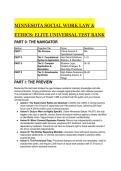
MINNESOTA SOCIAL WORK LAW &
ETHICS: ELITE UNIVERSAL TEST BANK
PART 0: THE NAVIGATOR
Section Cognitive Tier Focus Questions
PART I The Preview Critical Axioms & N/A
Operational Framework
PART II Tier 1: Foundational Hard Deck Definitions, 1–15
Syntax & Application Statutes, & Mandates
PART II Tier 2: Complex Situation Logic, 16–35
Application & Variable Changes, &
Simulation Multi-Step Procedures
PART II Tier 3: Grandmaster High-Stakes Scenarios, 36–60
Synthesis Competing Axioms, &
Triage
PART I: THE PREVIEW
Mastering this test bank bridges the gap between academic statutory knowledge and elite
clinical protection, forging practitioners who navigate legal ambushes with reflexive precision.
True competence in Minnesota social work is not merely passing a board exam; it is the
absolute, weaponized fluency of Chapter 148E to protect both the public and your license
simultaneously.
● Axiom I: The Supervision Ratios are Absolute. LGSWs and LISWs in clinical practice
must maintain 4 to 8 hours of supervision per 160 practice hours, achieving 200 total
hours over 4,000 to 8,000 hours of clinical practice.
● Axiom II: Duty to Warn is Highly Specific. Under Minnesota Statute 148.975, the duty
triggers only upon a specific, serious threat of physical violence against a clearly identified
or identifiable victim. Vague threats of harm do not breach confidentiality.
● Axiom III: Minor Consent Bypasses Parents. Minors may independently consent to
nonresidential mental health services, pregnancy/STI treatment, and chemical
dependency treatment. Parents do not have an inherent right to these specific records if
the minor consented independently.
● Axiom IV: The 90-Day Reporting Mandate. Licensees must self-report adverse actions,
malpractice settlements, or criminal convictions reasonably related to practice within
exactly 90 days.
● Axiom V: The Provisional Trap. Provisional licenses are strictly non-renewable, valid for
exactly three years, and require 2,000 hours of social work practice with 37.5 hours of
supervision before standard licensure.
,PART II: THE ELITE TEST BANK
Tier 1: Foundational Syntax & Application
Q1: A Licensed Graduate Social Worker (LGSW) in Minnesota is entering clinical practice to
pursue their LICSW. What is the REQUIRED continuous supervision ratio they must adhere to
under Chapter 148E? A) 1 hour of supervision for every 40 hours of practice. B) 2 hours of
supervision for every 100 hours of practice. C) 4 to 8 hours of supervision for every 160 hours of
practice. D) 10 hours of supervision for every 200 hours of practice.
● The Answer: C (4 to 8 hours of supervision for every 160 hours of practice.)
● Distractor Analysis:
○ A is incorrect: This reflects a common national standard, but fails to match the
Minnesota Chapter 148E mandate.
○ B is incorrect: This represents an arbitrary mathematical breakdown not recognized
by the Board.
○ D is incorrect: The maximum limit is 8 hours per 160 hours; 10 hours exceeds the
recognized pacing and cannot be counted.
The Mentor's Analysis: Statutory pacing prevents both inadequate oversight and superficial
supervision dumping. When facing supervision tracking, the immediate priority is adhering to the
rigid month-to-month ratio. By utilizing the 4-to-8 hour per 160-hour framework, you bypass the
common trap of front-loading or back-loading supervision hours to rush licensure.
Professional/Academic Intuition: Supervision must be longitudinal; 160 hours of practice
roughly equals one month of full-time work.
Q2: Under the updated Minnesota Board of Social Work biennial renewal requirements, a
licensee must complete 40 total hours of Continuing Education (CE). What is the MINIMUM
mandated distribution for specific topics? A) 2 hours in ethics and 4 hours in cultural
responsiveness. B) 4 hours in ethics and 2 hours in cultural responsiveness. C) 5 hours in
ethics and 5 hours in cultural responsiveness. D) 3 hours in ethics and 3 hours in clinical
supervision.
● The Answer: A (2 hours in ethics and 4 hours in cultural responsiveness.)
● Distractor Analysis:
○ B is incorrect: This inverses the correct statutory requirement, representing a
common clerical error.
○ C is incorrect: This overestimates the specific mandate, representing an arbitrary
inflation of the standard.
○ D is incorrect: Clinical supervision CEs (6 hours) are only required if the licensee is
an active supervisor during that specific renewal term.
The Mentor's Analysis: The Board explicitly prioritizes cultural competency to address shifting
demographic needs in clinical care. When facing license renewal, the immediate priority is
securing these specific content domains. By utilizing the 2/4 statutory distribution, you bypass
the common trap of auditing a renewal cycle with generalized, non-compliant CE credits.
Professional/Academic Intuition: Ethics and cultural responsiveness are unskippable
hard-decks for every single renewal cycle.
Q3: A licensed social worker receives a DUI conviction over the weekend. Under Minnesota
Statute 148E.240, within what timeframe MUST the social worker report this adverse action to
the Board? A) Immediately, within 24 hours. B) Within 30 days. C) Within 90 days. D) At the time
, of their next biennial license renewal.
● The Answer: C (Within 90 days.)
● Distractor Analysis:
○ A is incorrect: Immediate reporting applies to child and vulnerable adult
maltreatment, not self-reporting criminal convictions.
○ B is incorrect: 30 days is the requirement for updating address or name changes
with the Board.
○ D is incorrect: Waiting for renewal is a severe violation of the self-reporting statute
and invites immediate disciplinary action.
The Mentor's Analysis: The Board requires prompt transparency for criminal convictions
related to professional fitness. When facing personal legal jeopardy, the immediate priority is
regulatory disclosure. By utilizing the 90-day self-reporting mandate, you bypass the common
trap of concealing infractions until the biennial audit. Professional/Academic Intuition:
Concealment is always punished more severely than the underlying offense.
Q4: A 16-year-old high school student requests nonresidential mental health services for
depression. Under Minnesota Statute 144.3431, who MUST legally consent to this treatment?
A) The minor and at least one parent. B) The minor's legal guardian exclusively. C) The minor
may give effective consent independently. D) The minor, provided a court grants an
emancipation order.
● The Answer: C (The minor may give effective consent independently.)
● Distractor Analysis:
○ A is incorrect: Joint consent is explicitly not required for nonresidential mental
health services under Minnesota law.
○ B is incorrect: This ignores the minor's statutory right to access mental health care
autonomously.
○ D is incorrect: Minnesota does not require formal court emancipation for this
specific category of medical consent.
The Mentor's Analysis: Minnesota law intentionally lowers barriers for adolescents seeking
critical mental health and chemical dependency care. When facing an adolescent intake, the
immediate priority is recognizing their legal capacity. By utilizing independent minor consent,
you bypass the common trap of illegally denying care due to an artificial requirement for
parental involvement. Professional/Academic Intuition: In Minnesota, age 16 operates
functionally as an adult for nonresidential mental health treatment.
Q5: According to the 360 clinical clock hours requirement for LICSW applicants, how many
hours MUST specifically be dedicated to differential diagnosis and biopsychosocial
assessment? A) 36 clock hours. B) 72 clock hours. C) 108 clock hours. D) 120 clock hours.
● The Answer: C (108 clock hours.)
● Distractor Analysis:
○ A is incorrect: 36 hours is the strict requirement for assessment-based clinical
treatment planning.
○ B is incorrect: 72 hours is the requirement for social work values and ethics.
○ D is incorrect: 120 hours is the maximum amount of CE that can be applied to the
360-hour academic total.
The Mentor's Analysis: Diagnosis is the bedrock of clinical practice and carries the highest
educational burden. When organizing your clinical curriculum, the immediate priority is hitting
specific hour targets. By utilizing the 108-hour assessment metric, you bypass the common trap
of submitting an unbalanced, easily rejected academic grid. Professional/Academic Intuition:
Diagnosis and Intervention form the twin pillars of clinical education, requiring exactly
ETHICS: ELITE UNIVERSAL TEST BANK
PART 0: THE NAVIGATOR
Section Cognitive Tier Focus Questions
PART I The Preview Critical Axioms & N/A
Operational Framework
PART II Tier 1: Foundational Hard Deck Definitions, 1–15
Syntax & Application Statutes, & Mandates
PART II Tier 2: Complex Situation Logic, 16–35
Application & Variable Changes, &
Simulation Multi-Step Procedures
PART II Tier 3: Grandmaster High-Stakes Scenarios, 36–60
Synthesis Competing Axioms, &
Triage
PART I: THE PREVIEW
Mastering this test bank bridges the gap between academic statutory knowledge and elite
clinical protection, forging practitioners who navigate legal ambushes with reflexive precision.
True competence in Minnesota social work is not merely passing a board exam; it is the
absolute, weaponized fluency of Chapter 148E to protect both the public and your license
simultaneously.
● Axiom I: The Supervision Ratios are Absolute. LGSWs and LISWs in clinical practice
must maintain 4 to 8 hours of supervision per 160 practice hours, achieving 200 total
hours over 4,000 to 8,000 hours of clinical practice.
● Axiom II: Duty to Warn is Highly Specific. Under Minnesota Statute 148.975, the duty
triggers only upon a specific, serious threat of physical violence against a clearly identified
or identifiable victim. Vague threats of harm do not breach confidentiality.
● Axiom III: Minor Consent Bypasses Parents. Minors may independently consent to
nonresidential mental health services, pregnancy/STI treatment, and chemical
dependency treatment. Parents do not have an inherent right to these specific records if
the minor consented independently.
● Axiom IV: The 90-Day Reporting Mandate. Licensees must self-report adverse actions,
malpractice settlements, or criminal convictions reasonably related to practice within
exactly 90 days.
● Axiom V: The Provisional Trap. Provisional licenses are strictly non-renewable, valid for
exactly three years, and require 2,000 hours of social work practice with 37.5 hours of
supervision before standard licensure.
,PART II: THE ELITE TEST BANK
Tier 1: Foundational Syntax & Application
Q1: A Licensed Graduate Social Worker (LGSW) in Minnesota is entering clinical practice to
pursue their LICSW. What is the REQUIRED continuous supervision ratio they must adhere to
under Chapter 148E? A) 1 hour of supervision for every 40 hours of practice. B) 2 hours of
supervision for every 100 hours of practice. C) 4 to 8 hours of supervision for every 160 hours of
practice. D) 10 hours of supervision for every 200 hours of practice.
● The Answer: C (4 to 8 hours of supervision for every 160 hours of practice.)
● Distractor Analysis:
○ A is incorrect: This reflects a common national standard, but fails to match the
Minnesota Chapter 148E mandate.
○ B is incorrect: This represents an arbitrary mathematical breakdown not recognized
by the Board.
○ D is incorrect: The maximum limit is 8 hours per 160 hours; 10 hours exceeds the
recognized pacing and cannot be counted.
The Mentor's Analysis: Statutory pacing prevents both inadequate oversight and superficial
supervision dumping. When facing supervision tracking, the immediate priority is adhering to the
rigid month-to-month ratio. By utilizing the 4-to-8 hour per 160-hour framework, you bypass the
common trap of front-loading or back-loading supervision hours to rush licensure.
Professional/Academic Intuition: Supervision must be longitudinal; 160 hours of practice
roughly equals one month of full-time work.
Q2: Under the updated Minnesota Board of Social Work biennial renewal requirements, a
licensee must complete 40 total hours of Continuing Education (CE). What is the MINIMUM
mandated distribution for specific topics? A) 2 hours in ethics and 4 hours in cultural
responsiveness. B) 4 hours in ethics and 2 hours in cultural responsiveness. C) 5 hours in
ethics and 5 hours in cultural responsiveness. D) 3 hours in ethics and 3 hours in clinical
supervision.
● The Answer: A (2 hours in ethics and 4 hours in cultural responsiveness.)
● Distractor Analysis:
○ B is incorrect: This inverses the correct statutory requirement, representing a
common clerical error.
○ C is incorrect: This overestimates the specific mandate, representing an arbitrary
inflation of the standard.
○ D is incorrect: Clinical supervision CEs (6 hours) are only required if the licensee is
an active supervisor during that specific renewal term.
The Mentor's Analysis: The Board explicitly prioritizes cultural competency to address shifting
demographic needs in clinical care. When facing license renewal, the immediate priority is
securing these specific content domains. By utilizing the 2/4 statutory distribution, you bypass
the common trap of auditing a renewal cycle with generalized, non-compliant CE credits.
Professional/Academic Intuition: Ethics and cultural responsiveness are unskippable
hard-decks for every single renewal cycle.
Q3: A licensed social worker receives a DUI conviction over the weekend. Under Minnesota
Statute 148E.240, within what timeframe MUST the social worker report this adverse action to
the Board? A) Immediately, within 24 hours. B) Within 30 days. C) Within 90 days. D) At the time
, of their next biennial license renewal.
● The Answer: C (Within 90 days.)
● Distractor Analysis:
○ A is incorrect: Immediate reporting applies to child and vulnerable adult
maltreatment, not self-reporting criminal convictions.
○ B is incorrect: 30 days is the requirement for updating address or name changes
with the Board.
○ D is incorrect: Waiting for renewal is a severe violation of the self-reporting statute
and invites immediate disciplinary action.
The Mentor's Analysis: The Board requires prompt transparency for criminal convictions
related to professional fitness. When facing personal legal jeopardy, the immediate priority is
regulatory disclosure. By utilizing the 90-day self-reporting mandate, you bypass the common
trap of concealing infractions until the biennial audit. Professional/Academic Intuition:
Concealment is always punished more severely than the underlying offense.
Q4: A 16-year-old high school student requests nonresidential mental health services for
depression. Under Minnesota Statute 144.3431, who MUST legally consent to this treatment?
A) The minor and at least one parent. B) The minor's legal guardian exclusively. C) The minor
may give effective consent independently. D) The minor, provided a court grants an
emancipation order.
● The Answer: C (The minor may give effective consent independently.)
● Distractor Analysis:
○ A is incorrect: Joint consent is explicitly not required for nonresidential mental
health services under Minnesota law.
○ B is incorrect: This ignores the minor's statutory right to access mental health care
autonomously.
○ D is incorrect: Minnesota does not require formal court emancipation for this
specific category of medical consent.
The Mentor's Analysis: Minnesota law intentionally lowers barriers for adolescents seeking
critical mental health and chemical dependency care. When facing an adolescent intake, the
immediate priority is recognizing their legal capacity. By utilizing independent minor consent,
you bypass the common trap of illegally denying care due to an artificial requirement for
parental involvement. Professional/Academic Intuition: In Minnesota, age 16 operates
functionally as an adult for nonresidential mental health treatment.
Q5: According to the 360 clinical clock hours requirement for LICSW applicants, how many
hours MUST specifically be dedicated to differential diagnosis and biopsychosocial
assessment? A) 36 clock hours. B) 72 clock hours. C) 108 clock hours. D) 120 clock hours.
● The Answer: C (108 clock hours.)
● Distractor Analysis:
○ A is incorrect: 36 hours is the strict requirement for assessment-based clinical
treatment planning.
○ B is incorrect: 72 hours is the requirement for social work values and ethics.
○ D is incorrect: 120 hours is the maximum amount of CE that can be applied to the
360-hour academic total.
The Mentor's Analysis: Diagnosis is the bedrock of clinical practice and carries the highest
educational burden. When organizing your clinical curriculum, the immediate priority is hitting
specific hour targets. By utilizing the 108-hour assessment metric, you bypass the common trap
of submitting an unbalanced, easily rejected academic grid. Professional/Academic Intuition:
Diagnosis and Intervention form the twin pillars of clinical education, requiring exactly


