
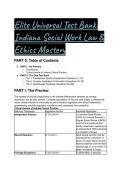
Elite Universal Test Bank:
Indiana Social Work Law &
Ethics Mastery
PART 0: Table of Contents
● PART I: The Preview
○ The Mission
○ Critical Axioms of Indiana Clinical Practice
● PART II: The Elite Test Bank
○ Tier 1: Foundational Syntax & Application (Questions 1–15)
○ Tier 2: Complex Application & Simulation (Questions 16–35)
○ Tier 3: Grandmaster Synthesis (Questions 36–60)
PART I: The Preview
The mastery of clinical jurisprudence is the ultimate differentiator between an average
practitioner and an elite clinician. Complete assimilation of this test bank forges a professional
whose clinical intuition is intrinsically bound to Indiana's legislative and ethical frameworks,
guaranteeing absolute regulatory compliance and maximized client protection.
Critical Axioms of Indiana Clinical Practice
Statutory Framework Legislative Anchor Axiomatic Application
Independent Practice IC 25-23.6-4-1 A Licensed Social Worker
(LSW) or Licensed Bachelor's
Degree Social Worker (LBSW)
must be W-2 employed and
strictly supervised; operating as
an independent 1099 contractor
is a violation of scope.
Record Retention IC 16-39-7-1 Adult clinical records must be
maintained for a minimum of
seven (7) years. Minor records
must be retained until the client
reaches age 21 or for seven (7)
years, whichever is longer.
Privilege Exceptions IC 25-23.6-6-1 Confidentiality is absolute,
,Statutory Framework Legislative Anchor Axiomatic Application
except in specific statutory
exemptions including homicide
proceedings, malpractice
defense, or abuse against an
unemancipated minor or
incompetent adult.
The Duty to Warn IC 34-30-16-1 Immunity from liability applies
unless a client communicates
an actual, imminent threat of
physical violence against a
reasonably identifiable victim.
Continuing Education 839 IAC 1-6-3 40 CEUs are required every
two-year cycle; a minimum of
20 must be Category I (formal),
and exactly 2 Category I hours
must be dedicated to Ethics.
PART II: The Elite Test Bank
Tier 1: Foundational Syntax & Application
Q1: A newly licensed Licensed Social Worker (LSW) accepts a position at a private group
practice. The clinic director informs the LSW that remuneration will be processed via an
independent 1099 contractor agreement, requiring the LSW to secure their own external
supervision. Based on the principles of the Indiana Professional Licensing Agency regulations,
which conclusion is the MOST ACCURATE? A) The arrangement is compliant provided the
LSW obtains exactly four hours of external clinical supervision per month. B) The arrangement
is strictly prohibited because LSWs cannot legally operate as independent contractors. C) The
arrangement is compliant only if the clinic director holds an active Licensed Clinical Social
Worker (LCSW) credential. D) The arrangement is prohibited because an LSW must complete
3,000 clinical hours before accepting 1099 status.
● The Answer: B (The arrangement is strictly prohibited because LSWs cannot legally
operate as independent contractors.)
● Distractor Analysis:
○ A is incorrect: While four hours of supervision is a statutory requirement, 1099
status inherently denotes independent practice, which an LSW cannot hold.
○ C is incorrect: The director's license does not override the state definition of 1099
independent practice constraints.
○ D is incorrect: While 3,000 hours are required for LCSW licensure, the numerical
hour count is not the primary mechanism invalidating the 1099 status in this
scenario.
The Mentor's Analysis: Statutory boundaries restrict independent practice exclusively to the
independent clinical license tier (LCSW). By utilizing the employment classification framework,
the practitioner bypasses the common trap of believing supervision alone cures
scope-of-practice violations. Professional/Academic Intuition: An LSW or LBSW working as
a 1099 contractor is practicing illegally, regardless of the presence of clinical
supervision.
, Q2: A 45-year-old client terminates therapy abruptly. The clinical social worker archives the
physical chart. Under the health record statutes, what is the MINIMUM duration the practitioner
must maintain this original health record? A) Five (5) years from the date of the last clinical
contact. B) Seven (7) years from the date of the last clinical contact. C) Ten (10) years from the
date of the last clinical contact. D) Seven (7) years from the date the file is officially closed
administratively.
● The Answer: B (Seven (7) years from the date of the last clinical contact.)
● Distractor Analysis:
○ A is incorrect: Five years is applicable to other specific record types (e.g., x-rays),
not standard clinical health records.
○ C is incorrect: Ten years represents a common institutional policy, but it is not the
Indiana statutory floor.
○ D is incorrect: The statutory retention clock begins at the date of service delivery,
not an arbitrary administrative closure date.
The Mentor's Analysis: Record retention is a strict liability statute designed to preserve
evidence and continuity of care. By adhering to IC 16-39-7-1, the clinician bypasses the
common trap of premature destruction of legal evidence. Professional/Academic Intuition:
Adult clinical records must survive exactly seven years post-service delivery.
Q3: An LCSW is auditing their continuing education units (CEUs) prior to the March 31 renewal
deadline. They have completed 40 hours of Category II (self-directed) learning. Based on the
839 IAC 1-6 continuing education rules, what is the IMMEDIATE status of this practitioner's
renewal eligibility? A) Eligible, as the total 40-hour aggregate requirement has been met. B)
Ineligible, because a maximum of 20 hours may be claimed from Category II sources. C)
Ineligible, because Category II learning is restricted to 10 hours per renewal cycle. D) Eligible,
provided 2 of the Category II hours were focused on clinical ethics.
● The Answer: B (Ineligible, because a maximum of 20 hours may be claimed from
Category II sources.)
● Distractor Analysis:
○ A is incorrect: CEU compliance requires specific categorical distribution, not merely
aggregate volume.
○ C is incorrect: The maximum allowance for Category II is 50% of the total 40 hours
(20 hours), not 10 hours.
○ D is incorrect: Ethics requirements MUST be completed via Category I formal
programming, making Category II ethics hours invalid for the specific mandate.
The Mentor's Analysis: The Board mandates a balance between peer-reviewed formal
education and self-directed study. By strictly utilizing the 50% categorical cap rule, the
professional bypasses the common trap of utilizing easily obtained, unstructured CEUs to fulfill
the entire mandate. Professional/Academic Intuition: Category II CEUs can never exceed
50% of the total biennial renewal requirement.
Q4: A 15-year-old minor presents to a community clinic requesting treatment for a substance
use disorder. The minor explicitly refuses to allow the clinic to notify their parents. Under Indiana
Code 12-23-12-1, what is the MOST APPROPRIATE clinical response? A) Refuse treatment
until parental consent is secured, as the minor has not reached the age of majority. B) Provide
treatment, as minors may voluntarily seek substance abuse treatment without parental
notification. C) Provide treatment only if the minor can prove they are legally emancipated or
currently married. D) Assess the minor clinically, but mandate parental notification within 48
hours of the initial intake.
● The Answer: B (Provide treatment, as minors may voluntarily seek substance abuse
Indiana Social Work Law &
Ethics Mastery
PART 0: Table of Contents
● PART I: The Preview
○ The Mission
○ Critical Axioms of Indiana Clinical Practice
● PART II: The Elite Test Bank
○ Tier 1: Foundational Syntax & Application (Questions 1–15)
○ Tier 2: Complex Application & Simulation (Questions 16–35)
○ Tier 3: Grandmaster Synthesis (Questions 36–60)
PART I: The Preview
The mastery of clinical jurisprudence is the ultimate differentiator between an average
practitioner and an elite clinician. Complete assimilation of this test bank forges a professional
whose clinical intuition is intrinsically bound to Indiana's legislative and ethical frameworks,
guaranteeing absolute regulatory compliance and maximized client protection.
Critical Axioms of Indiana Clinical Practice
Statutory Framework Legislative Anchor Axiomatic Application
Independent Practice IC 25-23.6-4-1 A Licensed Social Worker
(LSW) or Licensed Bachelor's
Degree Social Worker (LBSW)
must be W-2 employed and
strictly supervised; operating as
an independent 1099 contractor
is a violation of scope.
Record Retention IC 16-39-7-1 Adult clinical records must be
maintained for a minimum of
seven (7) years. Minor records
must be retained until the client
reaches age 21 or for seven (7)
years, whichever is longer.
Privilege Exceptions IC 25-23.6-6-1 Confidentiality is absolute,
,Statutory Framework Legislative Anchor Axiomatic Application
except in specific statutory
exemptions including homicide
proceedings, malpractice
defense, or abuse against an
unemancipated minor or
incompetent adult.
The Duty to Warn IC 34-30-16-1 Immunity from liability applies
unless a client communicates
an actual, imminent threat of
physical violence against a
reasonably identifiable victim.
Continuing Education 839 IAC 1-6-3 40 CEUs are required every
two-year cycle; a minimum of
20 must be Category I (formal),
and exactly 2 Category I hours
must be dedicated to Ethics.
PART II: The Elite Test Bank
Tier 1: Foundational Syntax & Application
Q1: A newly licensed Licensed Social Worker (LSW) accepts a position at a private group
practice. The clinic director informs the LSW that remuneration will be processed via an
independent 1099 contractor agreement, requiring the LSW to secure their own external
supervision. Based on the principles of the Indiana Professional Licensing Agency regulations,
which conclusion is the MOST ACCURATE? A) The arrangement is compliant provided the
LSW obtains exactly four hours of external clinical supervision per month. B) The arrangement
is strictly prohibited because LSWs cannot legally operate as independent contractors. C) The
arrangement is compliant only if the clinic director holds an active Licensed Clinical Social
Worker (LCSW) credential. D) The arrangement is prohibited because an LSW must complete
3,000 clinical hours before accepting 1099 status.
● The Answer: B (The arrangement is strictly prohibited because LSWs cannot legally
operate as independent contractors.)
● Distractor Analysis:
○ A is incorrect: While four hours of supervision is a statutory requirement, 1099
status inherently denotes independent practice, which an LSW cannot hold.
○ C is incorrect: The director's license does not override the state definition of 1099
independent practice constraints.
○ D is incorrect: While 3,000 hours are required for LCSW licensure, the numerical
hour count is not the primary mechanism invalidating the 1099 status in this
scenario.
The Mentor's Analysis: Statutory boundaries restrict independent practice exclusively to the
independent clinical license tier (LCSW). By utilizing the employment classification framework,
the practitioner bypasses the common trap of believing supervision alone cures
scope-of-practice violations. Professional/Academic Intuition: An LSW or LBSW working as
a 1099 contractor is practicing illegally, regardless of the presence of clinical
supervision.
, Q2: A 45-year-old client terminates therapy abruptly. The clinical social worker archives the
physical chart. Under the health record statutes, what is the MINIMUM duration the practitioner
must maintain this original health record? A) Five (5) years from the date of the last clinical
contact. B) Seven (7) years from the date of the last clinical contact. C) Ten (10) years from the
date of the last clinical contact. D) Seven (7) years from the date the file is officially closed
administratively.
● The Answer: B (Seven (7) years from the date of the last clinical contact.)
● Distractor Analysis:
○ A is incorrect: Five years is applicable to other specific record types (e.g., x-rays),
not standard clinical health records.
○ C is incorrect: Ten years represents a common institutional policy, but it is not the
Indiana statutory floor.
○ D is incorrect: The statutory retention clock begins at the date of service delivery,
not an arbitrary administrative closure date.
The Mentor's Analysis: Record retention is a strict liability statute designed to preserve
evidence and continuity of care. By adhering to IC 16-39-7-1, the clinician bypasses the
common trap of premature destruction of legal evidence. Professional/Academic Intuition:
Adult clinical records must survive exactly seven years post-service delivery.
Q3: An LCSW is auditing their continuing education units (CEUs) prior to the March 31 renewal
deadline. They have completed 40 hours of Category II (self-directed) learning. Based on the
839 IAC 1-6 continuing education rules, what is the IMMEDIATE status of this practitioner's
renewal eligibility? A) Eligible, as the total 40-hour aggregate requirement has been met. B)
Ineligible, because a maximum of 20 hours may be claimed from Category II sources. C)
Ineligible, because Category II learning is restricted to 10 hours per renewal cycle. D) Eligible,
provided 2 of the Category II hours were focused on clinical ethics.
● The Answer: B (Ineligible, because a maximum of 20 hours may be claimed from
Category II sources.)
● Distractor Analysis:
○ A is incorrect: CEU compliance requires specific categorical distribution, not merely
aggregate volume.
○ C is incorrect: The maximum allowance for Category II is 50% of the total 40 hours
(20 hours), not 10 hours.
○ D is incorrect: Ethics requirements MUST be completed via Category I formal
programming, making Category II ethics hours invalid for the specific mandate.
The Mentor's Analysis: The Board mandates a balance between peer-reviewed formal
education and self-directed study. By strictly utilizing the 50% categorical cap rule, the
professional bypasses the common trap of utilizing easily obtained, unstructured CEUs to fulfill
the entire mandate. Professional/Academic Intuition: Category II CEUs can never exceed
50% of the total biennial renewal requirement.
Q4: A 15-year-old minor presents to a community clinic requesting treatment for a substance
use disorder. The minor explicitly refuses to allow the clinic to notify their parents. Under Indiana
Code 12-23-12-1, what is the MOST APPROPRIATE clinical response? A) Refuse treatment
until parental consent is secured, as the minor has not reached the age of majority. B) Provide
treatment, as minors may voluntarily seek substance abuse treatment without parental
notification. C) Provide treatment only if the minor can prove they are legally emancipated or
currently married. D) Assess the minor clinically, but mandate parental notification within 48
hours of the initial intake.
● The Answer: B (Provide treatment, as minors may voluntarily seek substance abuse


