
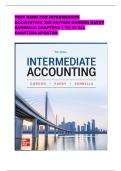
TEST BANK FOR INTERMEDIATE
ACCOUNTING 3RD EDITION GORDON RAEDY
SANNELLA CHAPTERS 1 TO 22 ALL
CHAPTERS UPDATED.
,TABLE OF CONTENTS
1. The Financial Reporting Environment
2. Financial Reporting Theory
3. Judgment and Applied Financial Accounting Research
4. Review of the Accounting Cycle
5. Statements of Net Income and Comprehensive Income
6. Statements of Financial Position and Cash Flows and the Annual
Report
7. Accounting and the Time Value of Money
8. Revenue Recognition (Current Standard)
9. Short-Term Operating Assets: Cash and Receivables
10. Short-Term Operating Assets: Inventory
11. Long-Term Operating Assets: Acquisition, Cost
Allocation, and Derecognition
12. Long-Term Operating Assets: Departures from Historical
Cost
, 13. Operating Liabilities and Contingencies
14. Financing Liabilities
15. Accounting for Stockholders’ Equity
16. Investments in Financial Assets
17. Accounting for Income Taxes
18. Accounting for Leases (New Standard)
19. Accounting for Employee Compensation and Benefits
20. Earnings per Share
21. Accounting Changes and Error Analysis
22. The Statement of Cash Flows
CHAPTER 1: THE FINANCIAL REPORTING
ENVIRONMENT
This chapter introduces the foundational aspects of financial
reporting, emphasizing the importance of understanding accounting
principles, the role of the Securities and Exchange Commission
, (SEC), and the various accounting standards governing financial
reports. Key concepts include the Generally Accepted Accounting
Principles (GAAP), International Financial Reporting Standards
(IFRS), and the preparation and presentation of financial statements.
These guidelines ensure consistency, transparency, and comparability
in financial reporting, which is crucial for informed decision-making
and stakeholder trust in the business environment.
1. Which organization is primarily responsible for overseeing
financial reporting in the United States?
A. American Institute of Certified Public Accountants (AICPA)
B. Securities and Exchange Commission (SEC)
C. Financial Accounting Standards Board (FASB)
D. International Accounting Standards Board (IASB)
Correct Answer: B
Rationale: The SEC oversees financial reporting for public
companies in the U.S., ensuring that businesses comply with
established financial reporting standards.
ACCOUNTING 3RD EDITION GORDON RAEDY
SANNELLA CHAPTERS 1 TO 22 ALL
CHAPTERS UPDATED.
,TABLE OF CONTENTS
1. The Financial Reporting Environment
2. Financial Reporting Theory
3. Judgment and Applied Financial Accounting Research
4. Review of the Accounting Cycle
5. Statements of Net Income and Comprehensive Income
6. Statements of Financial Position and Cash Flows and the Annual
Report
7. Accounting and the Time Value of Money
8. Revenue Recognition (Current Standard)
9. Short-Term Operating Assets: Cash and Receivables
10. Short-Term Operating Assets: Inventory
11. Long-Term Operating Assets: Acquisition, Cost
Allocation, and Derecognition
12. Long-Term Operating Assets: Departures from Historical
Cost
, 13. Operating Liabilities and Contingencies
14. Financing Liabilities
15. Accounting for Stockholders’ Equity
16. Investments in Financial Assets
17. Accounting for Income Taxes
18. Accounting for Leases (New Standard)
19. Accounting for Employee Compensation and Benefits
20. Earnings per Share
21. Accounting Changes and Error Analysis
22. The Statement of Cash Flows
CHAPTER 1: THE FINANCIAL REPORTING
ENVIRONMENT
This chapter introduces the foundational aspects of financial
reporting, emphasizing the importance of understanding accounting
principles, the role of the Securities and Exchange Commission
, (SEC), and the various accounting standards governing financial
reports. Key concepts include the Generally Accepted Accounting
Principles (GAAP), International Financial Reporting Standards
(IFRS), and the preparation and presentation of financial statements.
These guidelines ensure consistency, transparency, and comparability
in financial reporting, which is crucial for informed decision-making
and stakeholder trust in the business environment.
1. Which organization is primarily responsible for overseeing
financial reporting in the United States?
A. American Institute of Certified Public Accountants (AICPA)
B. Securities and Exchange Commission (SEC)
C. Financial Accounting Standards Board (FASB)
D. International Accounting Standards Board (IASB)
Correct Answer: B
Rationale: The SEC oversees financial reporting for public
companies in the U.S., ensuring that businesses comply with
established financial reporting standards.


