Abbie Leaver
Introduction to philosophy
Philosophy
What is philosophy?
- Metaphysics: the study of the ultimate nature of reality
- Epistemology: the study of knowledge
- Moral philosophy: the study of how we should live and act
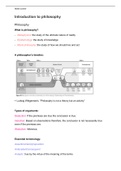
A philosopher’s timeline:
+ Ludwig Wittgenstein, “Philosophy is not a theory but an activity”
Types of arguments:
Deduction: If the premises are true the conclusion is true.
Induction: Based on observations therefore, the conclusion is not necessarily true
even if the premises are.
Abduction: Inference.
Essential terminology:
Assertion/claim/proposition
Antecedent/consequent
Analytic: true by the virtue of the meaning of the terms
,Abbie Leaver
Synthetic: non-analytic
A priori: something that can be known independently of experiencing
Posteriori: something that can’t be known independently of experiencing
Necessary: incapable of being false
Contingent: capable of being false
Consistent: repetitively the same
Inconsistent: not repetitively the same
Objective/subjective: based on opinion or not
Tautology: a statement that says the same thing twice
Dilemma: problem
Paradox: self contradictory?
Prove/proof: evidence that confirms a fact (verb/noun)
True/false: correct/incorrect
Justification: a point of evidence for a theory
Sound argument/proof: a logical and true argument
Deductive: If the premises are true, the conclusion must be true
Inductive: If the premises are true, the conclusion is probably true
3.1.1. What is knowledge
We use conceptual analysis to define things.
, Abbie Leaver
Conceptual analysis:
Getting clear about the precise meaning of some concept – knowing that a proposition is a
proposition
Propositional knowledge (knowing THAT)
Knowledge of propositions. A proposition can be defined as what is expressed by a declarative
statement.
Distinguish between propositions and statements:
The same proposition can be expressed by two statements.
o “Les lapins sont des oiseaux” and “rabbits are birds”
Different statements but the same proposition.
Two different propositions can be expressed by the same statement.
o When Charlotte and David say, “I am the president”
Same statements, different proposition.
“I” / “That” / “Now” are indexicals = mean different things depending on the
context of utterance
Basically, the proposition is the fact, the statement describes the fact.
Practical/ability knowledge (knowing HOW TO)
Knowing how to conduct an activity such as riding a bike.
Ability knowledge requires lots of propositional knowledge; you need to know many propositional
facts to know how to ride a bike.
Acquaintance knowledge (knowing A THING)
Knowing a person/place/language.
http://philosophyalevel.com/aqa-philosophy-revision-notes/#Epistemology
Linda Zagzebski
Knowledge is cognitive contact with reality.
Acquaintance Knowledge: Direct cognitive contact with reality.
Introduction to philosophy
Philosophy
What is philosophy?
- Metaphysics: the study of the ultimate nature of reality
- Epistemology: the study of knowledge
- Moral philosophy: the study of how we should live and act
A philosopher’s timeline:
+ Ludwig Wittgenstein, “Philosophy is not a theory but an activity”
Types of arguments:
Deduction: If the premises are true the conclusion is true.
Induction: Based on observations therefore, the conclusion is not necessarily true
even if the premises are.
Abduction: Inference.
Essential terminology:
Assertion/claim/proposition
Antecedent/consequent
Analytic: true by the virtue of the meaning of the terms
,Abbie Leaver
Synthetic: non-analytic
A priori: something that can be known independently of experiencing
Posteriori: something that can’t be known independently of experiencing
Necessary: incapable of being false
Contingent: capable of being false
Consistent: repetitively the same
Inconsistent: not repetitively the same
Objective/subjective: based on opinion or not
Tautology: a statement that says the same thing twice
Dilemma: problem
Paradox: self contradictory?
Prove/proof: evidence that confirms a fact (verb/noun)
True/false: correct/incorrect
Justification: a point of evidence for a theory
Sound argument/proof: a logical and true argument
Deductive: If the premises are true, the conclusion must be true
Inductive: If the premises are true, the conclusion is probably true
3.1.1. What is knowledge
We use conceptual analysis to define things.
, Abbie Leaver
Conceptual analysis:
Getting clear about the precise meaning of some concept – knowing that a proposition is a
proposition
Propositional knowledge (knowing THAT)
Knowledge of propositions. A proposition can be defined as what is expressed by a declarative
statement.
Distinguish between propositions and statements:
The same proposition can be expressed by two statements.
o “Les lapins sont des oiseaux” and “rabbits are birds”
Different statements but the same proposition.
Two different propositions can be expressed by the same statement.
o When Charlotte and David say, “I am the president”
Same statements, different proposition.
“I” / “That” / “Now” are indexicals = mean different things depending on the
context of utterance
Basically, the proposition is the fact, the statement describes the fact.
Practical/ability knowledge (knowing HOW TO)
Knowing how to conduct an activity such as riding a bike.
Ability knowledge requires lots of propositional knowledge; you need to know many propositional
facts to know how to ride a bike.
Acquaintance knowledge (knowing A THING)
Knowing a person/place/language.
http://philosophyalevel.com/aqa-philosophy-revision-notes/#Epistemology
Linda Zagzebski
Knowledge is cognitive contact with reality.
Acquaintance Knowledge: Direct cognitive contact with reality.