

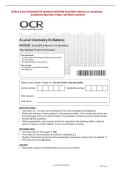
OCR A Level Chemistry B (Salters) H433/02 Scientific literacy in chemistry
Combined Question Paper and Mark Scheme
Oxford Cambridge and RSA
A Level Chemistry B (Salters)
H433/02 Scientific literacy in chemistry
Time allowed: 2 hours 15 minutes
You must have:
• a clean copy of the Advance Notice Article (inside
this document)
• the Data Sheet for Chemistry B
You can use:
• a scientific or graphical calculator
• an HB pencil
* H 4 3 3 0 2 *
Please write clearly in black ink. Do not write in the barcodes.
Centre number Candidate number
First name(s)
Last name
INSTRUCTIONS
• Use black ink. You can use an HB pencil, but only for graphs and diagrams.
• Write your answer to each question in the space provided. If you need extra space use
the lined page at the end of this booklet. The question numbers must be clearly shown.
• Answer all the questions.
• Where appropriate, your answer should be supported with working. Marks might be
given for using a correct method, even if your answer is wrong.
INFORMATION
• The total mark for this paper is 100.
• The marks for each question are shown in brackets [ ].
• Quality of extended response will be assessed in questions marked with an asterisk (*).
• This document has 20 pages.
ADVICE
• Read each question carefully before you start your answer.
DC (PQ/CT) 344767/6
OCR is an
, 3
1 This question is about reactions of haloalkanes.
(a) CH3Cl is made by plants that grow on marshes.
If CH3Cl reaches the stratosphere, electromagnetic radiation causes it to undergo homolytic
fission forming chlorine radicals.
(i) Give the systematic name of CH3Cl .
. ................................................................................................................................................... [1]
(ii) Draw ‘half curly arrows’ to show the mechanism of the homolytic fission of CH3Cl .
Show the products of the reaction.
H
H C Cl
H
[2]
(iii) Which type of electromagnetic radiation causes this homolytic fission to occur in the stratosphere?
. ................................................................................................................................................... [1]
(iv) The bond energy of the C–Cl bond is 346 kJ mol–1.
Calculate the wavelength (in m) of radiation which breaks this bond.
Give your answer to an appropriate number of significant figures.
Wavelength = ..................................................... m [5]
(v) Chlorine radicals catalyse the breakdown of ozone in the stratosphere.
Write equations to show how this occurs and give the overall equation.
Overall equation:
[2]
© OCR 2025 Turn over
, 2
(vi) Why is the breakdown of ozone in the stratosphere harmful to humans?
..........................................................................................................................................................
..........................................................................................................................................................
. ................................................................................................................................................... [2]
(b) CH3Cl reacts with ammonia to give an amine salt.
CH3Cl + NH3 CH3NH3Cl Equation 1.1
Ammonia is acting as a nucleophile here.
(i) Explain what is meant by the term nucleophile.
..........................................................................................................................................................
. ................................................................................................................................................... [1]
(ii) Show the mechanism of Equation 1.1.
Use curly arrows and show relevant lone pairs and the ionic products.
H
H C Cl
H
H N H
H
[2]
(iii) The product of Equation 1.1 is a salt of CH3NH2.
Give the systematic name for CH3NH2.
. ................................................................................................................................................... [1]
(c) The reaction between a haloalkane and hydroxide ions is a nucleophilic substitution reaction.
A student reacts 1-chlorobutane, 1-bromobutane and 1-iodobutane separately with aqueous
sodium hydroxide.
Which will react fastest and why?
..........................................................................................................................................................
..........................................................................................................................................................
. ................................................................................................................................................... [2]
© OCR 2025
, 4
2 Some students study the nitrogen compounds in the soil.
(a) How many neutrons are in an atom of 14N?
. ................................................................................................................................................... [1]
(b) The students make ammonia from a fertiliser containing NH4+ ions.
Identify the reagent that they use.
. ................................................................................................................................................... [1]
(c) The students add an aqueous solution of ammonia to a solution of FeSO4.
A precipitate forms.
Give the colour of the precipitate and write an ionic equation for its formation.
Include state symbols.
Colour: ..............................................................................................................................................
Ionic equation:
[3]
(d) The students read that ammonium ions are oxidised to NO2– by bacteria in the soil.
(i) Give the systematic name of NO 2–.
. ................................................................................................................................................... [1]
(ii) The students add acid to NaNO2(s) in a test tube.
A colourless gas A (with nitrogen in the +2 oxidation state) and NO 3– ions are produced.
Gas A turns to a brown gas B at the top of the test tube.
Suggest the formula of the brown gas B.
Suggest an ionic equation for the formation of gas A from acidified NO 2– ions.
Formula of brown gas B: ..................................................................................................................
Ionic equation:
[3]
© OCR 2025
Combined Question Paper and Mark Scheme
Oxford Cambridge and RSA
A Level Chemistry B (Salters)
H433/02 Scientific literacy in chemistry
Time allowed: 2 hours 15 minutes
You must have:
• a clean copy of the Advance Notice Article (inside
this document)
• the Data Sheet for Chemistry B
You can use:
• a scientific or graphical calculator
• an HB pencil
* H 4 3 3 0 2 *
Please write clearly in black ink. Do not write in the barcodes.
Centre number Candidate number
First name(s)
Last name
INSTRUCTIONS
• Use black ink. You can use an HB pencil, but only for graphs and diagrams.
• Write your answer to each question in the space provided. If you need extra space use
the lined page at the end of this booklet. The question numbers must be clearly shown.
• Answer all the questions.
• Where appropriate, your answer should be supported with working. Marks might be
given for using a correct method, even if your answer is wrong.
INFORMATION
• The total mark for this paper is 100.
• The marks for each question are shown in brackets [ ].
• Quality of extended response will be assessed in questions marked with an asterisk (*).
• This document has 20 pages.
ADVICE
• Read each question carefully before you start your answer.
DC (PQ/CT) 344767/6
OCR is an
, 3
1 This question is about reactions of haloalkanes.
(a) CH3Cl is made by plants that grow on marshes.
If CH3Cl reaches the stratosphere, electromagnetic radiation causes it to undergo homolytic
fission forming chlorine radicals.
(i) Give the systematic name of CH3Cl .
. ................................................................................................................................................... [1]
(ii) Draw ‘half curly arrows’ to show the mechanism of the homolytic fission of CH3Cl .
Show the products of the reaction.
H
H C Cl
H
[2]
(iii) Which type of electromagnetic radiation causes this homolytic fission to occur in the stratosphere?
. ................................................................................................................................................... [1]
(iv) The bond energy of the C–Cl bond is 346 kJ mol–1.
Calculate the wavelength (in m) of radiation which breaks this bond.
Give your answer to an appropriate number of significant figures.
Wavelength = ..................................................... m [5]
(v) Chlorine radicals catalyse the breakdown of ozone in the stratosphere.
Write equations to show how this occurs and give the overall equation.
Overall equation:
[2]
© OCR 2025 Turn over
, 2
(vi) Why is the breakdown of ozone in the stratosphere harmful to humans?
..........................................................................................................................................................
..........................................................................................................................................................
. ................................................................................................................................................... [2]
(b) CH3Cl reacts with ammonia to give an amine salt.
CH3Cl + NH3 CH3NH3Cl Equation 1.1
Ammonia is acting as a nucleophile here.
(i) Explain what is meant by the term nucleophile.
..........................................................................................................................................................
. ................................................................................................................................................... [1]
(ii) Show the mechanism of Equation 1.1.
Use curly arrows and show relevant lone pairs and the ionic products.
H
H C Cl
H
H N H
H
[2]
(iii) The product of Equation 1.1 is a salt of CH3NH2.
Give the systematic name for CH3NH2.
. ................................................................................................................................................... [1]
(c) The reaction between a haloalkane and hydroxide ions is a nucleophilic substitution reaction.
A student reacts 1-chlorobutane, 1-bromobutane and 1-iodobutane separately with aqueous
sodium hydroxide.
Which will react fastest and why?
..........................................................................................................................................................
..........................................................................................................................................................
. ................................................................................................................................................... [2]
© OCR 2025
, 4
2 Some students study the nitrogen compounds in the soil.
(a) How many neutrons are in an atom of 14N?
. ................................................................................................................................................... [1]
(b) The students make ammonia from a fertiliser containing NH4+ ions.
Identify the reagent that they use.
. ................................................................................................................................................... [1]
(c) The students add an aqueous solution of ammonia to a solution of FeSO4.
A precipitate forms.
Give the colour of the precipitate and write an ionic equation for its formation.
Include state symbols.
Colour: ..............................................................................................................................................
Ionic equation:
[3]
(d) The students read that ammonium ions are oxidised to NO2– by bacteria in the soil.
(i) Give the systematic name of NO 2–.
. ................................................................................................................................................... [1]
(ii) The students add acid to NaNO2(s) in a test tube.
A colourless gas A (with nitrogen in the +2 oxidation state) and NO 3– ions are produced.
Gas A turns to a brown gas B at the top of the test tube.
Suggest the formula of the brown gas B.
Suggest an ionic equation for the formation of gas A from acidified NO 2– ions.
Formula of brown gas B: ..................................................................................................................
Ionic equation:
[3]
© OCR 2025


