

Study Guide
for
Human Anatomy 231
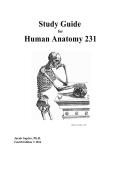
Andreas Vesalius, 1543
Jacob Sapiro, Ph.D.
Fourth Edition © 2016
, Table of Contents
How to use this study guide................... 2
The Language of Anatomy.......................3
Section I: Lecture Study Guide
Cells and Tissues ................................. 9
Integumentary System .......................... 13
Skeletal System .................................... 16
Articulations ......................................... 18
Muscular System .................................. 20
Circulatory System ................................ 23
Respiratory System ............................... 29
Nervous System...................................... 31
Sense Organs ......................................... 37
Endocrine System .................................. 40
Digestive System ................................... 41
Urinary System ...................................... 47
Male Reproductive System ................... 50
Female Reproductive System ................ 52
Development ......................................... 55
Section II: Laboratory Study Guide
Microscopy............................................ 57
Skeletal System
Appendicular Skeleton ............. 60
Axial Skeleton .......................... 64
Types Movement ................................... 69
Major Surface Landmarks ..................... 70
Muscular System ................................... 71
Cardiovascular system........................... 79
Nervous System..................................... 81
Thoracic Cavity .................................... 84
Abdominal Cavity ................................ 85
Reproductive System ............................ 87
Development ......................................... 89
1
, How to use this Study Guide
The purpose of this study guide is to facilitate your studying by giving you lists of many of the terms
and structures that you will be responsible for knowing. This study guide is divided into two parts. The first
part is intended primarily for use in lecture and the second part is intended primarily for use in lab. Probably
the single most important section of this study guide is the lists of clinical terms and drawings in each review
section. A significant portion of every lecture exam will ask you to explain the anatomical basis and clinical
significance of these terms. Also every exam will ask you to draw and label specific structures. The lab
portion of the study guide consists mostly of the terms you will be responsible for knowing on the lab exams.
During the lab exams you will be expected to identify the various structures of the body and understand why
they are important.
This study guide does not contain all of the information you will need to know for this class. There
are many other terms and concepts that will be given to you in lecture and lab that you will be responsible
for. I do not teach directly from the textbook. You do not need to read the textbook before you come to class.
Your best sources for what you need to know are the lectures and lab sessions. Even though I do not test
from the textbook, it is an important resource for helping you understand Anatomy. You will be expected
to bring the textbook with you to every lab. By the time you take a test, there should be no doubt in your
mind about what you need to know to get an A in the class. While I cannot guarantee that you will get an A,
if you work hard enough, and if you know how to study, you will do well. Simply memorizing these terms
will give you as much knowledge of Anatomy as memorizing the phone book will give you knowledge of
the people listed therein. Anatomy is not about memorizing names; it is about understanding the structure
of the human body. Your goals should be to understand the structural and functional importance of these
terms. If you only memorize definitions, you will earn, at best, a C. Too many students assume that this
course is like other classes where reading the notes three or four times before a test is sufficient to get a
passing grade. Could you pass a math class by merely reading over your notes? In this class you will need
to be able to do Anatomy, which takes understanding the principles and concepts, not just memorization.
As you look through this study guide, you will be overwhelmed by the number of terms and concepts
you will need to learn for this class. Don’t worry, students can, and do pass this course. The students who
will pass this class are the ones who make a commitment of time and effort. This course should be one of
the most important things in your life this semester. The only way to be able to learn this much material is
to study at least an hour or two every single day for lecture and an additional hour or two every day for lab.
If you start studying a week before the test, you will fail the test. If you fall behind, you will never be able
to catch up.
At the end of each section in the study guide are sample questions that are similar to the questions
on the exam. You can get help, if you are having trouble answering these questions, during office hours or
review sessions. Understand that sample questions are there just to give you an idea of what might be on the
exam; these questions may not appear on the exam. Also, in the review section are some drawing
assignments. At least one drawing will be required on each exam. It is highly recommended that you practice
these drawings at home and bring them in to be evaluated before the exam. Students have found these
drawings extremely helpful, so if you put a little effort into doing them, you will be rewarded with better
grades. In addition to this study guide, you will find copies of old exams on my website.
2
, Introduction to the Language of Anatomy
Anatomy is the language of health care. Learning Anatomy is like learning a new language. Anatomy
has its own vocabulary, which is sometimes different from English – for example: there is no such thing as
a “cheek bone” or “hip bone.” Likewise, words are sometimes used differently in Anatomy; the “arm” in
Anatomy includes only the region from the shoulder to the elbow; it is not the entire limb.
When learning a new language, it is not enough to merely memorize definitions. One needs to learn
how words are used. If you were given a French-English dictionary, would you be able to speak French?
Likewise, in this class, you need to understand how words are used, you need to understand how to form
plurals, you need to recognize the genitive forms of nouns, you need to be able to distinguish between
adjectives and nouns, etc.
The number of new terms you will encounter this semester will depend on your language skills
coming into the class. If you are fluent in English or Spanish (for example, if you scored above 750 in both
the reading and writing portions of the SAT), you may only have 600 - 700 new terms to learn. If however,
you are a more typical student, you may have more than 1,600 - 1,800 new terms to learn in this class. That
comes out to more than 100 new terms per week for a full-length semester!
While there are many hundreds of new terms for you to learn in this class, that is not as onerous as
it seems. The parts of the body are all named for where they are, what they look like, or what they do.
Therefore, if you understand what the name means, you already understand some important fact about that
structure. Most anatomical terms are based on just a few dozen prefixes, suffixes and roots. Almost all
anatomical terms are either English words or words derived from Greek or Latin. If you learn the root of a
word, you will have a much easier time. For example, the word “rectus” is Latin for “straight.” If you know
that, then you will know that the rectus abdominis muscle is the straight muscle of the abdomen; the erector
spinae muscle straightens the spine; the rectum of the large intestine is the straight portion of the large
intestine, etc.
Anatomy Course Objectives
This course is specifically designed for pre-health profession students. You will be learning the
Anatomy you will need to know as a health care provider. By the end of the semester, you will be
expected to:
1. Understand the concepts related to the organization and structure of the body
2. Know the language of health care
3. Be able to relate structure and function
4. Understand the anatomical basis of common diseases and conditions
5. Learn the study skills that will enable you to continue your studies toward a career in health care
3
for
Human Anatomy 231
Andreas Vesalius, 1543
Jacob Sapiro, Ph.D.
Fourth Edition © 2016
, Table of Contents
How to use this study guide................... 2
The Language of Anatomy.......................3
Section I: Lecture Study Guide
Cells and Tissues ................................. 9
Integumentary System .......................... 13
Skeletal System .................................... 16
Articulations ......................................... 18
Muscular System .................................. 20
Circulatory System ................................ 23
Respiratory System ............................... 29
Nervous System...................................... 31
Sense Organs ......................................... 37
Endocrine System .................................. 40
Digestive System ................................... 41
Urinary System ...................................... 47
Male Reproductive System ................... 50
Female Reproductive System ................ 52
Development ......................................... 55
Section II: Laboratory Study Guide
Microscopy............................................ 57
Skeletal System
Appendicular Skeleton ............. 60
Axial Skeleton .......................... 64
Types Movement ................................... 69
Major Surface Landmarks ..................... 70
Muscular System ................................... 71
Cardiovascular system........................... 79
Nervous System..................................... 81
Thoracic Cavity .................................... 84
Abdominal Cavity ................................ 85
Reproductive System ............................ 87
Development ......................................... 89
1
, How to use this Study Guide
The purpose of this study guide is to facilitate your studying by giving you lists of many of the terms
and structures that you will be responsible for knowing. This study guide is divided into two parts. The first
part is intended primarily for use in lecture and the second part is intended primarily for use in lab. Probably
the single most important section of this study guide is the lists of clinical terms and drawings in each review
section. A significant portion of every lecture exam will ask you to explain the anatomical basis and clinical
significance of these terms. Also every exam will ask you to draw and label specific structures. The lab
portion of the study guide consists mostly of the terms you will be responsible for knowing on the lab exams.
During the lab exams you will be expected to identify the various structures of the body and understand why
they are important.
This study guide does not contain all of the information you will need to know for this class. There
are many other terms and concepts that will be given to you in lecture and lab that you will be responsible
for. I do not teach directly from the textbook. You do not need to read the textbook before you come to class.
Your best sources for what you need to know are the lectures and lab sessions. Even though I do not test
from the textbook, it is an important resource for helping you understand Anatomy. You will be expected
to bring the textbook with you to every lab. By the time you take a test, there should be no doubt in your
mind about what you need to know to get an A in the class. While I cannot guarantee that you will get an A,
if you work hard enough, and if you know how to study, you will do well. Simply memorizing these terms
will give you as much knowledge of Anatomy as memorizing the phone book will give you knowledge of
the people listed therein. Anatomy is not about memorizing names; it is about understanding the structure
of the human body. Your goals should be to understand the structural and functional importance of these
terms. If you only memorize definitions, you will earn, at best, a C. Too many students assume that this
course is like other classes where reading the notes three or four times before a test is sufficient to get a
passing grade. Could you pass a math class by merely reading over your notes? In this class you will need
to be able to do Anatomy, which takes understanding the principles and concepts, not just memorization.
As you look through this study guide, you will be overwhelmed by the number of terms and concepts
you will need to learn for this class. Don’t worry, students can, and do pass this course. The students who
will pass this class are the ones who make a commitment of time and effort. This course should be one of
the most important things in your life this semester. The only way to be able to learn this much material is
to study at least an hour or two every single day for lecture and an additional hour or two every day for lab.
If you start studying a week before the test, you will fail the test. If you fall behind, you will never be able
to catch up.
At the end of each section in the study guide are sample questions that are similar to the questions
on the exam. You can get help, if you are having trouble answering these questions, during office hours or
review sessions. Understand that sample questions are there just to give you an idea of what might be on the
exam; these questions may not appear on the exam. Also, in the review section are some drawing
assignments. At least one drawing will be required on each exam. It is highly recommended that you practice
these drawings at home and bring them in to be evaluated before the exam. Students have found these
drawings extremely helpful, so if you put a little effort into doing them, you will be rewarded with better
grades. In addition to this study guide, you will find copies of old exams on my website.
2
, Introduction to the Language of Anatomy
Anatomy is the language of health care. Learning Anatomy is like learning a new language. Anatomy
has its own vocabulary, which is sometimes different from English – for example: there is no such thing as
a “cheek bone” or “hip bone.” Likewise, words are sometimes used differently in Anatomy; the “arm” in
Anatomy includes only the region from the shoulder to the elbow; it is not the entire limb.
When learning a new language, it is not enough to merely memorize definitions. One needs to learn
how words are used. If you were given a French-English dictionary, would you be able to speak French?
Likewise, in this class, you need to understand how words are used, you need to understand how to form
plurals, you need to recognize the genitive forms of nouns, you need to be able to distinguish between
adjectives and nouns, etc.
The number of new terms you will encounter this semester will depend on your language skills
coming into the class. If you are fluent in English or Spanish (for example, if you scored above 750 in both
the reading and writing portions of the SAT), you may only have 600 - 700 new terms to learn. If however,
you are a more typical student, you may have more than 1,600 - 1,800 new terms to learn in this class. That
comes out to more than 100 new terms per week for a full-length semester!
While there are many hundreds of new terms for you to learn in this class, that is not as onerous as
it seems. The parts of the body are all named for where they are, what they look like, or what they do.
Therefore, if you understand what the name means, you already understand some important fact about that
structure. Most anatomical terms are based on just a few dozen prefixes, suffixes and roots. Almost all
anatomical terms are either English words or words derived from Greek or Latin. If you learn the root of a
word, you will have a much easier time. For example, the word “rectus” is Latin for “straight.” If you know
that, then you will know that the rectus abdominis muscle is the straight muscle of the abdomen; the erector
spinae muscle straightens the spine; the rectum of the large intestine is the straight portion of the large
intestine, etc.
Anatomy Course Objectives
This course is specifically designed for pre-health profession students. You will be learning the
Anatomy you will need to know as a health care provider. By the end of the semester, you will be
expected to:
1. Understand the concepts related to the organization and structure of the body
2. Know the language of health care
3. Be able to relate structure and function
4. Understand the anatomical basis of common diseases and conditions
5. Learn the study skills that will enable you to continue your studies toward a career in health care
3


