
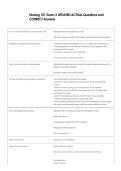
Nursing 101 Exam 3 UPDATED ACTUAL Questions and
CORRECT Answers
The use of one's personality and communication skills Hildegard Peplau's "therapeutic use of self"
Helpful with relating to patients, their families and other healthcare professionals
Traditional nurse-patient relationship phases 1. Orientation-Introductory "getting to know you", begins with developing trust
2. Working-address the tasks outlined in orientation phase; regression often
precedes positive change
3. Termination -therapeutic end to relationship
*each phase builds on the previous phase
these factors are involved in self awareness Professional boundaries- spaces between the nurse's professional power and the
patient's vulnerability (NCSBN)
Boundary violations-male nurse example
Principles for determining professional boundaries -nurse responsible for maintaining boundaries
-work within a zone of helpfulness. Not too aloof and not too emotionally
involved
-examine boundary crossing, aware of implications, avoid repeating
-care setting, community influences, client needs and nature of therapy affect
outlining of boundaries
-actions that overstep boundaries to meet the need of nurse is violation
-avoid duel relationships (business and friendship both)
-it may be difficult to determine when nurse-client relationship is truly terminated
with post-termination relationships. (client may need additional services)
Tips on developing self awareness: distinguish their own emotional needs from their patients' needs
Reflective practice
No stereotypes - ANA Code of Ethics provision 1
Nonjudgemental acceptance
Patient centered care
Patient centered care caring and human relatedness
Types of Communication Verbal-all forms of speech
Nonverbal- primary means of communicating feelings and emotions.
Facial expression
Body movement
, Proxemics
Personal appearance
Vocal cues
Pacing
Touch
Therapeutic communication: Bedside Manner
-connection between patient and a care provider. Ensures -patients understand
their conditions and recommend course of treatment.
-Consciously think about word choices, body language, tone and other signals.
Effects of touch Decrease heart rate
Increase muscle relaxation
Increase rapport between caregiver and patient
Increase response to treatment
Successful communication involves Feedback-reciever relays to sender effect of senders message
Appropriateness-when reply fits circumstances and matches message.
-may need to alter your question from "how are you" to something more specific
to get an appropriate answer.
Efficiency-simple clear words timed at a pace suitable to participants
Flexibility-base messages on immediate situation rather than preconceived
expectations.
ex: nursing student who prepares to teach patient about diabetes but enters room
to find them crying- first address the immediate situation
Active listening involves: a nonjudgemental acknowledgement of feelings where nurse communicates
interest and attention
Attention: physical attending skills (most powerful single communication skill)
Reception: psychological attending; listening to all three sources of the message
Perception - putting it all together; identifying the talkers feelings that are related
to their experience
Helpful responses to a patient (therapeutic Empathy
communication) Open ended questions
Giving information
Silence
Reflection,paraphrase
Different language (common words or pictures)
, Communication breakdown can be caused by: Asking a patient "why are you doing this?"
Failing to see uniqueness
Using cliches and value statements
False reassurance
Failing to clarify
Questions that: ask why, are close-ended, are leading
How to use electronic communication devises effectively pay attention to patient!
leave them area to take calls
be courteous in emails
avoid jargon
short messages
enunciate return phone numbers on voicemail
read, listen and evaluate entire messages before responding
Key components for effective professional collaboration: -respect collaborators
-be confident in your knowledge
-willing to learn
-cooperative
-common purpose
-value contributions of other disciplines
-willing to negotiate
-good communication skills
-self awareness (bias etc)
-tolerance
-not threatened
-know your own limits
Interdisciplinary learning involves: learning others roles and contributions
reducing stereotypes
reduce misconceptions about the value of other roles
Skills in conflict resolution: -acknowledge conflict
-recognize positives that can result
-facilitate debate over tasks and redirect away from personal concerns
-promote expression of different perspectives
-monitor tone of voice, eye contact, defensive nonverbal posture
-avoid locking into fixed position
-share power
-stay focused on outcome
if a conflict arises go chat with the person directly
SBAR introduction
S = situation
CORRECT Answers
The use of one's personality and communication skills Hildegard Peplau's "therapeutic use of self"
Helpful with relating to patients, their families and other healthcare professionals
Traditional nurse-patient relationship phases 1. Orientation-Introductory "getting to know you", begins with developing trust
2. Working-address the tasks outlined in orientation phase; regression often
precedes positive change
3. Termination -therapeutic end to relationship
*each phase builds on the previous phase
these factors are involved in self awareness Professional boundaries- spaces between the nurse's professional power and the
patient's vulnerability (NCSBN)
Boundary violations-male nurse example
Principles for determining professional boundaries -nurse responsible for maintaining boundaries
-work within a zone of helpfulness. Not too aloof and not too emotionally
involved
-examine boundary crossing, aware of implications, avoid repeating
-care setting, community influences, client needs and nature of therapy affect
outlining of boundaries
-actions that overstep boundaries to meet the need of nurse is violation
-avoid duel relationships (business and friendship both)
-it may be difficult to determine when nurse-client relationship is truly terminated
with post-termination relationships. (client may need additional services)
Tips on developing self awareness: distinguish their own emotional needs from their patients' needs
Reflective practice
No stereotypes - ANA Code of Ethics provision 1
Nonjudgemental acceptance
Patient centered care
Patient centered care caring and human relatedness
Types of Communication Verbal-all forms of speech
Nonverbal- primary means of communicating feelings and emotions.
Facial expression
Body movement
, Proxemics
Personal appearance
Vocal cues
Pacing
Touch
Therapeutic communication: Bedside Manner
-connection between patient and a care provider. Ensures -patients understand
their conditions and recommend course of treatment.
-Consciously think about word choices, body language, tone and other signals.
Effects of touch Decrease heart rate
Increase muscle relaxation
Increase rapport between caregiver and patient
Increase response to treatment
Successful communication involves Feedback-reciever relays to sender effect of senders message
Appropriateness-when reply fits circumstances and matches message.
-may need to alter your question from "how are you" to something more specific
to get an appropriate answer.
Efficiency-simple clear words timed at a pace suitable to participants
Flexibility-base messages on immediate situation rather than preconceived
expectations.
ex: nursing student who prepares to teach patient about diabetes but enters room
to find them crying- first address the immediate situation
Active listening involves: a nonjudgemental acknowledgement of feelings where nurse communicates
interest and attention
Attention: physical attending skills (most powerful single communication skill)
Reception: psychological attending; listening to all three sources of the message
Perception - putting it all together; identifying the talkers feelings that are related
to their experience
Helpful responses to a patient (therapeutic Empathy
communication) Open ended questions
Giving information
Silence
Reflection,paraphrase
Different language (common words or pictures)
, Communication breakdown can be caused by: Asking a patient "why are you doing this?"
Failing to see uniqueness
Using cliches and value statements
False reassurance
Failing to clarify
Questions that: ask why, are close-ended, are leading
How to use electronic communication devises effectively pay attention to patient!
leave them area to take calls
be courteous in emails
avoid jargon
short messages
enunciate return phone numbers on voicemail
read, listen and evaluate entire messages before responding
Key components for effective professional collaboration: -respect collaborators
-be confident in your knowledge
-willing to learn
-cooperative
-common purpose
-value contributions of other disciplines
-willing to negotiate
-good communication skills
-self awareness (bias etc)
-tolerance
-not threatened
-know your own limits
Interdisciplinary learning involves: learning others roles and contributions
reducing stereotypes
reduce misconceptions about the value of other roles
Skills in conflict resolution: -acknowledge conflict
-recognize positives that can result
-facilitate debate over tasks and redirect away from personal concerns
-promote expression of different perspectives
-monitor tone of voice, eye contact, defensive nonverbal posture
-avoid locking into fixed position
-share power
-stay focused on outcome
if a conflict arises go chat with the person directly
SBAR introduction
S = situation


