
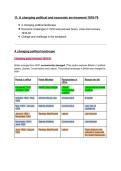
11. A changing political and economic environment 1918-79
❖ A changing political landscape
❖Economic challenges in 1918 and post-war boom, crisis and recovery
1918-39
❖ Change and challenge in the workplace
A changing political landscape
Changing party fortunes 1918-31
Britain emerged from WW1 economically damaged. (This section explores Britain’s 3 political
parties, Liberals, Conservatives and Labour). The political landscape in Britain was changed by
WW1
Period in office Prime Minister Party/parties in Reason for fall
office
December 1918 David Lloyd George Liberal - Conservatives ended
-October 1922 Conservative coalition
coalition
October 1922 - May Andrew Bonar Law Conservative Ill health
1923
May 1923 - January Stanley Baldwin Conservative Lost vote of
1924 confidence
January 1924 - Ramsay MacDonald Labour Lost election
November 1924
November 1924 - Stanley Baldwin Conservative Lost election
June 1929
June 1929 - August Ramsay MacDonald Labour Party division over
1931 policies to cope with
the Great Depression
,The Liberal Party in 1918
They believed in free trade and a limited role for government. They were a part of social
reform. They implemented state pensions, unemployment relief and the beginning of
state-provided healthcare.
→ Before WW1, they dominated British politics. After 1918, the problems of Ireland and trade
union unrest returned and most of the Liberal party voters (middle class and artisan working
class) began to decline. The perceived party of social reform in Britain became the Labour
Party.
The experience of the war divided the Liberals:
➔ The war resulted in a coalition with the Conservative Party from 1915 onwards
➔ Some MPs resigned because they refused conscription (compulsory military service)
➔ The election of 1918, Lloyd George campaigned against many members of the
Liberal Party. This split the party’s vote and they never recovered.
The Labour Party in 1918
The party had close ties to the unions who saw it as a useful tool in advancing working men’s
pay and conditions. The party split in 1914 about whether to go to war as most of their
supporters were pacifists.
➔ Wartime made the ‘socialist ideas’ of state control more accepted
➔ The war also led to the Representation of the People Act 1918 which provided more
working-class votes for the party
The Conservative Party in 1918
By the end of WW1, they presented themselves as a party of the middle classes and the
working-classes who aspired to ‘better’ themselves through property ownership.
→ A large proportion of their votes in 1918 came from newly enfranchised women
The decline of the Liberal Party
Elections
Both the 1918 and 1922 elections were important in understanding the decline of the
Liberal Party.
➔ By 1918, Lloyd George split the party.
1918 election results: Coalition Liberals (George) got 1.4 million votes, Conservatives got 4.14
million votes (they won)
● Conservatives decided not to govern on their own, they made George prime minister.
This is because they want to play safe as they just got out of the war and gave the
responsibility to him.
The history behind George and Asquith split:
● Asquith was prime minister in 1914 during the outbreak of the WW1 and George was the
Chancellor of the Exchequer
● Many were dissatisfied by how Asquith handled the war, so many began to support
George as a potential replacement of Asquith
, ● George resigned which caused a political crisis. Asquith rejected one of George’s idea
that he initially accepted. Asquith resigned 1916, so George became prime minister,
forming a coalition with the Conservatives
● This caused a deep split within the Liberal Party. George’s supporters (often referred to
as Coalition Liberals) formed a new government
This weakened the Liberal Party.
Knighthood scandal 1922→ He was involved in selling knighthoods. Titles had been sold by
government ministers to their supporters, but were done discreetly. He sold over 1,500
knighthoods during his reign as prime minister
Carlton Club→ A secret meeting of the Conservatives happened here and they decided to
abandon the coalition with the Liberals.
THEREFORE, George was partly responsible for the cause of the Liberals decline
1918 election results: Conservatives won
At this point, Labour increased support and they replaced the Liberals.
Democracy
Many Liberals saw George as a traitor to the party and continued to support Asquith as
Liberal Leader, the party was split and failed to reunite in time for the 1918 election.
‘Maurice debate’
Maurice wrote a public letter that accused George of lying to parliament about the numbers
of British troops on the Western Front.
→ George was forced to resign as prime minister 1922.
→ George got a lot of money from the selling of the knighthoods and refused to share any of it
with the Liberal Party until many of them supported Asquith. Without this money, the
Liberals couldn’t maintain the party and he only shared a bit when Asquith stepped down in
1926, but it was too late at this point because Labour replaced them.
First past the post= Candidate receiving the highest number of votes in a constituency is
returned to parliament.
Proportional representation= percentage of seats allocated to a party in parliament matches
the percentage of votes gained in an election.
The rise of the Labour Party
Trade unions and moderate leadership
MacDonald became the first Labour prime minister. Labour became the largest parliamentary
party in 1929 and MacDonald became prime minister for the 2nd time. There are many
reasons for this rise.
➔ Unions funded the party from membership fees, so Labour ran a successful local
political machine and the war led to a huge growth in trade union membership.
➔ Many argued that Labour’s ability to represent the working-class helped them to
win supporters from the Liberals.


