

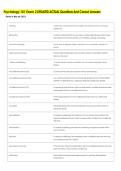
Psychology 101 Exam 2 UPDATED ACTUAL Questions And Correct Answers
Terms in this set (101)
Learning A systematic, relatively permanent change in the behavior that occurs through
experience.
Behaviorism Is a theory of learning that focuses solely on observable behaviors, discounting
the importance of mental activity such as thinking, wishing, and hoping.
Associative learning Occurs when as organism makes a connection, or an association, between to
events.
Observational learning. The learning that takes place when a person observes and imitates another's
behavior. Bandura
Classical conditioning A neutral stimulus becomes associated with an innately meaningful stimulus.
Watson
Unconditioned stimulus (US) Is a stimulus that produces a response without prior learning.
Unconditioned response (UR) Is an unlearned reaction that is automatically elicited by the US. INVOLUNTARY,
HAPPEN IN RESPONSE TO A STIMULUS WITHOUT CONSCIOUS EFFORT.
Conditioned stimulus (CS) Is a previously neutral stimulus that eventually elicits a conditioned response after
being paired with the unconditioned stimulus.
Conditioned response (CR) Is the learned response to the conditioned stimulus that occurs after CS-US
pairing.
Acquisition The initial learning of the connection between the US and CS when these two
stimuli are paired.
Generalization In classical conditioning is the tendency of a new stimulus that is similar to the
original conditioned stimulus to elicit a response that is similar to the conditioned
response.
Discrimination In classical conditioning is the process of learning to respond to certain stimuli
and not others.
Extinction In classical conditioning is the weakening of the conditioned response when the
unconditioned stimulus is absent.
Spontaneous recovery is the process in classical conditioning by which a conditioned response can recur
after time delay, without further conditioning.
Habituation Which refers to the decreased responsiveness to a stimulus after repeated
presentations.
, Operant conditioning A form of associative learning in which the consequences of a behavior change
the probability of the behavior's occurrence. Skinner
Shaping Refers to rewarding successive approximations of a desired behavior.
Reinforcement The process by which a stimulus or event following a particular behavior increases
the probability that the behavior will happen again.
Positive reinforcement The frequency of a behavior increases because it is followed by a desirable
stimulus.
Negative reinforcement The frequency of a behavior increases because it is followed by the removal of
something undesirable.
Avoidance learning Occurs when the organism learns that by making a particular response, a negative
stimulus can be altogether avoided.
Learned helplessness The organism has learned that it has no control over negative outcomes.
Primary reinforcer Is innately satisfying: that is, a primary reinforcer does not take any learning on the
organism's part to make it pleasurable.
Secondary reinforcer Acquires its positive value through an organism's experience; a secondary
reinforcer is a learned or conditioned reinforcer.
Schedules of reinforcement Are specific patterns that determine when a behavior will be reinforced.
Fixed ratio, variable ratio, fixed interval, and variable interval.
Punishment A consequence tat decreases the likelihood that a behavior will occur.
Insight learning A form of problem solving in which the organism develops a sudden insight into
or understanding of a problem's solution. Kohler
Memory The retention of information or experience over time.
Levels of processing A continuum from shallow to intermediate to deep.
Elaboration The formation of a number of different connections around a stimulus at any given
level of memory encoding.
Storage Encompasses how information is retained over time and how it is represented in
memory.
Atkinson-Shiffrin theory states that memory storage involves three separate systems: Sensory memory,
short-term memory, and long-term memory.
Sensory memory Holds information from the world in its original sensory form for only an instant,
not much longer than the brief time it is exposed to the visual, auditory, and other
senses.
Terms in this set (101)
Learning A systematic, relatively permanent change in the behavior that occurs through
experience.
Behaviorism Is a theory of learning that focuses solely on observable behaviors, discounting
the importance of mental activity such as thinking, wishing, and hoping.
Associative learning Occurs when as organism makes a connection, or an association, between to
events.
Observational learning. The learning that takes place when a person observes and imitates another's
behavior. Bandura
Classical conditioning A neutral stimulus becomes associated with an innately meaningful stimulus.
Watson
Unconditioned stimulus (US) Is a stimulus that produces a response without prior learning.
Unconditioned response (UR) Is an unlearned reaction that is automatically elicited by the US. INVOLUNTARY,
HAPPEN IN RESPONSE TO A STIMULUS WITHOUT CONSCIOUS EFFORT.
Conditioned stimulus (CS) Is a previously neutral stimulus that eventually elicits a conditioned response after
being paired with the unconditioned stimulus.
Conditioned response (CR) Is the learned response to the conditioned stimulus that occurs after CS-US
pairing.
Acquisition The initial learning of the connection between the US and CS when these two
stimuli are paired.
Generalization In classical conditioning is the tendency of a new stimulus that is similar to the
original conditioned stimulus to elicit a response that is similar to the conditioned
response.
Discrimination In classical conditioning is the process of learning to respond to certain stimuli
and not others.
Extinction In classical conditioning is the weakening of the conditioned response when the
unconditioned stimulus is absent.
Spontaneous recovery is the process in classical conditioning by which a conditioned response can recur
after time delay, without further conditioning.
Habituation Which refers to the decreased responsiveness to a stimulus after repeated
presentations.
, Operant conditioning A form of associative learning in which the consequences of a behavior change
the probability of the behavior's occurrence. Skinner
Shaping Refers to rewarding successive approximations of a desired behavior.
Reinforcement The process by which a stimulus or event following a particular behavior increases
the probability that the behavior will happen again.
Positive reinforcement The frequency of a behavior increases because it is followed by a desirable
stimulus.
Negative reinforcement The frequency of a behavior increases because it is followed by the removal of
something undesirable.
Avoidance learning Occurs when the organism learns that by making a particular response, a negative
stimulus can be altogether avoided.
Learned helplessness The organism has learned that it has no control over negative outcomes.
Primary reinforcer Is innately satisfying: that is, a primary reinforcer does not take any learning on the
organism's part to make it pleasurable.
Secondary reinforcer Acquires its positive value through an organism's experience; a secondary
reinforcer is a learned or conditioned reinforcer.
Schedules of reinforcement Are specific patterns that determine when a behavior will be reinforced.
Fixed ratio, variable ratio, fixed interval, and variable interval.
Punishment A consequence tat decreases the likelihood that a behavior will occur.
Insight learning A form of problem solving in which the organism develops a sudden insight into
or understanding of a problem's solution. Kohler
Memory The retention of information or experience over time.
Levels of processing A continuum from shallow to intermediate to deep.
Elaboration The formation of a number of different connections around a stimulus at any given
level of memory encoding.
Storage Encompasses how information is retained over time and how it is represented in
memory.
Atkinson-Shiffrin theory states that memory storage involves three separate systems: Sensory memory,
short-term memory, and long-term memory.
Sensory memory Holds information from the world in its original sensory form for only an instant,
not much longer than the brief time it is exposed to the visual, auditory, and other
senses.


