

univ 101 study guide set UPDATED ACTUAL Questions And Correct Answers
Terms in this set (73)
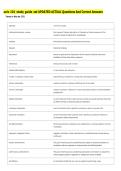
abstract overview of study
introduction/literature review Past research findings description of Concepts or theories purpose of the
research research questions or hypotheses
method Participants procedures questionnaires and surveys
Results Statistical findings
discussion Results in general terms implications of the research practical importance
limitations of the study future research
references listing of all sources used in article
Practice APA citations In text citations and references
4 steps in creating a research topic brainstorming, concept tree, writing style, developing a thesis
Intrinsic motivation a desire to perform a behavior effectively for its own sake
extrinsic motivation a desire to perform a behavior to receive promised rewards or avoid threatened
punishment
Global motivation Level of motivation that reveals a person's tendency towards activities influenced
by either intrinsic or extrinsic types of motivation
contextual motivation level of motivation that is specific to a domain or area in a person's life
situational motivation Level of motivation within a domain that is specific to a particular instance or
circumstance within that domain
self determination Perceiving autonomy competence and relatedness in a strong related to intrinsic
motivation
organismic integration theory Suggests motivation is best understood as a multidimensional concept along a
continuum
mastery achievement The goal of learning and accomplishing tasks based on personal standards of
excellence with an emphasis on Improvement and skill acquisition
performance achievement The goal of learning and accomplishing task based on the desire to outperform
others display Superior capability or validate one sense of ability
self efficacy An individual's belief that he or she is capable of performing a task.
, self efficacy beliefs are learned through Mastery experiences social modeling verbal persuasion and emotional arousal
attribution theory A Persons assumed cause for success or failure can influence motivation and
achievement
Three causal dimensions Locus of casualty, stability, and control ability
Locus of casualty the perceived source of an event's cause, determining whether it is seen as
internal (originating from within the individual, like effort or ability) or external
(originating from outside the individual, like luck or circumstance)
Stability attribution refers to how permanent a cause of success or failure is perceived to be. Stable
causes are seen as relatively permanent, such as ability or personality traits, while
unstable causes are considered temporary, like luck, mood, or effort for a specific
task
Control ability the dimension of causality that refers to the extent to which an individual believes
they can influence the cause of an event, such as success or failure. For example,
attributing a good grade to the effort you put in is a controllable cause, whereas
attributing it to innate ability is considered uncontrollable. This perception of
control impacts motivation, as believing you have control over an outcome often
leads to increased persistence and motivation.
Growth mindset the idea that our abilities are malleable qualities that we can cultivate and grow
fixed mindset the idea that we have a set amount of an ability that cannot change
cognition all the mental activities associated with thinking, knowing, remembering, and
communicating (unconscious)
metacognition "Thinking about thinking" or the ability to evaluate a cognitive task to determine
how best to accomplish it, and then to monitor and adjust one's performance on
that task
critical thinking mental process of purposefully monitoring analyzing and reformulating thoughts
beliefs and judgements
Declarative knowledge the "knowing that" type of knowledge, referring to facts, concepts, and
information that can be explicitly stated or declared, like historical dates, scientific
data, or the capital of a state
Procedural knowledge Knowledge of how to do something, such as riding a bike; expressed in behaviors
rather than in words.
3 stages of metacognitive regulation planning, monitoring, evaluating
3 types of metacognitive meta-theories tacit, informal, formal
Terms in this set (73)
abstract overview of study
introduction/literature review Past research findings description of Concepts or theories purpose of the
research research questions or hypotheses
method Participants procedures questionnaires and surveys
Results Statistical findings
discussion Results in general terms implications of the research practical importance
limitations of the study future research
references listing of all sources used in article
Practice APA citations In text citations and references
4 steps in creating a research topic brainstorming, concept tree, writing style, developing a thesis
Intrinsic motivation a desire to perform a behavior effectively for its own sake
extrinsic motivation a desire to perform a behavior to receive promised rewards or avoid threatened
punishment
Global motivation Level of motivation that reveals a person's tendency towards activities influenced
by either intrinsic or extrinsic types of motivation
contextual motivation level of motivation that is specific to a domain or area in a person's life
situational motivation Level of motivation within a domain that is specific to a particular instance or
circumstance within that domain
self determination Perceiving autonomy competence and relatedness in a strong related to intrinsic
motivation
organismic integration theory Suggests motivation is best understood as a multidimensional concept along a
continuum
mastery achievement The goal of learning and accomplishing tasks based on personal standards of
excellence with an emphasis on Improvement and skill acquisition
performance achievement The goal of learning and accomplishing task based on the desire to outperform
others display Superior capability or validate one sense of ability
self efficacy An individual's belief that he or she is capable of performing a task.
, self efficacy beliefs are learned through Mastery experiences social modeling verbal persuasion and emotional arousal
attribution theory A Persons assumed cause for success or failure can influence motivation and
achievement
Three causal dimensions Locus of casualty, stability, and control ability
Locus of casualty the perceived source of an event's cause, determining whether it is seen as
internal (originating from within the individual, like effort or ability) or external
(originating from outside the individual, like luck or circumstance)
Stability attribution refers to how permanent a cause of success or failure is perceived to be. Stable
causes are seen as relatively permanent, such as ability or personality traits, while
unstable causes are considered temporary, like luck, mood, or effort for a specific
task
Control ability the dimension of causality that refers to the extent to which an individual believes
they can influence the cause of an event, such as success or failure. For example,
attributing a good grade to the effort you put in is a controllable cause, whereas
attributing it to innate ability is considered uncontrollable. This perception of
control impacts motivation, as believing you have control over an outcome often
leads to increased persistence and motivation.
Growth mindset the idea that our abilities are malleable qualities that we can cultivate and grow
fixed mindset the idea that we have a set amount of an ability that cannot change
cognition all the mental activities associated with thinking, knowing, remembering, and
communicating (unconscious)
metacognition "Thinking about thinking" or the ability to evaluate a cognitive task to determine
how best to accomplish it, and then to monitor and adjust one's performance on
that task
critical thinking mental process of purposefully monitoring analyzing and reformulating thoughts
beliefs and judgements
Declarative knowledge the "knowing that" type of knowledge, referring to facts, concepts, and
information that can be explicitly stated or declared, like historical dates, scientific
data, or the capital of a state
Procedural knowledge Knowledge of how to do something, such as riding a bike; expressed in behaviors
rather than in words.
3 stages of metacognitive regulation planning, monitoring, evaluating
3 types of metacognitive meta-theories tacit, informal, formal


