
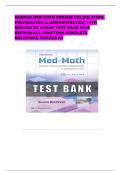
HENKES MED MATH DOSAGE CALCULATION,
PREPARATION & ADMINISTRATION 10TH
EDITION BY SUSAN TEST BANK 2025
EDITION ALL CHAPTERS COMPLETE
SOLUTIONS GRADED A+
,Table of Contents
1. Arithmetic Needed for Dosage
2. Metric and Household Systems of Measurement
3. Drug Abbreviations, Labels, and Packaging
4. Calculation of Oral Medications — Solids and Liquids
5. Liquids for Injection
6. Calculation of Basic IV Drip Rates
7. Special Types of IV Calculations
8. Dosage Problems for Infants and Children
9. Information Basic to Administering Drugs
10. Administration Procedures
CHAPTER 1: ARITHMETIC NEEDED FOR DOSAGE
,1. Which of the following is an example of a basic mathematical
operation used in dosage calculations?
A. Subtraction
B. Multiplication
C. Division
D. All of the above
Correct Answer: D
Rationale: Dosage calculations commonly involve all three
basic operations: addition, subtraction, multiplication, and
division, depending on the specific calculation.
2. A nurse needs to prepare a dose of medication. If the dosage
ordered is 500 mg, and the available tablets are 250 mg each,
how many tablets will the nurse administer?
A. 1
B. 2
C. 3
D. 4
Correct Answer: B
, Rationale: 500 mg divided by 250 mg equals 2 tablets, so the
nurse will administer 2 tablets.
3. The nurse is preparing a medication that requires dividing 300
mg by 6. What is the Correct Answer?
A. 50 mg
B. 30 mg
C. 200 mg
D. 150 mg
Correct Answer: B
Rationale: 300 mg divided by 6 equals 50 mg, so the Correct
Answer is 50 mg.
4. Which of the following is a crucial step when calculating
dosages?
A. Verifying patient allergies
B. Understanding the correct unit of measurement
C. Administering the medication immediately
D. Reviewing patient history
Correct Answer: B
PREPARATION & ADMINISTRATION 10TH
EDITION BY SUSAN TEST BANK 2025
EDITION ALL CHAPTERS COMPLETE
SOLUTIONS GRADED A+
,Table of Contents
1. Arithmetic Needed for Dosage
2. Metric and Household Systems of Measurement
3. Drug Abbreviations, Labels, and Packaging
4. Calculation of Oral Medications — Solids and Liquids
5. Liquids for Injection
6. Calculation of Basic IV Drip Rates
7. Special Types of IV Calculations
8. Dosage Problems for Infants and Children
9. Information Basic to Administering Drugs
10. Administration Procedures
CHAPTER 1: ARITHMETIC NEEDED FOR DOSAGE
,1. Which of the following is an example of a basic mathematical
operation used in dosage calculations?
A. Subtraction
B. Multiplication
C. Division
D. All of the above
Correct Answer: D
Rationale: Dosage calculations commonly involve all three
basic operations: addition, subtraction, multiplication, and
division, depending on the specific calculation.
2. A nurse needs to prepare a dose of medication. If the dosage
ordered is 500 mg, and the available tablets are 250 mg each,
how many tablets will the nurse administer?
A. 1
B. 2
C. 3
D. 4
Correct Answer: B
, Rationale: 500 mg divided by 250 mg equals 2 tablets, so the
nurse will administer 2 tablets.
3. The nurse is preparing a medication that requires dividing 300
mg by 6. What is the Correct Answer?
A. 50 mg
B. 30 mg
C. 200 mg
D. 150 mg
Correct Answer: B
Rationale: 300 mg divided by 6 equals 50 mg, so the Correct
Answer is 50 mg.
4. Which of the following is a crucial step when calculating
dosages?
A. Verifying patient allergies
B. Understanding the correct unit of measurement
C. Administering the medication immediately
D. Reviewing patient history
Correct Answer: B


