

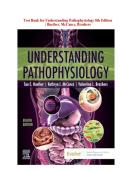
Test Bank for Understanding Pathophysiology, 8th Edition by Huether, McCance, and Brashers
The Test Bank for Understanding Pathophysiology, 8th Edition by Huether, McCance, and Brashers is a comprehensive and highly reliable academic resource designed to support students, educators, and healthcare professionals in mastering the complex concepts of pathophysiology. Aligned with the widely respected 8th edition textbook, this test bank provides a structured collection of exam-style questions, verified answers, and detailed rationales that enhance learning, reinforce critical thinking, and improve examination performance. Pathophysiology is a foundational subject in nursing, medicine, and allied health sciences that focuses on the functional changes occurring in the body as a result of disease or injury. The 8th edition of Understanding Pathophysiology emphasizes a systems-based approach, integrating cellular mechanisms, clinical manifestations, and evidence-based practice. This test bank complements that approach by offering carefully developed questions that help students connect theoretical knowledge with real-world clinical applications. This resource includes a wide variety of question formats designed to reflect modern academic and licensing examinations. Students will encounter multiple-choice questions (MCQs), select-all-that-apply (SATA) questions, true/false items, matching exercises, and case-based scenarios. These formats are designed not only to test factual recall but also to assess analytical thinking, clinical reasoning, and the ability to apply knowledge in patient care situations. This ensures that learners are well-prepared for both academic exams and professional licensing tests such as NCLEX-style assessments. One of the most valuable features of this test bank is its inclusion of accurate, verified answers with detailed rationales. Each question is accompanied by a clear explanation that identifies why the correct answer is right and why the other options are incorrect. This helps students move beyond memorization and develop a deeper understanding of disease mechanisms and physiological processes. The rationales are written in clear, accessible language, making complex scientific concepts easier to understand and retain. The content is systematically organized to align with the structure of the 8th edition textbook. Major topics covered include cellular adaptation, injury, and death; genetic and developmental disorders; fluid, electrolyte, and acid-base imbalances; inflammation and healing; immune system disorders; and neoplasia. In addition, the test bank provides extensive coverage of major body systems, including cardiovascular, respiratory, gastrointestinal, renal, endocrine, nervous, musculoskeletal, and hematologic systems. This comprehensive coverage ensures that learners gain a complete understanding of human disease processes. A key strength of this test bank is its emphasis on clinical application. Many questions are scenario-based, presenting realistic patient situations that require learners to analyze symptoms, interpret laboratory findings, and determine appropriate interventions. This approach strengthens clinical judgment and prepares students for real-world healthcare environments where critical thinking and rapid decision-making are essential. The Understanding Pathophysiology 8th Edition Test Bank is suitable for a wide range of users. Nursing students will find it especially useful for exam preparation and coursework review. Medical and allied health students can also benefit from its in-depth coverage and application-based questions. Educators can use it to develop quizzes, assignments, and examinations, ensuring consistency and academic quality while saving preparation time. Flexibility is another major advantage of this resource. It can be used for self-study, group discussions, classroom teaching, or exam revision sessions. Students can simulate timed exam conditions to improve speed and accuracy or review questions at their own pace for deeper comprehension. This adaptability makes it suitable for different learning styles and academic needs. In addition to supporting academic success, this test bank helps learners develop essential professional skills. By engaging with complex questions and clinical scenarios, students improve their critical thinking, diagnostic reasoning, and problem-solving abilities. These skills are vital for safe and effective patient care in clinical practice. The content is regularly updated to reflect current scientific knowledge and evidence-based practice in pathophysiology. This ensures that learners are studying accurate, relevant, and up-to-date material that aligns with modern healthcare standards. The questions are designed to mirror the style and difficulty level of contemporary exams, providing realistic and effective preparation. The user-friendly format of the test bank makes it easy to navigate and use. Questions are clearly structured, and answers are organized for quick reference and efficient study. Whether accessed digitally or in print, the layout supports focused and productive learning sessions. It is important to note that this test bank is intended as a supplementary study tool. It works best when used alongside the main textbook, lecture notes, and clinical practice experiences. By integrating this resource into a structured study plan, learners can significantly improve their understanding, retention, and application of pathophysiology concepts. In summary, the Test Bank for Understanding Pathophysiology, 8th Edition by Huether, McCance, and Brashers is an essential resource for anyone studying or teaching pathophysiology. With its comprehensive coverage, diverse question formats, verified answers, and detailed explanations, it provides a complete solution for exam preparation and academic success. Whether your goal is to achieve high grades or build a strong foundation in disease processes, this test bank offers the tools and support needed to excel in healthcare education.
Document information
- Uploaded on
- April 19, 2026
- Number of pages
- 368
- Written in
- 2025/2026
- Type
- Exam (elaborations)
- Contains
- Questions & answers


