

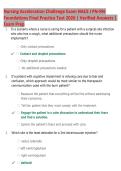
Nursing Acceleration Challenge Exam NACE I PN-RN
Foundations Final Practice Test 2026 | Verified Answers |
Exam Prep
1. In a scenario where a nurse is caring for a patient with a surgical-site infection
who also has a cough, what additional precautions should the nurse
implement?
Only contact precautions
Contact and droplet precautions
Only droplet precautions
No additional precautions needed
2. If a patient with cognitive impairment is refusing care due to fear and
confusion, which approach would be most similar to the therapeutic
communication used with the burn patient?
Reassure the patient that everything will be fine without addressing
their concerns.
Tell the patient that they must comply with the treatment.
Engage the patient in a calm discussion to understand their fears
and find a solution.
Ignore the patient's fears and proceed with care.
3. Which site is the least desirable for a 3ml intramuscular injection?
vastus lateralis
left ventrogluteal
right ventrogluteal
deltoid
,4. What is the recommended action when a Jehovah's Witness patient requires a
blood transfusion?
Tell the patient that he may die without the transfusion
Provide full information and the reasons for the transfusion
Assume the patient will not accept a transfusion and report this to the
physician
Tell the patient that his health is more important than religious beliefs
5. What is the legal document that allows an individual to make healthcare
decisions on behalf of a mentally incompetent patient?
Advance directive
General power of attorney
Do-not-resuscitate order
Durable power of attorney
6. Which medication is recommended by the WHO analgesic ladder for patients
with moderate to severe pain who do not respond to NSAIDs?
Codeine
Demerol
Morphine
Acetaminophen
7. A patient diagnosed with VRE infection in a surgical wound. which infection
precaution does the nurse implement?
droplet
airborne
, only standard
contact
8. Discuss why patients with cognitive impairment might be more sensitive to
sensory overload during the afternoon compared to other times of day.
The afternoon is typically quieter, leading to less sensory overload.
Afternoon is when patients are most alert and can handle more
stimuli.
Patients with cognitive impairment may be more sensitive to sensory
overload in the afternoon due to fatigue and accumulated stimuli
throughout the day.
Patients are usually more relaxed in the afternoon, reducing sensitivity
to sensory overload.
9. If a patient with Circadian Rhythm Sleep Disorder is struggling to adjust their
sleep schedule, which intervention would be most effective in promoting
phase advance?
Increasing caffeine intake before bed
Implementing light therapy in the morning
Reducing physical activity during the day
Encouraging late-night activities
10. During which time of day do patients with cognitive impairment typically
experience heightened sensitivity to sensory overload?
Early morning
Afternoon
Noon
Foundations Final Practice Test 2026 | Verified Answers |
Exam Prep
1. In a scenario where a nurse is caring for a patient with a surgical-site infection
who also has a cough, what additional precautions should the nurse
implement?
Only contact precautions
Contact and droplet precautions
Only droplet precautions
No additional precautions needed
2. If a patient with cognitive impairment is refusing care due to fear and
confusion, which approach would be most similar to the therapeutic
communication used with the burn patient?
Reassure the patient that everything will be fine without addressing
their concerns.
Tell the patient that they must comply with the treatment.
Engage the patient in a calm discussion to understand their fears
and find a solution.
Ignore the patient's fears and proceed with care.
3. Which site is the least desirable for a 3ml intramuscular injection?
vastus lateralis
left ventrogluteal
right ventrogluteal
deltoid
,4. What is the recommended action when a Jehovah's Witness patient requires a
blood transfusion?
Tell the patient that he may die without the transfusion
Provide full information and the reasons for the transfusion
Assume the patient will not accept a transfusion and report this to the
physician
Tell the patient that his health is more important than religious beliefs
5. What is the legal document that allows an individual to make healthcare
decisions on behalf of a mentally incompetent patient?
Advance directive
General power of attorney
Do-not-resuscitate order
Durable power of attorney
6. Which medication is recommended by the WHO analgesic ladder for patients
with moderate to severe pain who do not respond to NSAIDs?
Codeine
Demerol
Morphine
Acetaminophen
7. A patient diagnosed with VRE infection in a surgical wound. which infection
precaution does the nurse implement?
droplet
airborne
, only standard
contact
8. Discuss why patients with cognitive impairment might be more sensitive to
sensory overload during the afternoon compared to other times of day.
The afternoon is typically quieter, leading to less sensory overload.
Afternoon is when patients are most alert and can handle more
stimuli.
Patients with cognitive impairment may be more sensitive to sensory
overload in the afternoon due to fatigue and accumulated stimuli
throughout the day.
Patients are usually more relaxed in the afternoon, reducing sensitivity
to sensory overload.
9. If a patient with Circadian Rhythm Sleep Disorder is struggling to adjust their
sleep schedule, which intervention would be most effective in promoting
phase advance?
Increasing caffeine intake before bed
Implementing light therapy in the morning
Reducing physical activity during the day
Encouraging late-night activities
10. During which time of day do patients with cognitive impairment typically
experience heightened sensitivity to sensory overload?
Early morning
Afternoon
Noon


