

Iowa Commercial Pesticide Applicators:
Aquatic Pest Control (Category 5) Exam |
Questions with 100% Correct Answers |
Verified | Latest Update 2026
Save
Terms in this set (60)
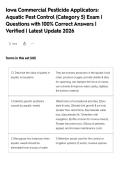
C1: Describe the value of plants in They are primary producers in the aquatic food
aquatic ecosystems chain, produce oxygen, provide shelter & sites
for spawning, can dampen the force of waves,
use nutrients & improve water clarity, stabilize
the bottom material
C1:Identify specific problems 1)Restriction of recreational activities, 2)foul
caused by aquatic weeds taste & odor, 3)hinder fish growth & survival,
4)water flow restrictions, 5)accelerate water
loss, 6)accelerate fill, 7)interfere with
navigation, 8)offer a home for noxious insects,
9)water becomes toxic, 10)loss of aesthetic
appeal, and increase maintenance costs.
C1:Recognize two instances when 1) Retention ponds used for fire control or
aquatic weeds should be irrigation systems; 2) exotic, invasive species
eliminated from a body of water
,C2:Describe how sunlight and Light: photic zone; water hardness- dissolved
nutrients affect plant growth calcium & magnesium, low hardness, soft,
prevents good light penetration, high hardness
(60-75 ppm) increased light penetration.
Nutrients: runoff; eutrophication.
C2:List the three nutrients 1) carbon (in the form of bicarbonates), 2)
regulating aquatic plant growth nitrogen, and
3) phosphorus
C2:Describe how water Most plants grow best in warming water in
temperature affects aquatic plant spring & early summer, most die back in fall as
growth water cools, some grow best in late winter &
spring (curlyleaf); a few later in summer
(naiads)
C2:Explain why sand is a good Rivers sand shifts, ponds it doesn't matter
substrate in small bodies of water,
but bad in rivers
C2:Explain why rock and gravel They provide little in the way of fertile
substrates are not conducive to sediments for nutrient uptake
growth of rooted plants
C3:Identify three major types of 1) microscopic, 2) filamentous, 3) stonewarts
algae (Nitella & Chara)
, C3:Differentiate between the four 1) submersed plants- water depths of less than
types of flowering plants based 1 foot to 20 feet, 2) free-floating plants- water
on the habitat they occupy in the surface (duckweed), 3) rooted floating plants-
aquatic environment water depths of 1 to 5 feet (water lotus,
pondweed), 4) emergent plants- water depths
less than 3 feet
C3:List four types of leaf 1) alternate leaf arrangement- one leaf per
arrangement that aid in the node (pondweed), 2) opposite leaf
identification of submersed plants arrangement- two leaves per node (naiads), 3)
whorled leaf arrangement- three or more
leaves per node (coontail & elodea), & 4) basal
leaf arrangement- does not have an erect stem
(eelgrass)
C3:Discuss why duckweed can be Can completely cover the surface and cause
especially problematic in a water the bottom layer of water to become
body anaerobic & unsuitable for fish
C3:Identify the location of leaf Underground or in sediment (rhizomes)-
emergence for rooted floating American lotus, spatterdock, water lily, water
plants shield; From stems- pondweeds
C3:Distinguish the two types of 1) herbaceous- grass-like plants (cattail,
emergent plants and give an bulrush), plants with broad leaves (arrowhead,
example of each smartweed); 2) woody plants- (willow,
buttonbush)
C4:Identify three major objectives 1) prevention of weed spread, 2) elimination of
in preventive aquatic plant control nutrient sources that support growth, and 3)
reduction of shallow areas where plants can
root
Aquatic Pest Control (Category 5) Exam |
Questions with 100% Correct Answers |
Verified | Latest Update 2026
Save
Terms in this set (60)
C1: Describe the value of plants in They are primary producers in the aquatic food
aquatic ecosystems chain, produce oxygen, provide shelter & sites
for spawning, can dampen the force of waves,
use nutrients & improve water clarity, stabilize
the bottom material
C1:Identify specific problems 1)Restriction of recreational activities, 2)foul
caused by aquatic weeds taste & odor, 3)hinder fish growth & survival,
4)water flow restrictions, 5)accelerate water
loss, 6)accelerate fill, 7)interfere with
navigation, 8)offer a home for noxious insects,
9)water becomes toxic, 10)loss of aesthetic
appeal, and increase maintenance costs.
C1:Recognize two instances when 1) Retention ponds used for fire control or
aquatic weeds should be irrigation systems; 2) exotic, invasive species
eliminated from a body of water
,C2:Describe how sunlight and Light: photic zone; water hardness- dissolved
nutrients affect plant growth calcium & magnesium, low hardness, soft,
prevents good light penetration, high hardness
(60-75 ppm) increased light penetration.
Nutrients: runoff; eutrophication.
C2:List the three nutrients 1) carbon (in the form of bicarbonates), 2)
regulating aquatic plant growth nitrogen, and
3) phosphorus
C2:Describe how water Most plants grow best in warming water in
temperature affects aquatic plant spring & early summer, most die back in fall as
growth water cools, some grow best in late winter &
spring (curlyleaf); a few later in summer
(naiads)
C2:Explain why sand is a good Rivers sand shifts, ponds it doesn't matter
substrate in small bodies of water,
but bad in rivers
C2:Explain why rock and gravel They provide little in the way of fertile
substrates are not conducive to sediments for nutrient uptake
growth of rooted plants
C3:Identify three major types of 1) microscopic, 2) filamentous, 3) stonewarts
algae (Nitella & Chara)
, C3:Differentiate between the four 1) submersed plants- water depths of less than
types of flowering plants based 1 foot to 20 feet, 2) free-floating plants- water
on the habitat they occupy in the surface (duckweed), 3) rooted floating plants-
aquatic environment water depths of 1 to 5 feet (water lotus,
pondweed), 4) emergent plants- water depths
less than 3 feet
C3:List four types of leaf 1) alternate leaf arrangement- one leaf per
arrangement that aid in the node (pondweed), 2) opposite leaf
identification of submersed plants arrangement- two leaves per node (naiads), 3)
whorled leaf arrangement- three or more
leaves per node (coontail & elodea), & 4) basal
leaf arrangement- does not have an erect stem
(eelgrass)
C3:Discuss why duckweed can be Can completely cover the surface and cause
especially problematic in a water the bottom layer of water to become
body anaerobic & unsuitable for fish
C3:Identify the location of leaf Underground or in sediment (rhizomes)-
emergence for rooted floating American lotus, spatterdock, water lily, water
plants shield; From stems- pondweeds
C3:Distinguish the two types of 1) herbaceous- grass-like plants (cattail,
emergent plants and give an bulrush), plants with broad leaves (arrowhead,
example of each smartweed); 2) woody plants- (willow,
buttonbush)
C4:Identify three major objectives 1) prevention of weed spread, 2) elimination of
in preventive aquatic plant control nutrient sources that support growth, and 3)
reduction of shallow areas where plants can
root


