

NAB RCAL Exam
NAB RCAL Exam Q&A [2026]
Study online at https://quizlet.com/_in3c74
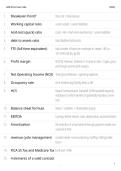
1. Breakeven Point? total cost = total revenue
2. Working capital ratio current assets / current liabilities
3. Acid-test (quick) ratio (cash + AR + short-term investments) / current liabilities
4. debt to assets ratio total liabilities/total assets
5. FTE (full time equivalent) total number of hours per employee in a week / 40 (i.e.
12+14+40+30 div. by 40)
6. Profit margin NOI/Tot. Revenue. Defined as "income to sales. 2 types, gross
prof margin and net prof margin)
7. Net Operating Income (NOI) Total (gross) Revenue - operating expenses
8. Occupancy rate (# of resident days/facility beds) x 365
9. HCS Hazard Communication Standard. OSHA standard requiring
employers to inform workers of potentially hazardous chem-
icals.
10. Balance sheet formula Assets = Liabilities + Shareholders Equity
11. EBITDA Earnings before interest, taxes, depreciation, and amortization
12. Amortization the reduction of a loan balance through payments made over
a period of time
13. revenue cycle management resident needs->service planning->staffing->billing/collec-
tions->
14. FICA SS Tax and Medicare Tax 6.2% and 1.45%
15. 4 elements of a valid contract
1
, NAB RCAL Exam
NAB RCAL Exam Q&A [2026]
Study online at https://quizlet.com/_in3c74
agreement, consideration, contractual capacity, legality (in
writing) "ACCL"
16. Liability insurance usually Bodily injury and property damage
covers..
17. Lock out tag out For all electrical equipment
18. safe electrical practices National Electrical Code or NEC
19. Following NFPA Life Safety fire plan, regular fire drills, detectors, training on procedure,
Code non combustable furnishing/draperies
20. Extinguisher class A ordinary combustibles such as wood/paper
21. Extinguisher Class B For flammable liquids and gas fires (grease, paint)
22. Extinguisher class C Live electrical equipment (panelling)
23. Extinguisher class D Combustable metals (aluminum)
24. Extinguisher class K Commercial cooking equipment (cooking oil, animal fats)
25. PASS (Fire Safety) P - Pull the pin.
A - Aim at the base of the fire, not at the flames.
S - Squeeze the lever.
S - Sweep the nozzle from side to side.
26. R.A.C.E. (Fire safety) rescue, alarm, contain, extinguish
27. Accrual Basis Accounting reporting income when it is earned and expenses when they
are incurred
2
NAB RCAL Exam Q&A [2026]
Study online at https://quizlet.com/_in3c74
1. Breakeven Point? total cost = total revenue
2. Working capital ratio current assets / current liabilities
3. Acid-test (quick) ratio (cash + AR + short-term investments) / current liabilities
4. debt to assets ratio total liabilities/total assets
5. FTE (full time equivalent) total number of hours per employee in a week / 40 (i.e.
12+14+40+30 div. by 40)
6. Profit margin NOI/Tot. Revenue. Defined as "income to sales. 2 types, gross
prof margin and net prof margin)
7. Net Operating Income (NOI) Total (gross) Revenue - operating expenses
8. Occupancy rate (# of resident days/facility beds) x 365
9. HCS Hazard Communication Standard. OSHA standard requiring
employers to inform workers of potentially hazardous chem-
icals.
10. Balance sheet formula Assets = Liabilities + Shareholders Equity
11. EBITDA Earnings before interest, taxes, depreciation, and amortization
12. Amortization the reduction of a loan balance through payments made over
a period of time
13. revenue cycle management resident needs->service planning->staffing->billing/collec-
tions->
14. FICA SS Tax and Medicare Tax 6.2% and 1.45%
15. 4 elements of a valid contract
1
, NAB RCAL Exam
NAB RCAL Exam Q&A [2026]
Study online at https://quizlet.com/_in3c74
agreement, consideration, contractual capacity, legality (in
writing) "ACCL"
16. Liability insurance usually Bodily injury and property damage
covers..
17. Lock out tag out For all electrical equipment
18. safe electrical practices National Electrical Code or NEC
19. Following NFPA Life Safety fire plan, regular fire drills, detectors, training on procedure,
Code non combustable furnishing/draperies
20. Extinguisher class A ordinary combustibles such as wood/paper
21. Extinguisher Class B For flammable liquids and gas fires (grease, paint)
22. Extinguisher class C Live electrical equipment (panelling)
23. Extinguisher class D Combustable metals (aluminum)
24. Extinguisher class K Commercial cooking equipment (cooking oil, animal fats)
25. PASS (Fire Safety) P - Pull the pin.
A - Aim at the base of the fire, not at the flames.
S - Squeeze the lever.
S - Sweep the nozzle from side to side.
26. R.A.C.E. (Fire safety) rescue, alarm, contain, extinguish
27. Accrual Basis Accounting reporting income when it is earned and expenses when they
are incurred
2


