
Accounting 3 Edition Kimmel, Weygandt, Kieso
(Solutions Manual All Chapters, 100% Original Verified A+ Grade)
CHAPTER 1
Introduction to Financial Statements
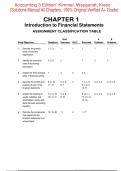
ASSIGNMENT CLASSIFICATION TABLE
Brief A B
Study Objectives Questions Exercises Do It! Exercises Problems Problems
1. Describe the primary 1, 2, 3 1 1 1 1 1
forms of business
organization.
2. Identify the users and 4, 5, 6 2 1 2 2
uses of accounting
information.
3. Explain the three principal 7 3 2 2, 3
types of business activity.
4. Describe the content and 8, 9, 10, 3, 4, 5, 3 1, 3, 4, 5, 2, 3, 4, 5 2, 3, 4, 5
purpose of each of the 11, 12 6, 7 6, 7, 8, 9,
financial statements. 10, 11
5. Explain the meaning of 13, 14, 15, 5, 6, 8, 9, 10, 11, 2, 3, 4, 5 2, 3, 4, 5
assets, liabilities, and 16, 17, 21 9, 10 12, 13, 14,
stockholders’ equity, and 15, 16
state the basic accounting
equation.
6. Describe the components 18, 19, 20 11 4 1, 17
that supplement the
financial statements in an
annual report.
Downloaded from Scholarfriends.com
,ASSIGNMENT CHARACTERISTICS TABLE
Problem Difficulty Time
Number Description Level Allotted (min.)
1A Determine forms of business organization. Simple 15–20
2A Identify users and uses of financial statements. Simple 15–20
3A Prepare an income statement, retained earnings Moderate 40–50
statement, and balance sheet; discuss results.
4A Determine items included in a statement of cash flows, Moderate 30–40
prepare the statement, and comment.
5A Comment on proper accounting treatment and prepare Moderate 40–50
a corrected balance sheet.
1B Determine forms of business organization. Simple 15–20
2B Identify users and uses of financial statements. Simple 15–20
3B Prepare an income statement, retained earnings Moderate 40–50
statement, and balance sheet; discuss results.
4B Determine items included in a statement of cash flows, Moderate 30–40
prepare the statement, and comment.
5B Comment on proper accounting treatment and prepare Moderate 40–50
a corrected income statement.
Downloaded from Scholarfriends.com
, ANSWERS TO QUESTIONS
1. The three basic forms of business organizations are (1) sole proprietorship, (2) partnership, and
(3) corporation.
2. Advantages of a corporation are limited liability (stockholders not being personally liable for cor-
porate debts), easy transferability of ownership, and easier to raise funds. Disadvantages of a
corporation are increased taxation and government regulations.
3. Proprietorships and partnerships receive favorable tax treatment compared to corporations and are
easier to form than corporations. They are also owner controlled. Disadvantages of proprietorships
and partnerships are unlimited liability (proprietors/partners are personally liable for all debts) and
difficulty in obtaining financing compared to corporations.
4. Yes. A person cannot earn a living, spend money, buy on credit, make an investment, or pay
taxes without receiving, using, or dispensing financial information. Accounting provides financial
information to interested users through the preparation and distribution of financial statements.
5. Internal users are managers who plan, organize, and run a business. To assist management,
accounting provides timely internal reports. Examples include financial comparisons of operating
alternatives, projections of income from new sales campaigns, forecasts of cash needs for the
next year and financial statements.
6. External users are those outside the business who have either a present or potential direct
financial interest (investors and creditors) or an indirect financial interest (taxing authorities, regu-
latory agencies, labor unions, customers, and economic planners).
7. The three types of business activity are financing activities, investing activities, and operating
activities. Financing activities include borrowing money and selling shares of stock. Investing
activities include the purchase and sale of property, plant, and equipment. Operating activities
include selling goods, performing services, and purchasing inventory.
8. (a) Income statement. (d) Balance sheet.
(b) Balance sheet. (e) Balance sheet.
(c) Income statement. (f) Balance sheet.
9. When a company pays dividends it reduces the amount of assets available to pay creditors.
Therefore banks and other creditors monitor dividend payments to ensure they do not put a
company’s ability to make debt payments at risk.
10. Yes. Net income does appear on the income statement—it is the result of subtracting expenses
from revenues. In addition, net income appears in the retained earnings statement—it is shown as
an addition to the beginning-of-period retained earnings. Indirectly, the net income of a company
is also included in the balance sheet. It is included in the retained earnings account which appears
in the stockholders’ equity section of the balance sheet.
11. The primary purpose of the statement of cash flows is to provide financial information about the
cash receipts and cash payments of a business for a specific period of time.
Downloaded from Scholarfriends.com
, Questions Chapter 1 (Continued)
12. The three categories of the statement of cash flows are operating activities, investing activities,
and financing activities. The categories were chosen because they represent the three principal
types of business activity.
13. Retained earnings is the net income retained in a corporation. Retained earnings is increased by
net income and is decreased by dividends and a net loss.
14. The basic accounting equation is Assets = Liabilities + Stockholders’ Equity.
15. (a) Assets are resources owned by a business. Liabilities are amounts owed to creditors. Put more
simply, liabilities are existing debts and obligations. Stockholders’ equity is the ownership claim
on total assets.
(b) The items that affect stockholders’ equity are common stock, retained earnings, dividends,
revenues, and expenses.
16. The liabilities are (b) Accounts payable and (g) Salaries payable.
17. (a) Net income from the income statement is reported as an increase to retained earnings on
the retained earnings statement.
(b) The ending amount on the retained earnings statement is reported as the retained earnings
amount on the balance sheet.
(c) The ending amount on the statement of cash flows is reported as the cash amount on the
balance sheet.
18. The purpose of the management discussion and analysis section is to provide management’s
views on its ability to pay short-term obligations, its ability to fund operations and expansion, and
its results of operations. The MD&A section is a required part of the annual report.
19. An unqualified opinion shows that, in the opinion of an independent auditor, the financial state-
ments have been presented fairly, in conformity with generally accepted accounting principles.
This gives investors more confidence that they can rely on the figures reported in the financial
statements.
20. Information included in the notes to the financial statements clarifies information presented in the
financial statements and includes descriptions of accounting policies, explanations of uncertain-
ties and contingencies, and statistics and details too voluminous to be reported in the financial
statements.
21. Using dollar amounts, Tootsie Roll’s accounting equation is:
Assets Liabilities Stockholders’ Equity
= +
$812,725,000 $174,495,000 $638,230,000
Downloaded from Scholarfriends.com
(Solutions Manual All Chapters, 100% Original Verified A+ Grade)
CHAPTER 1
Introduction to Financial Statements
ASSIGNMENT CLASSIFICATION TABLE
Brief A B
Study Objectives Questions Exercises Do It! Exercises Problems Problems
1. Describe the primary 1, 2, 3 1 1 1 1 1
forms of business
organization.
2. Identify the users and 4, 5, 6 2 1 2 2
uses of accounting
information.
3. Explain the three principal 7 3 2 2, 3
types of business activity.
4. Describe the content and 8, 9, 10, 3, 4, 5, 3 1, 3, 4, 5, 2, 3, 4, 5 2, 3, 4, 5
purpose of each of the 11, 12 6, 7 6, 7, 8, 9,
financial statements. 10, 11
5. Explain the meaning of 13, 14, 15, 5, 6, 8, 9, 10, 11, 2, 3, 4, 5 2, 3, 4, 5
assets, liabilities, and 16, 17, 21 9, 10 12, 13, 14,
stockholders’ equity, and 15, 16
state the basic accounting
equation.
6. Describe the components 18, 19, 20 11 4 1, 17
that supplement the
financial statements in an
annual report.
Downloaded from Scholarfriends.com
,ASSIGNMENT CHARACTERISTICS TABLE
Problem Difficulty Time
Number Description Level Allotted (min.)
1A Determine forms of business organization. Simple 15–20
2A Identify users and uses of financial statements. Simple 15–20
3A Prepare an income statement, retained earnings Moderate 40–50
statement, and balance sheet; discuss results.
4A Determine items included in a statement of cash flows, Moderate 30–40
prepare the statement, and comment.
5A Comment on proper accounting treatment and prepare Moderate 40–50
a corrected balance sheet.
1B Determine forms of business organization. Simple 15–20
2B Identify users and uses of financial statements. Simple 15–20
3B Prepare an income statement, retained earnings Moderate 40–50
statement, and balance sheet; discuss results.
4B Determine items included in a statement of cash flows, Moderate 30–40
prepare the statement, and comment.
5B Comment on proper accounting treatment and prepare Moderate 40–50
a corrected income statement.
Downloaded from Scholarfriends.com
, ANSWERS TO QUESTIONS
1. The three basic forms of business organizations are (1) sole proprietorship, (2) partnership, and
(3) corporation.
2. Advantages of a corporation are limited liability (stockholders not being personally liable for cor-
porate debts), easy transferability of ownership, and easier to raise funds. Disadvantages of a
corporation are increased taxation and government regulations.
3. Proprietorships and partnerships receive favorable tax treatment compared to corporations and are
easier to form than corporations. They are also owner controlled. Disadvantages of proprietorships
and partnerships are unlimited liability (proprietors/partners are personally liable for all debts) and
difficulty in obtaining financing compared to corporations.
4. Yes. A person cannot earn a living, spend money, buy on credit, make an investment, or pay
taxes without receiving, using, or dispensing financial information. Accounting provides financial
information to interested users through the preparation and distribution of financial statements.
5. Internal users are managers who plan, organize, and run a business. To assist management,
accounting provides timely internal reports. Examples include financial comparisons of operating
alternatives, projections of income from new sales campaigns, forecasts of cash needs for the
next year and financial statements.
6. External users are those outside the business who have either a present or potential direct
financial interest (investors and creditors) or an indirect financial interest (taxing authorities, regu-
latory agencies, labor unions, customers, and economic planners).
7. The three types of business activity are financing activities, investing activities, and operating
activities. Financing activities include borrowing money and selling shares of stock. Investing
activities include the purchase and sale of property, plant, and equipment. Operating activities
include selling goods, performing services, and purchasing inventory.
8. (a) Income statement. (d) Balance sheet.
(b) Balance sheet. (e) Balance sheet.
(c) Income statement. (f) Balance sheet.
9. When a company pays dividends it reduces the amount of assets available to pay creditors.
Therefore banks and other creditors monitor dividend payments to ensure they do not put a
company’s ability to make debt payments at risk.
10. Yes. Net income does appear on the income statement—it is the result of subtracting expenses
from revenues. In addition, net income appears in the retained earnings statement—it is shown as
an addition to the beginning-of-period retained earnings. Indirectly, the net income of a company
is also included in the balance sheet. It is included in the retained earnings account which appears
in the stockholders’ equity section of the balance sheet.
11. The primary purpose of the statement of cash flows is to provide financial information about the
cash receipts and cash payments of a business for a specific period of time.
Downloaded from Scholarfriends.com
, Questions Chapter 1 (Continued)
12. The three categories of the statement of cash flows are operating activities, investing activities,
and financing activities. The categories were chosen because they represent the three principal
types of business activity.
13. Retained earnings is the net income retained in a corporation. Retained earnings is increased by
net income and is decreased by dividends and a net loss.
14. The basic accounting equation is Assets = Liabilities + Stockholders’ Equity.
15. (a) Assets are resources owned by a business. Liabilities are amounts owed to creditors. Put more
simply, liabilities are existing debts and obligations. Stockholders’ equity is the ownership claim
on total assets.
(b) The items that affect stockholders’ equity are common stock, retained earnings, dividends,
revenues, and expenses.
16. The liabilities are (b) Accounts payable and (g) Salaries payable.
17. (a) Net income from the income statement is reported as an increase to retained earnings on
the retained earnings statement.
(b) The ending amount on the retained earnings statement is reported as the retained earnings
amount on the balance sheet.
(c) The ending amount on the statement of cash flows is reported as the cash amount on the
balance sheet.
18. The purpose of the management discussion and analysis section is to provide management’s
views on its ability to pay short-term obligations, its ability to fund operations and expansion, and
its results of operations. The MD&A section is a required part of the annual report.
19. An unqualified opinion shows that, in the opinion of an independent auditor, the financial state-
ments have been presented fairly, in conformity with generally accepted accounting principles.
This gives investors more confidence that they can rely on the figures reported in the financial
statements.
20. Information included in the notes to the financial statements clarifies information presented in the
financial statements and includes descriptions of accounting policies, explanations of uncertain-
ties and contingencies, and statistics and details too voluminous to be reported in the financial
statements.
21. Using dollar amounts, Tootsie Roll’s accounting equation is:
Assets Liabilities Stockholders’ Equity
= +
$812,725,000 $174,495,000 $638,230,000
Downloaded from Scholarfriends.com


