
CHEM 120 - Phys & Chem Prop of Matter - Class Notes/Study
Guide:
This document contains:
- Chemical bonds (Ionic, Covalent, Metallic)
- How bonding and structure are related to the properties of
substances (Solid, Liquid, Gas)
- Properties of small molecules, alloys and metals.
1. Chemical bonds (ionic, covalent and metallic)
a) Ionic Bonding:
i) Occurs in compounds formed when metals combined with
non-metals. For IB, (ionic bonding), the particles are oppositely
charged ions.
ii) A metal atom reacts w/ a non-metal atom and the electrons in the
outer shell are transferred. Metal atoms lose electrons to become
positively charged. Non-metal atoms gain the lost electrons (from the
metal atoms) and become negatively charged.
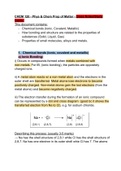
iii) The electron transfer during the formation of an ionic compound
can be represented by a dot and cross diagram (good bc it shows the
transferred election from Na to Cl), e.g. for sodium chloride.
Describing this process: (usually 3-5 marks)
→ Na has the shell structure of 2,8,1 while Cl has the shell structure of
2,8,7. Na has one electron in its outer shell whie Cl has 7. The atoms
, want to have their outermost shell full soNg transfers its one electron
on its outer shell and gives it to Cl. Since Na has lost its electron, it
becomes positive and Cl gains an electron so it becomes negative.
Now both of the atoms have a full outer shell so it becomes very
stable.
b) Ionic Compounds:
i) An ionic compound is a giant structure of ions.
ii) Ionic compounds are held together by strong electrostatic forces of
attraction between oppositely charged ions. These forces act in all
directions in the lattice and this is called ionic bonding.
The structure of sodium chloride can be represented in the following
forms:
c) Covalent bonding:
i) Occurs in compounds formed when non-metals combined with
non-metals. Covalently bonded substances may consist of small
molecules. However, some (such as polymers) have larger molecules.
Guide:
This document contains:
- Chemical bonds (Ionic, Covalent, Metallic)
- How bonding and structure are related to the properties of
substances (Solid, Liquid, Gas)
- Properties of small molecules, alloys and metals.
1. Chemical bonds (ionic, covalent and metallic)
a) Ionic Bonding:
i) Occurs in compounds formed when metals combined with
non-metals. For IB, (ionic bonding), the particles are oppositely
charged ions.
ii) A metal atom reacts w/ a non-metal atom and the electrons in the
outer shell are transferred. Metal atoms lose electrons to become
positively charged. Non-metal atoms gain the lost electrons (from the
metal atoms) and become negatively charged.
iii) The electron transfer during the formation of an ionic compound
can be represented by a dot and cross diagram (good bc it shows the
transferred election from Na to Cl), e.g. for sodium chloride.
Describing this process: (usually 3-5 marks)
→ Na has the shell structure of 2,8,1 while Cl has the shell structure of
2,8,7. Na has one electron in its outer shell whie Cl has 7. The atoms
, want to have their outermost shell full soNg transfers its one electron
on its outer shell and gives it to Cl. Since Na has lost its electron, it
becomes positive and Cl gains an electron so it becomes negative.
Now both of the atoms have a full outer shell so it becomes very
stable.
b) Ionic Compounds:
i) An ionic compound is a giant structure of ions.
ii) Ionic compounds are held together by strong electrostatic forces of
attraction between oppositely charged ions. These forces act in all
directions in the lattice and this is called ionic bonding.
The structure of sodium chloride can be represented in the following
forms:
c) Covalent bonding:
i) Occurs in compounds formed when non-metals combined with
non-metals. Covalently bonded substances may consist of small
molecules. However, some (such as polymers) have larger molecules.


