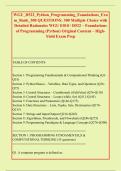
WGU_D522_Python_Programming_Foundations_Exa
m_Bank_300 QUESTIONS: 300 Multiple Choice with
Detailed Rationales WGU E010 / D522 – Foundations
of Programming (Python) Original Content – High-
Yield Exam Prep
========================================
TABLE OF CONTENTS
========================================
Section 1: Programming Fundamentals & Computational Thinking (Q1-
Q35)
Section 2: Python Basics – Variables, Data Types, and Operators (Q36-
Q75)
Section 3: Control Structures – Conditionals (if/elif/else) (Q76-Q110)
Section 4: Control Structures – Loops (while, for) (Q111-Q145)
Section 5: Functions and Parameters (Q146-Q175)
Section 6: Data Structures – Lists, Tuples, Sets, Dictionaries (Q176-
Q215)
Section 7: Strings and Input/Output (Q216-Q245)
Section 8: Algorithms, Pseudocode, and Flowcharts (Q246-Q275)
Section 9: Programming Paradigms & Language Concepts (Q276-Q300)
========================================
SECTION 1: PROGRAMMING FUNDAMENTALS &
COMPUTATIONAL THINKING (35 questions)
========================================
Q1. A computer program is defined as:
,A) A physical device that stores data
B) A set of instructions that a computer follows to perform tasks
C) A type of hardware component
D) A network connection protocol
Answer: B
Rationale: A program is a sequence of instructions executed by a
computer to perform specific tasks [citation:3].
Q2. Which of the following are the three basic instruction types in
programming?
A) Read, Write, Execute
B) Input, Process, Output
C) Compile, Link, Run
D) Initialize, Calculate, Terminate
Answer: B
Rationale: The three fundamental operations are Input (getting data),
Process (computing), and Output (sending data) [citation:3].
Q3. Computational thinking refers to:
A) Using a calculator for math problems
B) Creating a sequence of instructions to solve a problem
C) Installing computer hardware
D) Browsing the internet
Answer: B
Rationale: Computational thinking involves formulating problems and
representing solutions as step-by-step instructions a computer can
execute [citation:9].
Q4. An algorithm is best described as:
A) A hardware component
B) A step-by-step set of instructions to solve a problem
,C) A type of programming language
D) An error in a program
Answer: B
Rationale: An algorithm is a precise sequence of instructions that solves a
specific problem or accomplishes a task [citation:3].
Q5. Which of the following is an example of an algorithm?
A) A computer mouse
B) Insert key, turn key, open door
C) Python programming language
D) The color blue
Answer: B
Rationale: A sequence of actions like "insert key, turn key, open door"
represents an algorithmic process [citation:8].
Q6. The "Analysis Phase" in the Systems Development Life Cycle
(SDLC) involves:
A) Writing the actual code
B) Defining a program's goals and requirements
C) Testing for bugs
D) Deploying the program to users
Answer: B
Rationale: The analysis phase defines what the program needs to
accomplish before any coding begins [citation:9].
Q7. The "Design Phase" in SDLC involves:
A) Defining program goals
B) Writing code
C) Defining specifics of how to build the program
D) User acceptance testing
, Answer: C
Rationale: The design phase creates the blueprint for the program's
structure and behavior [citation:9].
Q8. The "Implementation Phase" in SDLC involves:
A) Planning the project timeline
B) Writing the program code
C) Gathering requirements from stakeholders
D) Creating flowcharts
Answer: B
Rationale: Implementation is the actual coding phase where the program
is written [citation:9].
Q9. The "Testing Phase" in SDLC ensures:
A) The program meets the original goals and works correctly
B) The budget is approved
C) The hardware is purchased
D) The documentation is written
Answer: A
Rationale: Testing verifies the program functions as intended and meets
requirements [citation:9].
Q10. The "Waterfall" approach to software development:
A) Carries out SDLC phases in sequence without returning to earlier
phases
B) Repeats phases in small increments
C) Skips the testing phase
D) Only uses one developer
Answer: A
Rationale: The waterfall model completes each phase fully before
moving to the next, like water flowing downstream [citation:9].
m_Bank_300 QUESTIONS: 300 Multiple Choice with
Detailed Rationales WGU E010 / D522 – Foundations
of Programming (Python) Original Content – High-
Yield Exam Prep
========================================
TABLE OF CONTENTS
========================================
Section 1: Programming Fundamentals & Computational Thinking (Q1-
Q35)
Section 2: Python Basics – Variables, Data Types, and Operators (Q36-
Q75)
Section 3: Control Structures – Conditionals (if/elif/else) (Q76-Q110)
Section 4: Control Structures – Loops (while, for) (Q111-Q145)
Section 5: Functions and Parameters (Q146-Q175)
Section 6: Data Structures – Lists, Tuples, Sets, Dictionaries (Q176-
Q215)
Section 7: Strings and Input/Output (Q216-Q245)
Section 8: Algorithms, Pseudocode, and Flowcharts (Q246-Q275)
Section 9: Programming Paradigms & Language Concepts (Q276-Q300)
========================================
SECTION 1: PROGRAMMING FUNDAMENTALS &
COMPUTATIONAL THINKING (35 questions)
========================================
Q1. A computer program is defined as:
,A) A physical device that stores data
B) A set of instructions that a computer follows to perform tasks
C) A type of hardware component
D) A network connection protocol
Answer: B
Rationale: A program is a sequence of instructions executed by a
computer to perform specific tasks [citation:3].
Q2. Which of the following are the three basic instruction types in
programming?
A) Read, Write, Execute
B) Input, Process, Output
C) Compile, Link, Run
D) Initialize, Calculate, Terminate
Answer: B
Rationale: The three fundamental operations are Input (getting data),
Process (computing), and Output (sending data) [citation:3].
Q3. Computational thinking refers to:
A) Using a calculator for math problems
B) Creating a sequence of instructions to solve a problem
C) Installing computer hardware
D) Browsing the internet
Answer: B
Rationale: Computational thinking involves formulating problems and
representing solutions as step-by-step instructions a computer can
execute [citation:9].
Q4. An algorithm is best described as:
A) A hardware component
B) A step-by-step set of instructions to solve a problem
,C) A type of programming language
D) An error in a program
Answer: B
Rationale: An algorithm is a precise sequence of instructions that solves a
specific problem or accomplishes a task [citation:3].
Q5. Which of the following is an example of an algorithm?
A) A computer mouse
B) Insert key, turn key, open door
C) Python programming language
D) The color blue
Answer: B
Rationale: A sequence of actions like "insert key, turn key, open door"
represents an algorithmic process [citation:8].
Q6. The "Analysis Phase" in the Systems Development Life Cycle
(SDLC) involves:
A) Writing the actual code
B) Defining a program's goals and requirements
C) Testing for bugs
D) Deploying the program to users
Answer: B
Rationale: The analysis phase defines what the program needs to
accomplish before any coding begins [citation:9].
Q7. The "Design Phase" in SDLC involves:
A) Defining program goals
B) Writing code
C) Defining specifics of how to build the program
D) User acceptance testing
, Answer: C
Rationale: The design phase creates the blueprint for the program's
structure and behavior [citation:9].
Q8. The "Implementation Phase" in SDLC involves:
A) Planning the project timeline
B) Writing the program code
C) Gathering requirements from stakeholders
D) Creating flowcharts
Answer: B
Rationale: Implementation is the actual coding phase where the program
is written [citation:9].
Q9. The "Testing Phase" in SDLC ensures:
A) The program meets the original goals and works correctly
B) The budget is approved
C) The hardware is purchased
D) The documentation is written
Answer: A
Rationale: Testing verifies the program functions as intended and meets
requirements [citation:9].
Q10. The "Waterfall" approach to software development:
A) Carries out SDLC phases in sequence without returning to earlier
phases
B) Repeats phases in small increments
C) Skips the testing phase
D) Only uses one developer
Answer: A
Rationale: The waterfall model completes each phase fully before
moving to the next, like water flowing downstream [citation:9].