
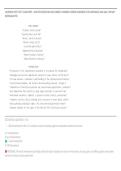
COLORADO POST TEST 1 EXAM PREP – PRACTICE QUESTIONS AND CORRECT ANSWERS (VERIFIED ANSWERS) PLUS RATIONALES 2026 Q&A | INSTANT
DOWNLOAD PDF.
*CORE DOMAINS*
*Criminal Justice System*
*Constitutional Law & CRS*
*Arrest, Search & Seizure*
*Officer Safety Skills*
*Law Enforcement Ethics*
*Community-Police Relations*
*Report Writing & Literacy*
*Human Relations & Advocacy*
*INTRODUCTION*
*The purpose of this comprehensive assessment is to evaluate the foundational*
*knowledge and practical competencies required for peace officer certification.*
*The exam assesses a candidate’s understanding of the Colorado Revised Statutes,*
*constitutional mandates, and tactical decision-making processes. Through a*
*combination of theoretical questions and scenario-based applications, candidates*
*must demonstrate their ability to apply legal principles to real-world law*
*enforcement encounters. Emphasis is placed on ethical conduct, professional*
*standards, and the critical thinking skills necessary to ensure public safety*
*while upholding individual rights. This structured multiple-choice format*
*prepares students for the rigors of the official POST certification process.*
SECTION ONE: QUESTIONS 1–100
1. Which amendment to the U.S. Constitution protects individuals against unreasonable searches and seizures?
A. First Amendment
B. Second Amendment
🟢 C. Fourth Amendment
D. Fifth Amendment
🔴 RATIONALE: The Fourth Amendment specifically protects the right of people to be secure in their persons, houses, papers, and effects against unreasonable
searches and seizures by the government.
, 2. In Colorado, a peace officer may make an arrest without a warrant when:
🟢 A. A crime has been or is being committed in such officer's presence.
B. The officer has a subjective "hunch" that a crime occurred.
C. A person is known to have a criminal record but is currently law-abiding.
D. A neighbor complains about a loud dog without further evidence.
🔴 RATIONALE: Per CRS, an officer has the authority to arrest without a warrant if a crime is committed in their presence or if they have probable cause to believe
the person committed a felony.
3. Which of the following is the highest court in the state of Colorado?
A. Colorado District Court
B. Colorado Court of Appeals
🟢 C. Colorado Supreme Court
D. Denver County Court
🔴 RATIONALE: The Colorado Supreme Court is the state's court of last resort, providing final oversight of state legal interpretations and lower court rulings.
4. Under the "Plain View" doctrine, an officer may seize evidence without a warrant if:
A. They have to move objects to see the evidence.
B. They are trespassing on private property when they see it.
🟢 C. They are lawfully in a position to observe the item and its incriminating nature is immediately apparent.
D. The owner of the property is not present at the time of observation.
🔴 RATIONALE: Plain view requires the officer to be lawfully present, have a lawful right of access to the object, and the item's incriminating character must be
immediately apparent.
5. What is the standard of proof required to obtain a search warrant?
A. Reasonable suspicion
B. Preponderance of the evidence
🟢 C. Probable cause
D. Beyond a reasonable doubt
🔴 RATIONALE: The Fourth Amendment explicitly states that no warrants shall issue but upon probable cause, supported by oath or affirmation.
6. An officer stops a vehicle for speeding. While speaking to the driver, the officer smells the strong odor of burnt marijuana and sees a pipe in the center
console. This is an example of:
A. Mere suspicion
🟢 B. Probable cause for a vehicle search under the automobile exception
, C. An illegal detention
D. A consensual encounter
🔴 RATIONALE: Under the Carroll Doctrine (automobile exception), the presence of drug paraphernalia and the odor of illegal substances can provide probable
cause to search a vehicle without a warrant.
7. Which Colorado statute covers the "Use of Physical Force in Making an Arrest"?
🟢 A. CRS 18-1-707
B. CRS 42-4-1301
C. CRS 16-3-102
D. CRS 18-4-203
🔴 RATIONALE: CRS 18-1-707 outlines the legal standards and limitations for peace officers regarding the use of physical force and deadly physical force during
an arrest or escape prevention.
8. When must an officer read the Miranda warnings to a suspect?
A. Immediately upon every arrest
B. Only when a suspect asks for a lawyer
🟢 C. When the suspect is in custody and subject to interrogation
D. Only during a traffic stop
🔴 RATIONALE: Miranda requirements are triggered by "custodial interrogation," meaning the suspect is not free to leave and the officer is asking questions
designed to elicit an incriminating response.
9. A person who intentionally sets fire to an occupied apartment building would most likely be charged with:
🟢 A. First Degree Arson
B. Second Degree Arson
C. Fourth Degree Arson
D. Third Degree Arson
🔴 RATIONALE: First Degree Arson involves knowingly setting fire to, or causing to be burned, any building or occupied structure of another without consent.
10. Which of the following is considered an "Exigent Circumstance" that justifies a warrantless entry into a home?
A. Investigation of a misdemeanor shoplifting that occurred two days ago.
🟢 B. Hot pursuit of a fleeing felon.
C. A desire to conduct a routine safety inspection.
D. The owner of the home is a known drug dealer.
🔴 RATIONALE: Exigent circumstances include hot pursuit, the need to prevent the imminent destruction of evidence, or the need to prevent a suspect's escape.
DOWNLOAD PDF.
*CORE DOMAINS*
*Criminal Justice System*
*Constitutional Law & CRS*
*Arrest, Search & Seizure*
*Officer Safety Skills*
*Law Enforcement Ethics*
*Community-Police Relations*
*Report Writing & Literacy*
*Human Relations & Advocacy*
*INTRODUCTION*
*The purpose of this comprehensive assessment is to evaluate the foundational*
*knowledge and practical competencies required for peace officer certification.*
*The exam assesses a candidate’s understanding of the Colorado Revised Statutes,*
*constitutional mandates, and tactical decision-making processes. Through a*
*combination of theoretical questions and scenario-based applications, candidates*
*must demonstrate their ability to apply legal principles to real-world law*
*enforcement encounters. Emphasis is placed on ethical conduct, professional*
*standards, and the critical thinking skills necessary to ensure public safety*
*while upholding individual rights. This structured multiple-choice format*
*prepares students for the rigors of the official POST certification process.*
SECTION ONE: QUESTIONS 1–100
1. Which amendment to the U.S. Constitution protects individuals against unreasonable searches and seizures?
A. First Amendment
B. Second Amendment
🟢 C. Fourth Amendment
D. Fifth Amendment
🔴 RATIONALE: The Fourth Amendment specifically protects the right of people to be secure in their persons, houses, papers, and effects against unreasonable
searches and seizures by the government.
, 2. In Colorado, a peace officer may make an arrest without a warrant when:
🟢 A. A crime has been or is being committed in such officer's presence.
B. The officer has a subjective "hunch" that a crime occurred.
C. A person is known to have a criminal record but is currently law-abiding.
D. A neighbor complains about a loud dog without further evidence.
🔴 RATIONALE: Per CRS, an officer has the authority to arrest without a warrant if a crime is committed in their presence or if they have probable cause to believe
the person committed a felony.
3. Which of the following is the highest court in the state of Colorado?
A. Colorado District Court
B. Colorado Court of Appeals
🟢 C. Colorado Supreme Court
D. Denver County Court
🔴 RATIONALE: The Colorado Supreme Court is the state's court of last resort, providing final oversight of state legal interpretations and lower court rulings.
4. Under the "Plain View" doctrine, an officer may seize evidence without a warrant if:
A. They have to move objects to see the evidence.
B. They are trespassing on private property when they see it.
🟢 C. They are lawfully in a position to observe the item and its incriminating nature is immediately apparent.
D. The owner of the property is not present at the time of observation.
🔴 RATIONALE: Plain view requires the officer to be lawfully present, have a lawful right of access to the object, and the item's incriminating character must be
immediately apparent.
5. What is the standard of proof required to obtain a search warrant?
A. Reasonable suspicion
B. Preponderance of the evidence
🟢 C. Probable cause
D. Beyond a reasonable doubt
🔴 RATIONALE: The Fourth Amendment explicitly states that no warrants shall issue but upon probable cause, supported by oath or affirmation.
6. An officer stops a vehicle for speeding. While speaking to the driver, the officer smells the strong odor of burnt marijuana and sees a pipe in the center
console. This is an example of:
A. Mere suspicion
🟢 B. Probable cause for a vehicle search under the automobile exception
, C. An illegal detention
D. A consensual encounter
🔴 RATIONALE: Under the Carroll Doctrine (automobile exception), the presence of drug paraphernalia and the odor of illegal substances can provide probable
cause to search a vehicle without a warrant.
7. Which Colorado statute covers the "Use of Physical Force in Making an Arrest"?
🟢 A. CRS 18-1-707
B. CRS 42-4-1301
C. CRS 16-3-102
D. CRS 18-4-203
🔴 RATIONALE: CRS 18-1-707 outlines the legal standards and limitations for peace officers regarding the use of physical force and deadly physical force during
an arrest or escape prevention.
8. When must an officer read the Miranda warnings to a suspect?
A. Immediately upon every arrest
B. Only when a suspect asks for a lawyer
🟢 C. When the suspect is in custody and subject to interrogation
D. Only during a traffic stop
🔴 RATIONALE: Miranda requirements are triggered by "custodial interrogation," meaning the suspect is not free to leave and the officer is asking questions
designed to elicit an incriminating response.
9. A person who intentionally sets fire to an occupied apartment building would most likely be charged with:
🟢 A. First Degree Arson
B. Second Degree Arson
C. Fourth Degree Arson
D. Third Degree Arson
🔴 RATIONALE: First Degree Arson involves knowingly setting fire to, or causing to be burned, any building or occupied structure of another without consent.
10. Which of the following is considered an "Exigent Circumstance" that justifies a warrantless entry into a home?
A. Investigation of a misdemeanor shoplifting that occurred two days ago.
🟢 B. Hot pursuit of a fleeing felon.
C. A desire to conduct a routine safety inspection.
D. The owner of the home is a known drug dealer.
🔴 RATIONALE: Exigent circumstances include hot pursuit, the need to prevent the imminent destruction of evidence, or the need to prevent a suspect's escape.


