Hazardous Earth
1. What is the evidence for continental drift and plate tectonics?
a) Theories of continental drift and plate tectonics
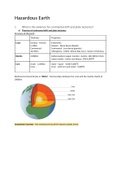
Structure of the Earth
Thickness Properties
Crust Oceanic - thinner 8 elements
5-10km Oceanic - More dense (basalt)
Continental - Continental - Less dense (granite)
10-70km Lithosphere - brittle. Where EQs occur. Varies in thickness.
Mantle 2,900km Asthenosphere (upper mantle) - ductile, 100-300 km thick
Lower mantle - hotter and denser. 500-4,000℃
Core Outer - 2,200km Outer - liquid - 4,000-5,000℃
Inner - Inner - solid iron and nickel - 5,000℃
Mohorovicic Discontinuity or ‘Moho’ - the boundary between the crust and the mantle. Depth of
2900km.
Convection Currents - the mechanisms by which tectonic plates move.
,Slab Pull
- Newly formed oceanic lithosphere is dense, sinks into the mantle in subduction zones.
- Responsible for seafloor spreading a divergent plate boundaries.
Ridge Push
- Occurs at spreading centres, where plates move apart.
- Pushing due to difference in GPE between plates at the spreading centre and the subduction
zone.
- Responsible for Mid Ocean Ridges.
Evidence for continental drift and plate tectonics
➢ 1912 Alfred Wegener - Described...
Existence of a supercontinent called Pangea.
1. Fossil remains of a fresh water reptile e.g. Mesosaurus found in South America and Africa.
2. Geological evidence e.g. coal found in Antarctica (unlikely it would have been formed at this
latitude as it requires hot climate and dense vegetation).
E.g. basalt lava flows where continents tore apart (S. America and Africa - Walvis Hot Spot).
3. Jigsaw-like fit e.g. East South America and West Africa
➢ 1962 Harry Hammond Hess - Explanation of seafloor spreading.
Mapped topography (WW2 drove innovation).
● Identified the presence of Mid Ocean Ridges above the surrounding flat sea floor.
● Discovered oceans were shallower in the middle.
● Envisaged that oceans grew from their centres, with molten material (basalt) oozing up
from the Earth’s mantle along the mid ocean ridges. This created new seafloor which then
spread away from the ridge in both directions. The ocean ridge was thermally expanded and
consequently higher than the ocean floor further away. As spreading continued, the older
ocean floor cooled and subsided.
➢ 1960s Fred Vine and Drummond Matthews ‘Cambridge Team’ - Evidence for Hess’ Theory.
Paleomagnetism - Combined topography and magnetism to prove that the seafloor spreads.
● Polarity swaps over time. Magnetite crystals in basalt (oceanic crust) are strongly
magnetic, and align with the magnetic field when it cools.
● They noticed a symmetrical pattern of magnetic stripes either side of Mid Ocean Ridges,
same age at similar distances away from the ridge on each side.
, ● Proof ocean floor was created at the Mid Ocean Ridges, then was split in half by later
activity and pushed sideways.
➢ 1965 John Tuzo-Wilson - Completed plate tectonic theory.
Explained why active volcanoes are not always found at plate boundaries e.g. Hawaii.
● Proposed plates might move over fixed ‘hotspots’ in the mantle, forming volcanic island
chains like Hawaii.
● Discovered a 3rd type of plate boundary - transform faults (conservative). Plates could slide
past eachother without crust being created or destroyed e.g. San Andreas. No volcanoes or
EQs.
➢ 1966 McKenzie - identified 2 layers in the mantle which move and control the movement of
the plates above.
b) Earth’s Crustal Features and Processes
Global Pattern of plates and plate boundaries
, Plate Boundaries
Type Features Example
DIVERGENT Plates pull apart from Mid Atlantic Ridge
(constructive) eachother. - Rate of spreading 2.5cm/yr.
New crust created. - 16,000km long.
Occurs along spreading - North American - Eurasian
centres. Explosive - South American - African
eruptions, high viscosity - Volcanoes e.g. Krafla in Iceland
magma. - Shallow focus EQs
‘Ridge Push’
● Mid Ocean Ridge /
submarine
mountain range
● Transform faults
● Mantle plumes
DIVERGENT Plates pull apart from East African Rift Valley
Continental - eachother. - 4,000km long
Continental Normal fault: - Nubian and Somalian Plate
Hanging wall moves down, - Faults on both sides
footwall moves up. - Valley floor lowered.
● Horst - - Spreading processes have torn Saudi Arabia
Escarpments from the rest of the African continent, forming
● Graben - Rift the Red Sea (a complete developed rift). If this
Valleys continues, geologists believe the African
● Deepwater lakes continent will separate completely. A new
ocean basin could be produced.
- Western Ridge: series of deep water lakes e.g.
Lake Tanganyika, high elevation mountain
1. What is the evidence for continental drift and plate tectonics?
a) Theories of continental drift and plate tectonics
Structure of the Earth
Thickness Properties
Crust Oceanic - thinner 8 elements
5-10km Oceanic - More dense (basalt)
Continental - Continental - Less dense (granite)
10-70km Lithosphere - brittle. Where EQs occur. Varies in thickness.
Mantle 2,900km Asthenosphere (upper mantle) - ductile, 100-300 km thick
Lower mantle - hotter and denser. 500-4,000℃
Core Outer - 2,200km Outer - liquid - 4,000-5,000℃
Inner - Inner - solid iron and nickel - 5,000℃
Mohorovicic Discontinuity or ‘Moho’ - the boundary between the crust and the mantle. Depth of
2900km.
Convection Currents - the mechanisms by which tectonic plates move.
,Slab Pull
- Newly formed oceanic lithosphere is dense, sinks into the mantle in subduction zones.
- Responsible for seafloor spreading a divergent plate boundaries.
Ridge Push
- Occurs at spreading centres, where plates move apart.
- Pushing due to difference in GPE between plates at the spreading centre and the subduction
zone.
- Responsible for Mid Ocean Ridges.
Evidence for continental drift and plate tectonics
➢ 1912 Alfred Wegener - Described...
Existence of a supercontinent called Pangea.
1. Fossil remains of a fresh water reptile e.g. Mesosaurus found in South America and Africa.
2. Geological evidence e.g. coal found in Antarctica (unlikely it would have been formed at this
latitude as it requires hot climate and dense vegetation).
E.g. basalt lava flows where continents tore apart (S. America and Africa - Walvis Hot Spot).
3. Jigsaw-like fit e.g. East South America and West Africa
➢ 1962 Harry Hammond Hess - Explanation of seafloor spreading.
Mapped topography (WW2 drove innovation).
● Identified the presence of Mid Ocean Ridges above the surrounding flat sea floor.
● Discovered oceans were shallower in the middle.
● Envisaged that oceans grew from their centres, with molten material (basalt) oozing up
from the Earth’s mantle along the mid ocean ridges. This created new seafloor which then
spread away from the ridge in both directions. The ocean ridge was thermally expanded and
consequently higher than the ocean floor further away. As spreading continued, the older
ocean floor cooled and subsided.
➢ 1960s Fred Vine and Drummond Matthews ‘Cambridge Team’ - Evidence for Hess’ Theory.
Paleomagnetism - Combined topography and magnetism to prove that the seafloor spreads.
● Polarity swaps over time. Magnetite crystals in basalt (oceanic crust) are strongly
magnetic, and align with the magnetic field when it cools.
● They noticed a symmetrical pattern of magnetic stripes either side of Mid Ocean Ridges,
same age at similar distances away from the ridge on each side.
, ● Proof ocean floor was created at the Mid Ocean Ridges, then was split in half by later
activity and pushed sideways.
➢ 1965 John Tuzo-Wilson - Completed plate tectonic theory.
Explained why active volcanoes are not always found at plate boundaries e.g. Hawaii.
● Proposed plates might move over fixed ‘hotspots’ in the mantle, forming volcanic island
chains like Hawaii.
● Discovered a 3rd type of plate boundary - transform faults (conservative). Plates could slide
past eachother without crust being created or destroyed e.g. San Andreas. No volcanoes or
EQs.
➢ 1966 McKenzie - identified 2 layers in the mantle which move and control the movement of
the plates above.
b) Earth’s Crustal Features and Processes
Global Pattern of plates and plate boundaries
, Plate Boundaries
Type Features Example
DIVERGENT Plates pull apart from Mid Atlantic Ridge
(constructive) eachother. - Rate of spreading 2.5cm/yr.
New crust created. - 16,000km long.
Occurs along spreading - North American - Eurasian
centres. Explosive - South American - African
eruptions, high viscosity - Volcanoes e.g. Krafla in Iceland
magma. - Shallow focus EQs
‘Ridge Push’
● Mid Ocean Ridge /
submarine
mountain range
● Transform faults
● Mantle plumes
DIVERGENT Plates pull apart from East African Rift Valley
Continental - eachother. - 4,000km long
Continental Normal fault: - Nubian and Somalian Plate
Hanging wall moves down, - Faults on both sides
footwall moves up. - Valley floor lowered.
● Horst - - Spreading processes have torn Saudi Arabia
Escarpments from the rest of the African continent, forming
● Graben - Rift the Red Sea (a complete developed rift). If this
Valleys continues, geologists believe the African
● Deepwater lakes continent will separate completely. A new
ocean basin could be produced.
- Western Ridge: series of deep water lakes e.g.
Lake Tanganyika, high elevation mountain