
Page 1 of 124
PEPP Final ACTUAL EXAM QUESTIONS AND CORRECT
DETAILED ANSWERS LATEST UPDATE THIS YEAR
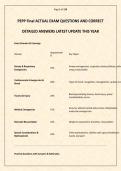
Exam Domains & Coverage
Approximate
Domain Key Topics
%
Airway & Respiratory Airway management, respiratory distress/failure, asthm
25%
Emergencies croup, bronchiolitis
Cardiovascular Emergencies &
20% Types of shock, recognition, management, cardiac arre
Shock
Blunt/penetrating trauma, head injury, spinal
Trauma & Injury 20%
immobilization, burns
Seizures, altered mental status, fever, dehydration,
Medical Emergencies 15%
endocrine emergencies
Neonatal Resuscitation 10% Newborn assessment, transition, resuscitation
Special Considerations & Child maltreatment, children with special healthcare
10%
Maltreatment needs, transport
Practice Questions with Answers & Rationales
, Page 2 of 124
Domain 1: Airway & Respiratory Emergencies
1. A 7-year-old boy has difficulty breathing and is wheezing. Vital signs are BP 94/62, HR 128,
and RR 32. What initial management should be performed?
• A. Open the airway with the jaw-thrust maneuver
• B. Initiate bag-mask ventilation
• C. Place the patient in the Trendelenburg position
• D. Apply oxygen by non-rebreather mask
Answer: D
Rationale: The patient is in respiratory distress with wheezing. Initial management includes
applying high-flow oxygen. The jaw-thrust is for trauma patients with suspected spinal injury.
Bag-mask ventilation is for respiratory failure, not distress. Trendelenburg is not indicated for
respiratory distress .
2. What is the initial airway management of an unrestrained child in a motor vehicle collision
who has blood and broken teeth noted in the airway along with gurgling respirations?
• A. Suction the oropharynx
• B. Insert an endotracheal tube
• C. Insert an oropharyngeal airway
, Page 3 of 124
• D. Administer bag-mask ventilation
Answer: A
Rationale: The priority is to clear the airway of blood, broken teeth, and secretions using suction.
An OPA would not be effective with these obstructions, and BVM would force debris further into
the airway. Endotracheal intubation would be delayed until the airway is cleared .
3. A 7-year-old boy was having difficulty breathing during his physical education class. He
appears tired and has audible wheezing. His vital signs are BP 98/66, HR 124, and RR 32. What
should the treatment of this patient include?
• A. Preparing equipment for orotracheal intubation
• B. Initiating bag-mask ventilation at 12 breaths per minute
• C. Administering a nebulized beta-agonist medication
• D. Administering IV epinephrine 1:10,000
Answer: C
Rationale: The patient is experiencing an asthma exacerbation with wheezing. A nebulized beta-
agonist (albuterol) is the first-line treatment. Intubation is not yet indicated. BVM is for
respiratory failure. IV epinephrine is for anaphylaxis or cardiac arrest .
4. In what position should a child in mild respiratory distress be placed?
• A. Left lateral recumbent
, Page 4 of 124
• B. Position of comfort
• C. Supine with feet up
• D. On his or her right side
Answer: B
Rationale: Children in mild respiratory distress should be placed in the position of comfort (often
sitting up or leaning forward), which optimizes breathing mechanics. Supine positioning may
worsen distress. Trendelenburg is not indicated .
5. A 9-year-old patient fell down a steep incline after rolling over the handlebars of his bicycle.
He was not wearing a helmet and has begun vomiting. How should you manage this patient?
• A. Elevate his head to 90 degrees
• B. Begin suctioning the airway
• C. Insert an oropharyngeal airway
• D. Open the airway with a head-tilt/chin-lift maneuver
Answer: B
Rationale: The patient has a suspected head injury (no helmet, vomiting). Vomiting requires
immediate suctioning to protect the airway. Avoid unnecessary head movement; use jaw-thrust
if needed. OPA insertion without suction could induce further vomiting .
PEPP Final ACTUAL EXAM QUESTIONS AND CORRECT
DETAILED ANSWERS LATEST UPDATE THIS YEAR
Exam Domains & Coverage
Approximate
Domain Key Topics
%
Airway & Respiratory Airway management, respiratory distress/failure, asthm
25%
Emergencies croup, bronchiolitis
Cardiovascular Emergencies &
20% Types of shock, recognition, management, cardiac arre
Shock
Blunt/penetrating trauma, head injury, spinal
Trauma & Injury 20%
immobilization, burns
Seizures, altered mental status, fever, dehydration,
Medical Emergencies 15%
endocrine emergencies
Neonatal Resuscitation 10% Newborn assessment, transition, resuscitation
Special Considerations & Child maltreatment, children with special healthcare
10%
Maltreatment needs, transport
Practice Questions with Answers & Rationales
, Page 2 of 124
Domain 1: Airway & Respiratory Emergencies
1. A 7-year-old boy has difficulty breathing and is wheezing. Vital signs are BP 94/62, HR 128,
and RR 32. What initial management should be performed?
• A. Open the airway with the jaw-thrust maneuver
• B. Initiate bag-mask ventilation
• C. Place the patient in the Trendelenburg position
• D. Apply oxygen by non-rebreather mask
Answer: D
Rationale: The patient is in respiratory distress with wheezing. Initial management includes
applying high-flow oxygen. The jaw-thrust is for trauma patients with suspected spinal injury.
Bag-mask ventilation is for respiratory failure, not distress. Trendelenburg is not indicated for
respiratory distress .
2. What is the initial airway management of an unrestrained child in a motor vehicle collision
who has blood and broken teeth noted in the airway along with gurgling respirations?
• A. Suction the oropharynx
• B. Insert an endotracheal tube
• C. Insert an oropharyngeal airway
, Page 3 of 124
• D. Administer bag-mask ventilation
Answer: A
Rationale: The priority is to clear the airway of blood, broken teeth, and secretions using suction.
An OPA would not be effective with these obstructions, and BVM would force debris further into
the airway. Endotracheal intubation would be delayed until the airway is cleared .
3. A 7-year-old boy was having difficulty breathing during his physical education class. He
appears tired and has audible wheezing. His vital signs are BP 98/66, HR 124, and RR 32. What
should the treatment of this patient include?
• A. Preparing equipment for orotracheal intubation
• B. Initiating bag-mask ventilation at 12 breaths per minute
• C. Administering a nebulized beta-agonist medication
• D. Administering IV epinephrine 1:10,000
Answer: C
Rationale: The patient is experiencing an asthma exacerbation with wheezing. A nebulized beta-
agonist (albuterol) is the first-line treatment. Intubation is not yet indicated. BVM is for
respiratory failure. IV epinephrine is for anaphylaxis or cardiac arrest .
4. In what position should a child in mild respiratory distress be placed?
• A. Left lateral recumbent
, Page 4 of 124
• B. Position of comfort
• C. Supine with feet up
• D. On his or her right side
Answer: B
Rationale: Children in mild respiratory distress should be placed in the position of comfort (often
sitting up or leaning forward), which optimizes breathing mechanics. Supine positioning may
worsen distress. Trendelenburg is not indicated .
5. A 9-year-old patient fell down a steep incline after rolling over the handlebars of his bicycle.
He was not wearing a helmet and has begun vomiting. How should you manage this patient?
• A. Elevate his head to 90 degrees
• B. Begin suctioning the airway
• C. Insert an oropharyngeal airway
• D. Open the airway with a head-tilt/chin-lift maneuver
Answer: B
Rationale: The patient has a suspected head injury (no helmet, vomiting). Vomiting requires
immediate suctioning to protect the airway. Avoid unnecessary head movement; use jaw-thrust
if needed. OPA insertion without suction could induce further vomiting .


