Pediatric Nursing Notes
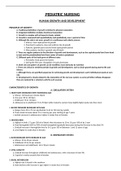
PEDIATRIC NURSING NOTES HUMAN GROWTH AND DEVELOPMENT PRINCIPLES OF GROWTH A. Traditional definition of growth is limited to physical maturation B. Integrated definition includes functional maturation C. Growth is complex with all aspects closely related D. Growth is measured both quantitatively and qualitatively over a period of time E. Although the rate is not even, growth is a continuous and orderly process 1. Infancy: most rapid period of growth 2. Preschool to puberty: slow and uniform rate of growth 3. Puberty: (growth spurt) second most rapid growth period 4. After puberty: decline in growth rate till death F. There are regular patterns in the direction of growth and development, such as the cephalocaudal law (from head to toe) and the proximodistal law (from center of body to periphery) G. Different parts of the body grow at different rates 1. Prenatally: head grows the fastest 2. During the first year: elongation of trunk dominates H. Both rate and pattern of growth can be modified, most obviously by nutrition I. There are critical or sensitive periods in growth and development, such as brain growth during uterine life and infancy J. Although there are specified sequences for achieving growth and development, each individual proceeds at own rate K. Development is closely related to the maturation of the nervous system; as some primitive reflexes disappear, they are replaced by a voluntary activity such as grasp CHARACTERISTICS OF GROWTH A. CIRCULATORY SYSTEM 1. HEART RATE DECREASES WITH INCREASING AGE a. Infancy: 120 beats per minute (bpm) b. One year: 80 to 120 bpm c. Childhood: 70 to 110 bpm d. Adolescence to adulthood: 55 to 90 bpm (after maturity, women have slightly higher pulse rate than men) 2. BLOOD PRESSURE INCREASES WITH AGE a. Ranges from 40 to 70 mm Hg diastolic to 65 to 140 mm Hg systolic b. These levels increase about 2 to 3 mm Hg per year starting at age 7 years c. Systolic pressure in adolescence: higher in males than in females 3. HEMOGLOBIN a. Highest at birth, 17 g per 100 ml of blood; then decreases to 10 to 15 g per 100 ml by 1 year b. Fetal hemoglobin (60% to 90% of total hemoglobin) gradually decreases during the first year to less than 5% c. Gradual increase in hemoglobin level to 14.5 g per 100 ml between 1 and 12 years of age d. Level higher in males than in females B. RESPIRATORY SYSTEM 1. RATE DECREASES WITH INCREASE IN AGE a. Infancy: 30 to 40 per minute b. Childhood: 20 to 24 per minute c. Adolescence and adulthood: 16 to 18 per minute 2. VITAL CAPACITY a. Gradual increase throughout childhood and adolescence, with a decrease in later life b. Capacity in males exceeds that in females 3. BASAL METABOLISM a. Highest rate is found in the newborn b. Rate declines with increase in age; higher in males than in females C. URINARY SYSTEM ______________________________________________________________
Document information
- Uploaded on
- May 3, 2021
- Number of pages
- 96
- Written in
- 2020/2021
- Type
- Class notes
- Professor(s)
- -
- Contains
- Pediatric nursing