
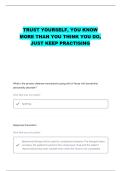
What is the primary defense mechanism/coping skill of those with borderline
personality disorder?
Give this one a try later!
Splitting
Response Prevention
Give this one a try later!
Behavioral therapy that is used for compulsive behavior. The therapist does
not allow the patient to perform the compulsive ritual and the patient
learns that anxiety does subside even when the ritual is not completed.
,oxazepam (Serax)
Give this one a try later!
Benzodiazepine
A woman is unable to enjoy sex after having pushed out of awareness a traumatic
sexual incident from childhood is an example of _______?
Give this one a try later!
Maladaptive use of repression
Therapeutic Communication: Focusing
Give this one a try later!
Concentrates attention on a single point.
Generalized Anxiety Disorder (GAD)
Give this one a try later!
Characterized by excessive anxiety or worry about numerous things lasting
6 months or longer.
,A man responds to the death of his wife by focusing on the details of day care and
operating the household, rather than processing grief with his children is an example
of ________?
Give this one a try later!
Maladaptive use of intellectualization
Sublimation
Give this one a try later!
An unconscious process of substituting mature, constructive, and socially
acceptable activity for immature, destructive, and unacceptable impulses.
Often these impulses are sexual or aggressive.
Defense Mechanism: Denial
Give this one a try later!
Outright refusal to admit or recognize that something has occurred or is
currently occurring. Can involve a flat out rejection of the existence of a
fact or reality. In other cases, it might involve admitting that something is
true, but minimizing its importance.
Therapeutic Communication: Reflecting
Give this one a try later!
, Directs questions, feelings, and ideas back to the patient.
TCAs are all off label use for _________, _________, and ____________.
Give this one a try later!
Panic disorder, GAD, and PTSD
Identification
Give this one a try later!
Attributing to oneself the characteristics of another person or group. This
may be done consciously or unconsciously.
Agoraphobia
Give this one a try later!
Intense, excessive anxiety or fear about being in places or situations from
which escape might be difficult or embarrassing or in which help may not
be available if a panic attack occurred. (ex: being outside alone, in a plane
alone, at home alone, traveling in a car, ect...)
Cognitive Distortions: Labeling
personality disorder?
Give this one a try later!
Splitting
Response Prevention
Give this one a try later!
Behavioral therapy that is used for compulsive behavior. The therapist does
not allow the patient to perform the compulsive ritual and the patient
learns that anxiety does subside even when the ritual is not completed.
,oxazepam (Serax)
Give this one a try later!
Benzodiazepine
A woman is unable to enjoy sex after having pushed out of awareness a traumatic
sexual incident from childhood is an example of _______?
Give this one a try later!
Maladaptive use of repression
Therapeutic Communication: Focusing
Give this one a try later!
Concentrates attention on a single point.
Generalized Anxiety Disorder (GAD)
Give this one a try later!
Characterized by excessive anxiety or worry about numerous things lasting
6 months or longer.
,A man responds to the death of his wife by focusing on the details of day care and
operating the household, rather than processing grief with his children is an example
of ________?
Give this one a try later!
Maladaptive use of intellectualization
Sublimation
Give this one a try later!
An unconscious process of substituting mature, constructive, and socially
acceptable activity for immature, destructive, and unacceptable impulses.
Often these impulses are sexual or aggressive.
Defense Mechanism: Denial
Give this one a try later!
Outright refusal to admit or recognize that something has occurred or is
currently occurring. Can involve a flat out rejection of the existence of a
fact or reality. In other cases, it might involve admitting that something is
true, but minimizing its importance.
Therapeutic Communication: Reflecting
Give this one a try later!
, Directs questions, feelings, and ideas back to the patient.
TCAs are all off label use for _________, _________, and ____________.
Give this one a try later!
Panic disorder, GAD, and PTSD
Identification
Give this one a try later!
Attributing to oneself the characteristics of another person or group. This
may be done consciously or unconsciously.
Agoraphobia
Give this one a try later!
Intense, excessive anxiety or fear about being in places or situations from
which escape might be difficult or embarrassing or in which help may not
be available if a panic attack occurred. (ex: being outside alone, in a plane
alone, at home alone, traveling in a car, ect...)
Cognitive Distortions: Labeling


