

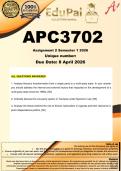
APC3702
Assignment 2 Semester 1 2026
Unique number:
Due Date: 8 April 2026
ALL QUESTIONS ANSWERED
1. Analyse Kenya‟s transformation from a single party to a multi-party state. In your answer
you should address the internal and external factors that impacted on the development of a
multi-party state since the 1990s. [50]
2. Critically discuss the one-party system in Tanzania under Nyerere‟s rule. [50]
3. Analyse the factors behind the rise of African nationalism in Uganda and their relevance in
post-independence politics. [50]
Terms of use
By making use of this document you agree to:
Use this document as a guide for learning, comparison and reference purpose,
Terms of use
Not to duplicate, reproduce and/or misrepresent the contents of this document as your own work,
By making use of this document you agree to:
Use this document
Fully accept the consequences
solely as a guide forshould you plagiarise
learning, reference,or and
misuse this document.
comparison purposes,
Ensure originality of your own work, and fully accept the consequences should you plagiarise or misuse this document.
Comply with all relevant standards, guidelines, regulations, and legislation governing academic and written work.
Disclaimer
Great care has been taken in the preparation of this document; however, the contents are provided "as is" without any express or
implied representations or warranties. The author accepts no responsibility or liability for any actions taken based on the
information contained within this document. This document is intended solely for comparison, research, and reference purposes.
Reproduction, resale, or transmission of any part of this document, in any form or by any means, is strictly prohibited.
, +27 81 278 3372
QUESTION 1
KENYA’S TRANSFORMATION FROM A SINGLE PARTY TO A MULTI-PARTY
STATE.
1. INTRODUCTION
Kenya‟s transition from a single-party state to a multiparty democracy in the 1990s
reflects a complex restructuring of political authority shaped by both domestic
pressures and international influence. Under the leadership of Daniel arap Moi,
Kenya operated as a de jure one-party state following the 1982 constitutional
amendment that entrenched the dominance of Kenya African National Union. This
system centralised power within the executive and marginalised dissenting voices.
By the late 1980s and early 1990s, however, mounting economic crises, civil
resistance, and global democratic shifts forced the Kenyan state to reconsider its
political structure. The transition was therefore not a single event but a gradual and
contested process driven by both internal and external dynamics (Barkan, 1993).
2. HISTORICAL CONTEXT: THE SINGLE-PARTY STATE
2.1 Consolidation of One-Party Rule
Following independence in 1963, Kenya initially allowed multiparty competition.
However, political consolidation under Jomo Kenyatta led to the weakening of
opposition parties. Over time, KANU emerged as the dominant political force,
absorbing or sidelining rival groups.
The situation intensified under Moi, particularly after the 1982 constitutional
amendment, which formally declared Kenya a one-party state. This legal framework
eliminated political pluralism and institutionalised KANU‟s monopoly over political life.
Elections during this period were largely procedural, serving to legitimise the regime
rather than offer genuine competition (Widner, 1992).
2.2 Political Repression and Centralisation
Disclaimer
Great care has been taken in the preparation of this document; however, the contents are provided "as is"
without any express or implied representations or warranties. The author accepts no responsibility or
liability for any actions taken based on the information contained within this document. This document is
intended solely for comparison, research, and reference purposes. Reproduction, resale, or transmission
of any part of this document, in any form or by any means, is strictly prohibited.
, +27 81 278 3372
The one-party era was characterised by extensive state control over political activity.
Opposition leaders were detained without trial, media freedom was restricted, and
civil liberties were curtailed. The state relied on coercive apparatuses, including
security forces, to suppress dissent.
This centralisation of power created a political environment in which alternative
voices were systematically excluded. However, repression also generated
resistance, as citizens and political elites increasingly challenged the legitimacy of
the regime. This tension laid the groundwork for the eventual push toward multiparty
democracy (Throup & Hornsby, 1998).
3. INTERNAL FACTORS DRIVING MULTIPARTY TRANSITION
3.1 Rise of Opposition Movements
The emergence of organised opposition was a critical internal factor in Kenya‟s
political transformation. Leaders such as Oginga Odinga spearheaded efforts to
challenge the one-party system through the formation of the Forum for the
Restoration of Democracy in 1991.
FORD united various political actors under a common agenda of constitutional
reform and political pluralism. Although the movement later fragmented into factions,
its formation marked a significant shift in Kenya‟s political landscape by
demonstrating that organised resistance to KANU was possible. The opposition‟s
ability to mobilise public support increased pressure on the regime to introduce
reforms (Ndegwa, 2001).
3.2 Civil Society and Religious Organisations
Civil society organisations played a central role in advocating for democratic change.
Churches, legal associations, and human rights groups actively criticised
government abuses and demanded accountability. These organisations provided
platforms for political mobilisation and public debate.
Disclaimer
Great care has been taken in the preparation of this document; however, the contents are provided "as is"
without any express or implied representations or warranties. The author accepts no responsibility or
liability for any actions taken based on the information contained within this document. This document is
intended solely for comparison, research, and reference purposes. Reproduction, resale, or transmission
of any part of this document, in any form or by any means, is strictly prohibited.
Assignment 2 Semester 1 2026
Unique number:
Due Date: 8 April 2026
ALL QUESTIONS ANSWERED
1. Analyse Kenya‟s transformation from a single party to a multi-party state. In your answer
you should address the internal and external factors that impacted on the development of a
multi-party state since the 1990s. [50]
2. Critically discuss the one-party system in Tanzania under Nyerere‟s rule. [50]
3. Analyse the factors behind the rise of African nationalism in Uganda and their relevance in
post-independence politics. [50]
Terms of use
By making use of this document you agree to:
Use this document as a guide for learning, comparison and reference purpose,
Terms of use
Not to duplicate, reproduce and/or misrepresent the contents of this document as your own work,
By making use of this document you agree to:
Use this document
Fully accept the consequences
solely as a guide forshould you plagiarise
learning, reference,or and
misuse this document.
comparison purposes,
Ensure originality of your own work, and fully accept the consequences should you plagiarise or misuse this document.
Comply with all relevant standards, guidelines, regulations, and legislation governing academic and written work.
Disclaimer
Great care has been taken in the preparation of this document; however, the contents are provided "as is" without any express or
implied representations or warranties. The author accepts no responsibility or liability for any actions taken based on the
information contained within this document. This document is intended solely for comparison, research, and reference purposes.
Reproduction, resale, or transmission of any part of this document, in any form or by any means, is strictly prohibited.
, +27 81 278 3372
QUESTION 1
KENYA’S TRANSFORMATION FROM A SINGLE PARTY TO A MULTI-PARTY
STATE.
1. INTRODUCTION
Kenya‟s transition from a single-party state to a multiparty democracy in the 1990s
reflects a complex restructuring of political authority shaped by both domestic
pressures and international influence. Under the leadership of Daniel arap Moi,
Kenya operated as a de jure one-party state following the 1982 constitutional
amendment that entrenched the dominance of Kenya African National Union. This
system centralised power within the executive and marginalised dissenting voices.
By the late 1980s and early 1990s, however, mounting economic crises, civil
resistance, and global democratic shifts forced the Kenyan state to reconsider its
political structure. The transition was therefore not a single event but a gradual and
contested process driven by both internal and external dynamics (Barkan, 1993).
2. HISTORICAL CONTEXT: THE SINGLE-PARTY STATE
2.1 Consolidation of One-Party Rule
Following independence in 1963, Kenya initially allowed multiparty competition.
However, political consolidation under Jomo Kenyatta led to the weakening of
opposition parties. Over time, KANU emerged as the dominant political force,
absorbing or sidelining rival groups.
The situation intensified under Moi, particularly after the 1982 constitutional
amendment, which formally declared Kenya a one-party state. This legal framework
eliminated political pluralism and institutionalised KANU‟s monopoly over political life.
Elections during this period were largely procedural, serving to legitimise the regime
rather than offer genuine competition (Widner, 1992).
2.2 Political Repression and Centralisation
Disclaimer
Great care has been taken in the preparation of this document; however, the contents are provided "as is"
without any express or implied representations or warranties. The author accepts no responsibility or
liability for any actions taken based on the information contained within this document. This document is
intended solely for comparison, research, and reference purposes. Reproduction, resale, or transmission
of any part of this document, in any form or by any means, is strictly prohibited.
, +27 81 278 3372
The one-party era was characterised by extensive state control over political activity.
Opposition leaders were detained without trial, media freedom was restricted, and
civil liberties were curtailed. The state relied on coercive apparatuses, including
security forces, to suppress dissent.
This centralisation of power created a political environment in which alternative
voices were systematically excluded. However, repression also generated
resistance, as citizens and political elites increasingly challenged the legitimacy of
the regime. This tension laid the groundwork for the eventual push toward multiparty
democracy (Throup & Hornsby, 1998).
3. INTERNAL FACTORS DRIVING MULTIPARTY TRANSITION
3.1 Rise of Opposition Movements
The emergence of organised opposition was a critical internal factor in Kenya‟s
political transformation. Leaders such as Oginga Odinga spearheaded efforts to
challenge the one-party system through the formation of the Forum for the
Restoration of Democracy in 1991.
FORD united various political actors under a common agenda of constitutional
reform and political pluralism. Although the movement later fragmented into factions,
its formation marked a significant shift in Kenya‟s political landscape by
demonstrating that organised resistance to KANU was possible. The opposition‟s
ability to mobilise public support increased pressure on the regime to introduce
reforms (Ndegwa, 2001).
3.2 Civil Society and Religious Organisations
Civil society organisations played a central role in advocating for democratic change.
Churches, legal associations, and human rights groups actively criticised
government abuses and demanded accountability. These organisations provided
platforms for political mobilisation and public debate.
Disclaimer
Great care has been taken in the preparation of this document; however, the contents are provided "as is"
without any express or implied representations or warranties. The author accepts no responsibility or
liability for any actions taken based on the information contained within this document. This document is
intended solely for comparison, research, and reference purposes. Reproduction, resale, or transmission
of any part of this document, in any form or by any means, is strictly prohibited.


