

learning 3 Questions And Answers 2026
Update!!!
The study of the acquisition and retention of
lists by humans in an effort to describe the basic
laws of learning
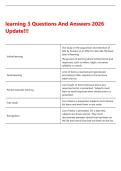
Verbal learning
the process of learning about verbal stimuli and
responses, such as letters, digits, nonsense
syllables, or words
A list of items is learned and reproduced
Serial learning according to their sequence of occurrence
within the list
List of pairs of items (stimulus terms and
response terms) is presented. Subjects must
Paired-associate learning
learn to recall response when stimulus term is
presented.
List of items is presented. Subjects must retrieve
Free recall
list items and emit them in any order
List of items is presented. On a later test,
subjects are shown stimuli. They must
Recognition
discriminate between stimuli that had been on
the list and stimuli that had not been on the list.
, –Monkeys see list of (between 3-7) pictures.
Must learn to touch pictures in particular order.
On each trial, the pictures are shown in a
different spatial arrangement, so the monkeys
must learn the pictures, not the locations or
movements. Performance continues until
Simultaneous chain task monkeys reach a criterion (e.g., 65% on a whole
session of trials).
–Serial learning of each list is shown, with
performance improving across sessions
Evidence of learning how to learn. When given
new lists, experienced monkeys reach criterion
faster
Update!!!
The study of the acquisition and retention of
lists by humans in an effort to describe the basic
laws of learning
Verbal learning
the process of learning about verbal stimuli and
responses, such as letters, digits, nonsense
syllables, or words
A list of items is learned and reproduced
Serial learning according to their sequence of occurrence
within the list
List of pairs of items (stimulus terms and
response terms) is presented. Subjects must
Paired-associate learning
learn to recall response when stimulus term is
presented.
List of items is presented. Subjects must retrieve
Free recall
list items and emit them in any order
List of items is presented. On a later test,
subjects are shown stimuli. They must
Recognition
discriminate between stimuli that had been on
the list and stimuli that had not been on the list.
, –Monkeys see list of (between 3-7) pictures.
Must learn to touch pictures in particular order.
On each trial, the pictures are shown in a
different spatial arrangement, so the monkeys
must learn the pictures, not the locations or
movements. Performance continues until
Simultaneous chain task monkeys reach a criterion (e.g., 65% on a whole
session of trials).
–Serial learning of each list is shown, with
performance improving across sessions
Evidence of learning how to learn. When given
new lists, experienced monkeys reach criterion
faster


