

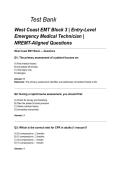
Test Bank
West Coast EMT Block 3 | Entry-Level
Emergency Medical Technician |
NREMT-Aligned Questions
West Coast EMT Block — Questions
Q1: The primary assessment of a patient focuses on:
A) Past medical history
B) Immediate life threats
C) Vital signs only
D) Allergies
Answer: B
Rationale: The primary assessment identifies and addresses immediate threats to life.
Q2: During a rapid trauma assessment, you should first:
A) Check for airway and breathing
B) Take the patient’s blood pressure
C) Obtain medical history
D) Immobilize extremities
Answer: A
Q3: Which is the correct ratio for CPR in adults (1 rescuer)?
A) 30 compressions : 2 breaths
B) 15 compressions : 2 breaths
C) 30 compressions : 1 breath
D) 15 compressions : 1 breath
Answer: A
,Q4: Which of the following is a sign of inadequate breathing?
A) Cyanosis
B) Pink lips
C) Normal respiratory rate
D) Clear lung sounds
Answer: A
Q5: The term "tachycardia" refers to:
A) Fast heart rate
B) Slow heart rate
C) Irregular breathing
D) Low blood pressure
Answer: A
Q6: You are treating a patient with anaphylaxis. The first-line treatment is:
A) Epinephrine
B) Albuterol
C) Aspirin
D) Nitroglycerin
Answer: A
Q7: The proper method to open an airway in a trauma patient is:
A) Jaw-thrust without head tilt
B) Head-tilt, chin-lift
C) Oropharyngeal suction only
D) Nasal cannula
Answer: A
,Q8: Which pulse site is preferred for an unconscious adult patient?
A) Carotid
B) Radial
C) Brachial
D) Femoral
Answer: A
Q9: A patient has slow, shallow respirations. This indicates:
A) Respiratory compromise
B) Normal breathing
C) Hyperventilation
D) Tachypnea
Answer: A
Q10: When assessing circulation in a trauma patient, EMTs should check:
A) Pulse, skin color, temperature, and condition
B) Blood glucose only
C) Vital signs after transport
D) Medication history
Answer: A
Q11: Shock is best defined as:
A) Inadequate tissue perfusion
B) Cardiac arrest
C) Elevated blood pressure
D) Fever
Answer: A
Q12: Which is a common sign of hypoperfusion?
, A) Pale, cool, clammy skin
B) Flushed, warm skin
C) Bradycardia only
D) Normal breathing
Answer: A
Q13: Which is a contraindication for administering nitroglycerin?
A) Systolic BP < 100 mmHg
B) Chest pain
C) History of hypertension
D) Dyspnea
Answer: A
Q14: Your patient is experiencing chest pain, nausea, and diaphoresis. You
should first:
A) Assess vital signs and administer oxygen if needed
B) Administer nitroglycerin immediately
C) Start CPR
D) Transport without assessment
Answer: A
Q15: The term “cyanosis” refers to:
A) Bluish discoloration of skin or mucous membranes
B) Elevated heart rate
C) Confusion
D) Red skin
Answer: A
Q16: Which patient requires immediate transport?
West Coast EMT Block 3 | Entry-Level
Emergency Medical Technician |
NREMT-Aligned Questions
West Coast EMT Block — Questions
Q1: The primary assessment of a patient focuses on:
A) Past medical history
B) Immediate life threats
C) Vital signs only
D) Allergies
Answer: B
Rationale: The primary assessment identifies and addresses immediate threats to life.
Q2: During a rapid trauma assessment, you should first:
A) Check for airway and breathing
B) Take the patient’s blood pressure
C) Obtain medical history
D) Immobilize extremities
Answer: A
Q3: Which is the correct ratio for CPR in adults (1 rescuer)?
A) 30 compressions : 2 breaths
B) 15 compressions : 2 breaths
C) 30 compressions : 1 breath
D) 15 compressions : 1 breath
Answer: A
,Q4: Which of the following is a sign of inadequate breathing?
A) Cyanosis
B) Pink lips
C) Normal respiratory rate
D) Clear lung sounds
Answer: A
Q5: The term "tachycardia" refers to:
A) Fast heart rate
B) Slow heart rate
C) Irregular breathing
D) Low blood pressure
Answer: A
Q6: You are treating a patient with anaphylaxis. The first-line treatment is:
A) Epinephrine
B) Albuterol
C) Aspirin
D) Nitroglycerin
Answer: A
Q7: The proper method to open an airway in a trauma patient is:
A) Jaw-thrust without head tilt
B) Head-tilt, chin-lift
C) Oropharyngeal suction only
D) Nasal cannula
Answer: A
,Q8: Which pulse site is preferred for an unconscious adult patient?
A) Carotid
B) Radial
C) Brachial
D) Femoral
Answer: A
Q9: A patient has slow, shallow respirations. This indicates:
A) Respiratory compromise
B) Normal breathing
C) Hyperventilation
D) Tachypnea
Answer: A
Q10: When assessing circulation in a trauma patient, EMTs should check:
A) Pulse, skin color, temperature, and condition
B) Blood glucose only
C) Vital signs after transport
D) Medication history
Answer: A
Q11: Shock is best defined as:
A) Inadequate tissue perfusion
B) Cardiac arrest
C) Elevated blood pressure
D) Fever
Answer: A
Q12: Which is a common sign of hypoperfusion?
, A) Pale, cool, clammy skin
B) Flushed, warm skin
C) Bradycardia only
D) Normal breathing
Answer: A
Q13: Which is a contraindication for administering nitroglycerin?
A) Systolic BP < 100 mmHg
B) Chest pain
C) History of hypertension
D) Dyspnea
Answer: A
Q14: Your patient is experiencing chest pain, nausea, and diaphoresis. You
should first:
A) Assess vital signs and administer oxygen if needed
B) Administer nitroglycerin immediately
C) Start CPR
D) Transport without assessment
Answer: A
Q15: The term “cyanosis” refers to:
A) Bluish discoloration of skin or mucous membranes
B) Elevated heart rate
C) Confusion
D) Red skin
Answer: A
Q16: Which patient requires immediate transport?


