

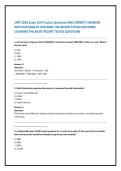
CRPC 2026 Exam 150 Practice Questions AND CORRECT ANSWERS
WITH RATIONALES COVERING THE RECENT TESTED QIESTIONS
COVERING THE MOST RECENT TESTED QUESTIONS
1. An insurance company collects $500,000 in premiums and pays $300,000 in claims in a year. What is
the loss ratio?
A. 40%
B. 60%
C. 150%
D. 100%
Answer: B
Rationale:
Loss ratio = (Claims ÷ Premiums) × 100
= ($300,000 ÷ $500,000) × 100 = 60%
--------------------------------------------------
2. Which federal law regulates the privacy of consumer financial information?
A. Gramm-Leach-Bliley Act
B. HIPAA
C. ERISA
D. Dodd-Frank Act
Answer: A
Rationale:
The Gramm-Leach-Bliley Act requires financial institutions to protect consumers’ nonpublic personal
information.
--------------------------------------------------
3. A policyholder pays $1,200 annual premium for a 1-year term policy. If they cancel after 4 months,
how much premium should be refunded using the pro-rata method?
A. $800
B. $400
C. $600
D. $1,200
,Answer: A
Rationale:
Pro-rata refund = Unused portion of premium
Unused months = 12 − 4 = 8 months
Monthly premium = $1,200 ÷ 12 = $100
Refund = 8 × $100 = $800
--------------------------------------------------
4. Which ratio measures the profitability of an insurance company relative to its equity?
A. Return on equity (ROE)
B. Loss ratio
C. Expense ratio
D. Combined ratio
Answer: A
Rationale:
ROE = Net Income ÷ Shareholder Equity × 100; it indicates profitability relative to equity.
--------------------------------------------------
5. An insurer has $1,000,000 in earned premiums and $700,000 in incurred losses. What is the expense
ratio if operating expenses are $150,000?
A. 15%
B. 70%
C. 85%
D. 100%
Answer: A
Rationale:
Expense ratio = Operating Expenses ÷ Earned Premiums × 100
= $150,000 ÷ $1,000,000 × 100 = 15%
--------------------------------------------------
6. Which regulatory body oversees the solvency of insurance companies in the U.S.?
A. State insurance departments
B. SEC
C. Federal Reserve
D. NAIC
,Answer: A
Rationale:
Each state’s insurance department regulates insurers’ solvency, licensing, and market conduct.
--------------------------------------------------
7. A life insurance policy has a face value of $100,000. The cash value is $20,000, and the policyholder
borrows $5,000. What is the net cash value?
A. $15,000
B. $25,000
C. $20,000
D. $5,000
Answer: A
Rationale:
Net cash value = Cash value − Loan
= $20,000 − $5,000 = $15,000
--------------------------------------------------
8. Which type of insurance coverage protects directors and officers from personal liability?
A. D&O insurance
B. E&O insurance
C. Workers’ compensation
D. Fidelity bond
Answer: A
Rationale:
D&O insurance covers personal liability of company directors and officers for wrongful acts.
--------------------------------------------------
9. An insurer writes $2,000,000 in premiums and expects a 40% loss ratio. What are the expected
losses?
A. $800,000
B. $1,200,000
C. $1,000,000
D. $400,000
Answer: A
Rationale:
, Expected losses = Premiums × Loss ratio
= $2,000,000 × 0.40 = $800,000
--------------------------------------------------
10. Which law governs the regulation of variable annuities and securities products?
A. Securities Act of 1933
B. HIPAA
C. NAIC Model Act
D. ERISA
Answer: A
Rationale:
Variable products are securities; the Securities Act of 1933 regulates their issuance and sale.
--------------------------------------------------
11. A company holds $500,000 in surplus and $2,000,000 in premiums. What is the premium-to-
surplus ratio?
A. 4:1
B. 5:1
C. 2:1
D. 3:1
Answer: B
Rationale:
Premium-to-surplus ratio = Premiums ÷ Surplus = $2,000,000 ÷ $500,000 = 4:1
(Note: This is a calculation to check capitalization adequacy.)
--------------------------------------------------
12. Which term describes the risk that arises from inadequate internal controls and management
processes?
A. Operational risk
B. Market risk
C. Credit risk
D. Liquidity risk
Answer: A
Rationale:
Operational risk comes from failures in processes, people, or systems.
WITH RATIONALES COVERING THE RECENT TESTED QIESTIONS
COVERING THE MOST RECENT TESTED QUESTIONS
1. An insurance company collects $500,000 in premiums and pays $300,000 in claims in a year. What is
the loss ratio?
A. 40%
B. 60%
C. 150%
D. 100%
Answer: B
Rationale:
Loss ratio = (Claims ÷ Premiums) × 100
= ($300,000 ÷ $500,000) × 100 = 60%
--------------------------------------------------
2. Which federal law regulates the privacy of consumer financial information?
A. Gramm-Leach-Bliley Act
B. HIPAA
C. ERISA
D. Dodd-Frank Act
Answer: A
Rationale:
The Gramm-Leach-Bliley Act requires financial institutions to protect consumers’ nonpublic personal
information.
--------------------------------------------------
3. A policyholder pays $1,200 annual premium for a 1-year term policy. If they cancel after 4 months,
how much premium should be refunded using the pro-rata method?
A. $800
B. $400
C. $600
D. $1,200
,Answer: A
Rationale:
Pro-rata refund = Unused portion of premium
Unused months = 12 − 4 = 8 months
Monthly premium = $1,200 ÷ 12 = $100
Refund = 8 × $100 = $800
--------------------------------------------------
4. Which ratio measures the profitability of an insurance company relative to its equity?
A. Return on equity (ROE)
B. Loss ratio
C. Expense ratio
D. Combined ratio
Answer: A
Rationale:
ROE = Net Income ÷ Shareholder Equity × 100; it indicates profitability relative to equity.
--------------------------------------------------
5. An insurer has $1,000,000 in earned premiums and $700,000 in incurred losses. What is the expense
ratio if operating expenses are $150,000?
A. 15%
B. 70%
C. 85%
D. 100%
Answer: A
Rationale:
Expense ratio = Operating Expenses ÷ Earned Premiums × 100
= $150,000 ÷ $1,000,000 × 100 = 15%
--------------------------------------------------
6. Which regulatory body oversees the solvency of insurance companies in the U.S.?
A. State insurance departments
B. SEC
C. Federal Reserve
D. NAIC
,Answer: A
Rationale:
Each state’s insurance department regulates insurers’ solvency, licensing, and market conduct.
--------------------------------------------------
7. A life insurance policy has a face value of $100,000. The cash value is $20,000, and the policyholder
borrows $5,000. What is the net cash value?
A. $15,000
B. $25,000
C. $20,000
D. $5,000
Answer: A
Rationale:
Net cash value = Cash value − Loan
= $20,000 − $5,000 = $15,000
--------------------------------------------------
8. Which type of insurance coverage protects directors and officers from personal liability?
A. D&O insurance
B. E&O insurance
C. Workers’ compensation
D. Fidelity bond
Answer: A
Rationale:
D&O insurance covers personal liability of company directors and officers for wrongful acts.
--------------------------------------------------
9. An insurer writes $2,000,000 in premiums and expects a 40% loss ratio. What are the expected
losses?
A. $800,000
B. $1,200,000
C. $1,000,000
D. $400,000
Answer: A
Rationale:
, Expected losses = Premiums × Loss ratio
= $2,000,000 × 0.40 = $800,000
--------------------------------------------------
10. Which law governs the regulation of variable annuities and securities products?
A. Securities Act of 1933
B. HIPAA
C. NAIC Model Act
D. ERISA
Answer: A
Rationale:
Variable products are securities; the Securities Act of 1933 regulates their issuance and sale.
--------------------------------------------------
11. A company holds $500,000 in surplus and $2,000,000 in premiums. What is the premium-to-
surplus ratio?
A. 4:1
B. 5:1
C. 2:1
D. 3:1
Answer: B
Rationale:
Premium-to-surplus ratio = Premiums ÷ Surplus = $2,000,000 ÷ $500,000 = 4:1
(Note: This is a calculation to check capitalization adequacy.)
--------------------------------------------------
12. Which term describes the risk that arises from inadequate internal controls and management
processes?
A. Operational risk
B. Market risk
C. Credit risk
D. Liquidity risk
Answer: A
Rationale:
Operational risk comes from failures in processes, people, or systems.


