

Written by students who passed Immediately available after payment Read online or as PDF Wrong document? Swap it for free 4.6 TrustPilot
logo-home
Document preview thumbnail
Preview 2 out of 10 pages
Exam (elaborations)

PYC-612: Advanced Pharmacology - Week 3 Quiz (Questions and answers) 100% Latest 2026/2027 - Indiana Wesleyan University, Marion.

Document preview thumbnail
Preview 2 out of 10 pages

PYC-612: Advanced Pharmacology - Week 3 Quiz (Questions and answers) 100% Latest 2026/2027 - Indiana Wesleyan University, Marion. Which beta-blocker is not recommended for use in heart failure? 1) Metoprolol tartrate (Lopressor®) 2) Carvedilol (Coreg®) 3) Bisoprolol (Zebeta®) 4) Metoprolol succinate (Toprol XL®) Question 2 2 / 2 points The maintenance medication of choice for angina is considered to be the beta-blockers. 1) True 2) False Question 3 2 / 2 points All of the following medications can be used for the treatment of angina EXCEPT: 1) Calcium channel blockers 2) ACE inhibitors 3) Nitrates 4) Beta-blockers Question 4 2 / 2 points Clonidine (Catapres®) offers some unique properties that other medications in its group do not, they are: 1) Both oral and topical formulations 2) May help with smoking cessation 3) Caution should be used in combination with beta-blockers 4) All of the above 5) Both a and b Question 5 2 / 2 points According to the 2013 cholesterol guidelines, which of the following is not a statin benefit group? 1) Clinical ASCVD 2) Diabetes 3) LDL 170 mg/dL 4) Age 40-75 with 10-year ASCVD risk 7.5%Question 6 2 / 2 points Hypertension-related deaths can result from all of the following EXCEPT: 1) Cerebral hemorrhage 2) Renal failure 3) Heart failure 4) Myocardial infarction 5) None of the above Question 7 2 / 2 points Peripheral resistance is determined by the diameter of the arterioles. Dilation of the arterioles raises blood pressure. 1) True 2) False Question 8 2 / 2 points Peripheral resistance is primarily regulated through the constriction and dilation of arterioles. 1) True 2) False Question 9 2 / 2 points What can be done to minimize a patient's reaction to niacin's predominant side effect? 1) Have the patient take dose at bedtime 2) Have the patient take an aspirin 30 minutes before niacin 3) Prescribe long-acting formulation verses immediate release products 4) All of the above 5) None of the above, just have the patient "tough-it-out" Question 10 2 / 2 points A hypertensive emergency is defined when the systolic blood pressure is 140 and the diastolic is than 100? 1) True 2) False Question 11 2 / 2 points Contraindications to the use of B-Blockers include:1) Decompensated heart failure 2) Sick sinus syndrome 3) Second or third degree heart block 4) All the above Question 12 2 / 2 points All of the following medications have shown benefit in patients with systolic heart failure EXCEPT: 1) ACE inhibitors 2) Diuretics 3) Non-dihydropyridine calcium channel blockers 4) Nitrates and hydralazine 5) Digoxin Question 13 2 / 2 points Which of the following antihypertensive agents should be used with caution in patients with diabetes? 1) ACE inhibitors 2) Calcium channel blockers 3) Beta-blockers Question 14 2 / 2 points Aspirin 81 mg, 30 minutes prior to niacin (Niaspan®) administration is recommended to minimize flushing. 1) True 2) False Question 15 2 / 2 points Hydrochlorothiazide’s (Microzide®) site of action is in the: 1) proximal convoluted tubule 2) ascending limb of Henle’s loop 3) early distal convoluted tubule 4) late distal convoluted tubule Question 16 2 / 2 pointsWhich of the following loop diuretics is the most potent: 1) Furosemide (Lasix®) 2) Ethacrynic acid (Edecrin®) 3) Bumetanide (Bumex®) 4) Torsemide (Demadex®) Question 17 2 / 2 points When considering selection of appropriate drug therapy for treatment of hyperlipidemia which of the following should be considered: 1) Type of hyperlipidemia 2) Cost of medication 3) Adverse effects 4) All of the above 5) Only b and c Question 18 2 / 2 points Heart failure is characterized by _________ and ____________. 1) Volume overload and inadequate tissue perfusion. 2) Overperfusion of tissues and hypovolemia. 3) Pulmonary hypertension and nephropathy. Question 19 2 / 2 points Patients with a history of second degree and third degree AV block can safely use amiodarone (Cordarone®). 1) True 2) False Question 20 2 / 2 points Which of the following is true regarding ranolazine (Ranexa®)? 1) It is indicated for the treatment of hypertension. 2) It has been associated with prolongation of the Q-T interval. 3) It is used for the treatment of acute angina episodes in place of sublingual nitroglycerin. Question 21 2 / 2 points Spironolactone’s (Aldactone®) site of action is in the:1) proximal convoluted tubule 2) ascending limb of Henle’s loop 3) early distal convoluted tubule 4) late distal convoluted tubule Question 22 2 / 2 points All of the following factors are reasonable influences of drug selection in the treatment of hypertension EXCEPT: 1) Safety profile of the medication 2) Cost of a medication 3) Efficacy of a medication 4) Concomitant disease states of a specific patient 5) Pressure from a manufacturer's drug representative to prescribe a specific medication Question 23 2 / 2 points Nifedipine (Procardia®) can cause constipation but verapamil (Calan®) does not. 1) True 2) False Question 24 2 / 2 points The primary pacemaker of the heart is found in: 1) Right ventricle 2) Sinoatrial node 3) Myocardium 4) Atrioventicular node Question 25 2 / 2 points According to the 2017 hypertension guidelines, what would be considered stage 1 hypertension? 1) 96/60 mm Hg 2) 128/82 mm Hg 3) 118/72 mm Hg 4) 140/92 mm HgQuestion 1 Verapamil (Calan®) is recommended in heart failure if ejection fraction is less than 30%. 1) True 2) False Question 2 2 / 2 points Clonidine, in addition to helping to lower blood pressure can make patients crave smoking more. 1) True 2) False Question 3 2 / 2 points Warfarin (Coumadin®) would be the treatment of choice in patients who are hemodynamically unstable with a life-threatening PE. 1) True 2) False Question 4 2 / 2 points Class I antidysrhythmic medications: 1) block sodium channels. 2) are beta-blockers. 3) delay repolarization. 4) block calcium channels. Question 5 2 / 2 points Which of the following is true regarding ranolazine (Ranexa®)? 1) It is indicated for the treatment of hypertension. 2) It has been associated with prolongation of the Q-T interval. 3) It is used for the treatment of acute angina episodes in place of sublingual nitroglycerin. Question 6 2 / 2 points Which of the following antihypertensive agents should be used with caution in patients with diabetes? 1) ACE inhibitors 2) Calcium channel blockers 3) Beta-blockers Question 7 2 / 2 points Why should beta-blockers be used with caution in patients with diabetes? 1) Beta-blockers block the signs of hypoglycemia2) Beta-blockers can cause hypoglycemia 3) Beta-blockers can blunt the recovery from a hypoglycemic reaction 4) Both a and c 5) None of the above Question 8 2 / 2 points Which of the following direct oral anticoagulants (DOACs) is not recommended for atrial fibrillation if creatinine clearance is greater than95 mL/min? 1) Rivaroxaban (Xarelto®) 2) Dabigatran (Pradaxa®) 3) Apixaban (Eliquis®) 4) Edoxaban (Savaysa®) Question 9 2 / 2 points When considering selection of appropriate drug therapy for treatment of hyperlipidemia which of the following should be considered: 1) Type of hyperlipidemia 2) Cost of medication 3) Adverse effects 4) All of the above 5) Only b and c Question 10 2 / 2 points Which one of the statements below is incorrect regarding warfarin? 1) Typically, initial dosing is between 2-5 mg daily. 2) INR should be monitored frequently until at goal and then periodically with frequency depending on I 3) Gingko has been linked to prolonged clotting times. 4) The recommended INR goal is 2-3 for most indications. 5) None of the above Question 11 2 / 2 points According to the 2013 cholesterol guidelines, which of the following is not a statin benefit group? 1) Clinical ASCVD 2) Diabetes3) LDL 170 mg/dL 4) Age 40-75 with 10-year ASCVD risk 7.5% Question 12 2 / 2 points If chest pain is not relieved 10 minutes after taking sublingual nitroglycerin (Nitrostat®), a person should call 911. 1) True 2) False Question 13 2 / 2 points Which is the best medication to treat hypertension for a patient with a history of heart failure and diabetes? 1) Atenolol (Tenormin®) 2) Losartan (Cozaar®) 3) Verapamil (Calan®) 4) All of the above Question 14 2 / 2 points Which heart conditions must B-blockers be used with caution? 1) Heart block 2) Sinus bradycardia 3) Cardiogenic shock 4) All of the above Question 15 2 / 2 points Patients on warfarin (Coumadin®) should increase the amount of daily Vitamin K intake. 1) True 2) False Question 16 2 / 2 points In addition to hypertension, verapamil (Calan®), a non-dihydropyridine calcium channel blocker, might also be beneficial in a patient who has: 1) Atrial fibrillation 2) CHF 3) Migraine headaches 4) Both a and b5) Both a and c Question 17 2 / 2 points Calcium channel blockers can be divided into 2 groups [the non-dyhydropyridines (i.e. diltiazem and verapamil) and dihydropyridines (nifepine, amlodipine...)]. Each group has a unique adverse effect profile. Select the answer that best represents the predominant adverse effects of each group and also provides the best explanation for the difference. 1) Non-dihyropyridines (non-DHP) cause decreases in heart rate and force of contraction while dihydro are more likely to cause headache, flushing, ankle edema and palpitations because each class block channels in different locations in the body. 2) Non-DHP cause increases in heart rate and force of contraction while DHPs are more likely to cause flushing, ankle edema and palpitations because each class blocks calcium channels in different loca body. 3) Non-DHPs cause decreases in heart rate and force of contraction while dihydropyridines (DHP) are m cause headache, flushing, ankle edema and palpitations because non-DHPs block magnesium rece to calcium channels and DHPs only block calcium channels. Question 18 2 / 2 points Spironolactone’s (Aldactone®) site of action is in the: 1) proximal convoluted tubule 2) ascending limb of Henle’s loop 3) early distal convoluted tubule 4) late distal convoluted tubule Question 19 2 / 2 points Which of the following diuretics can cause hyperkalemia? 1) Furosemide (Lasix®) 2) Hydrochlorothiazide (Microzide®) 3) Spironolactone (Aldactone®) 4) Chlorthalidone (Thalitone®) Question 20 2 / 2 points Hydrochlorothiazide’s (Microzide®) site of action is in the: 1) proximal convoluted tubule 2) ascending limb of Henle’s loop 3) early distal convoluted tubule 4) late distal convoluted tubule Question 21 2 / 2 points When taking Niacin, which common reaction is most likely to occur shortly after ingestion?1) Diaphoresis 2) Flushing 3) Hypertension 4) None of the above Question 22 2 / 2 points All of the following factors are reasonable influences of drug selection in the treatment of hypertension EXCEPT: 1) Safety profile of the medication 2) Cost of a medication 3) Efficacy of a medication 4) Concomitant disease states of a specific patient 5) Pressure from a manufacturer's drug representative to prescribe a specific medication Question 23 2 / 2 points Stable angina, also known as exertional angina, is most often triggered by an increase in physical activity. 1) True 2) False Question 24 2 / 2 points The primary pacemaker of the heart is found in: 1) Right ventricle 2) Sinoatrial node 3) Myocardium 4) Atrioventicular node Question 25 2 / 2 points The best medication(s) for a patient with high cholesterol, high triglycerides, high LDL, low HDL is? 1) Colestipol (Colestid®) 2) Atorvastatin (Lipitor®) 3) Ezetimibe (Zetia®) 4) Any of the above

Content preview

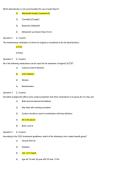
Which beta-blocker is not recommended for use in heart failure?

1) Metoprolol tartrate (Lopressor®)

2) Carvedilol (Coreg®)

3) Bisoprolol (Zebeta®)

4) Metoprolol succinate (Toprol XL®)

Question 2 points

The maintenance medication of choice for angina is considered to be the beta-blockers.

1) True

2) False

Question 3 points

All of the following medications can be used for the treatment of angina EXCEPT:

1) Calcium channel blockers

2) ACE inhibitors

3) Nitrates

4) Beta-blockers

Question 4 points

Clonidine (Catapres®) offers some unique properties that other medications in its group do not, they are:

1) Both oral and topical formulations

2) May help with smoking cessation

3) Caution should be used in combination with beta-blockers

4) All of the above

5) Both a and b

Question 5 points

According to the 2013 cholesterol guidelines, which of the following is not a statin benefit group?

1) Clinical ASCVD

2) Diabetes

3) LDL >170 mg/dL

4) Age 40-75 with 10-year ASCVD risk >7.5%

, Question 6 points

Hypertension-related deaths can result from all of the following EXCEPT:

1) Cerebral hemorrhage

2) Renal failure

3) Heart failure

4) Myocardial infarction

5) None of the above

Question 7 points

Peripheral resistance is determined by the diameter of the arterioles. Dilation of the arterioles raises blood pressure.

1) True

2) False

Question 8 points

Peripheral resistance is primarily regulated through the constriction and dilation of arterioles.

1) True

2) False

Question 9 points

What can be done to minimize a patient's reaction to niacin's predominant side effect?

1) Have the patient take dose at bedtime

2) Have the patient take an aspirin 30 minutes before niacin

3) Prescribe long-acting formulation verses immediate release products

4) All of the above

5) None of the above, just have the patient "tough-it-out"

Question 10 points

A hypertensive emergency is defined when the systolic blood pressure is > 140 and the diastolic is > than 100?

1) True

2) False

Question 11 points

Contraindications to the use of B-Blockers include:

Document information

Uploaded on
April 6, 2026
Number of pages
10
Written in
2025/2026
Type
Exam (elaborations)
Contains
Questions & answers
$14.99

Wrong document? Swap it for free Within 14 days of purchase and before downloading, you can choose a different document. You can simply spend the amount again.
Written by students who passed
Immediately available after payment
Read online or as PDF

Seller avatar
Reputation scores are based on the amount of documents a seller has sold for a fee and the reviews they have received for those documents. There are three levels: Bronze, Silver and Gold. The better the reputation, the more your can rely on the quality of the sellers work.
MindCraft
3.8
(51)
Sold
422
Followers
10
Items
2905
Last sold
9 hours ago


Why students choose Stuvia

Created by fellow students, verified by reviews

Quality you can trust: written by students who passed their tests and reviewed by others who've used these notes.

Didn't get what you expected? Choose another document

No worries! You can instantly pick a different document that better fits what you're looking for.

Pay as you like, start learning right away

No subscription, no commitments. Pay the way you're used to via credit card and download your PDF document instantly.

Student with book image

“Bought, downloaded, and aced it. It really can be that simple.”

Alisha Student

Working on your references?

Create accurate citations in APA, MLA and Harvard with our free citation generator.

Working on your references?

Frequently asked questions

