
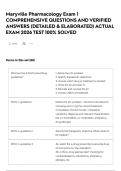
Maryville Pharmacology Exam 1
COMPREHENSIVE QUESTIONS AND VERIFIED
ANSWERS (DETAILED & ELABORATED) ACTUAL
EXAM 2026 TEST 100% SOLVED
Save
Terms in this set (88)
What are the 5 WHO prescribing 1. define the pt's problem
guidelines? 2. Specify therapeutic objectives
3. choose which drug or treatment is needed
4. Write the Rx and start tx
5. Educate and counsel the pt
6. monitor effect of treatment
WHO rx guideline 1 Define the pt's problem . This forms the basis for
choosing and rx-ing the correct treatment.
Consultation should include: complaints,
symptoms, diagnosis and relevant characteristics
like co-morbidities, co-medication, pregnancy,
drug allergies
WHO rx guideline 2 Specify the therapeutic objective. What needs to
be treated?
WHO rx guideline 3 3a. select the p-drug (prescribers personal drug
of first choice for the indication.)
3b. Is the p-drug appropriate? checking for
contraindications, interactions, pregnancy,
allergies, etc.
,WHO rx guideline 4 Write rx and start the treatment.
WHO rx guideline 5 Educate and counsel the pt. Intructions and
warnings about the tx.
WHO rx 6 Monitor the treatment.
Coreg (Carvedilol) *beta blocker used to treat mild to severe CHF,
left ventricular dysfunction following MI, HTN.
*works by causing vasodilation to the peripheral
vasculature to decrease the workload on the
heart.
*Non selective beta blocker and Alpha-1 blocker
*3rd generation beta blocker
*particularly useful in African Americans
*Dose: 0.625 mg-25mg PO BID with food
*administering with food helps prevent postural
hypotension
*Education: don't skip doses, take with food
hypersensitivty reactions: 1. A-allergic
mnemonic ACID 2.C-cytotoxic
3.I- Immune complex deposition
4. D-delayed
Type I hypersensitivity A-allergic
*IgE mediated- quick onset after exposure
*production of IgE after antigen exposure.
*urticaria, wheezing, rhinitis, anaphylaxis
Type II hypersensitivity C-cytotoxic
*cytotoxic/antibody mediated
* drug binds to RBCs and is recognized by
antibody-usually IgG
*complement and cytotoxic T cells are activated
*Rare response
, Type III hypersensitivity I-immune complex/IgG/IgM mediated
*antibodies are formed against soluble antigens.
ANtigen-antibody complexes are deposited in
tissues such as joints and lungs.
*cause serum sickness. Ex: ceclor (antibiotic)
Type IV hypersensitivity D-delayed- delayed or cell mediated
*cytotoxic T cells are activated
*poison ivy, latex, etc
*causes contact dermatitis
*cytokine storm if there is repeated exposure
Grapefruit juice *increases drug toxicity
*don't drink with SSRIs, calcium channel blockers,
statins, benzos
*increases absorption and decreases the
metabolism
Atropine-class/mechanism of action *anticholinergic
*inhibits action of acetylcholine and blocks the
PNS.
*Increases HR by increasing conduction int eh SA
and AV node
atropine- indications *symptomatic bradycardia (sinus, junctional, AV
blocks, causing significant hypotension,
ventricular ectopy, angina, etc.)
*organphosphate poisoning
* RSI in peds
*beta blocker and calcium channel blocker
overdose
atropine- contraindications *tachycardia
*HTN
*hypothermic bradycardia
*narrow angle glaucoma
COMPREHENSIVE QUESTIONS AND VERIFIED
ANSWERS (DETAILED & ELABORATED) ACTUAL
EXAM 2026 TEST 100% SOLVED
Save
Terms in this set (88)
What are the 5 WHO prescribing 1. define the pt's problem
guidelines? 2. Specify therapeutic objectives
3. choose which drug or treatment is needed
4. Write the Rx and start tx
5. Educate and counsel the pt
6. monitor effect of treatment
WHO rx guideline 1 Define the pt's problem . This forms the basis for
choosing and rx-ing the correct treatment.
Consultation should include: complaints,
symptoms, diagnosis and relevant characteristics
like co-morbidities, co-medication, pregnancy,
drug allergies
WHO rx guideline 2 Specify the therapeutic objective. What needs to
be treated?
WHO rx guideline 3 3a. select the p-drug (prescribers personal drug
of first choice for the indication.)
3b. Is the p-drug appropriate? checking for
contraindications, interactions, pregnancy,
allergies, etc.
,WHO rx guideline 4 Write rx and start the treatment.
WHO rx guideline 5 Educate and counsel the pt. Intructions and
warnings about the tx.
WHO rx 6 Monitor the treatment.
Coreg (Carvedilol) *beta blocker used to treat mild to severe CHF,
left ventricular dysfunction following MI, HTN.
*works by causing vasodilation to the peripheral
vasculature to decrease the workload on the
heart.
*Non selective beta blocker and Alpha-1 blocker
*3rd generation beta blocker
*particularly useful in African Americans
*Dose: 0.625 mg-25mg PO BID with food
*administering with food helps prevent postural
hypotension
*Education: don't skip doses, take with food
hypersensitivty reactions: 1. A-allergic
mnemonic ACID 2.C-cytotoxic
3.I- Immune complex deposition
4. D-delayed
Type I hypersensitivity A-allergic
*IgE mediated- quick onset after exposure
*production of IgE after antigen exposure.
*urticaria, wheezing, rhinitis, anaphylaxis
Type II hypersensitivity C-cytotoxic
*cytotoxic/antibody mediated
* drug binds to RBCs and is recognized by
antibody-usually IgG
*complement and cytotoxic T cells are activated
*Rare response
, Type III hypersensitivity I-immune complex/IgG/IgM mediated
*antibodies are formed against soluble antigens.
ANtigen-antibody complexes are deposited in
tissues such as joints and lungs.
*cause serum sickness. Ex: ceclor (antibiotic)
Type IV hypersensitivity D-delayed- delayed or cell mediated
*cytotoxic T cells are activated
*poison ivy, latex, etc
*causes contact dermatitis
*cytokine storm if there is repeated exposure
Grapefruit juice *increases drug toxicity
*don't drink with SSRIs, calcium channel blockers,
statins, benzos
*increases absorption and decreases the
metabolism
Atropine-class/mechanism of action *anticholinergic
*inhibits action of acetylcholine and blocks the
PNS.
*Increases HR by increasing conduction int eh SA
and AV node
atropine- indications *symptomatic bradycardia (sinus, junctional, AV
blocks, causing significant hypotension,
ventricular ectopy, angina, etc.)
*organphosphate poisoning
* RSI in peds
*beta blocker and calcium channel blocker
overdose
atropine- contraindications *tachycardia
*HTN
*hypothermic bradycardia
*narrow angle glaucoma


