

Written by students who passed Immediately available after payment Read online or as PDF Wrong document? Swap it for free 4.6 TrustPilot
logo-home
Document preview thumbnail
Preview 3 out of 30 pages
Exam (elaborations)

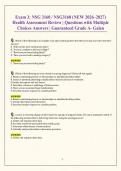
Exam 3: NSG 3160 / NSG3160 (NEW 2026–2027) Health Assessment Review | Questions with Multiple Choices Answers | Guaranteed Grade A- Galen

Document preview thumbnail
Preview 3 out of 30 pages

Exam 3: NSG 3160 / NSG3160 (NEW 2026–2027) Health Assessment Review | Questions with Multiple Choices Answers | Guaranteed Grade A- Galen Q. Which of the following is an example of an open-ended question that the nurse may use in the interview process? A. "Did you take your medication today?" B. "Are you a student at the local college?" C. "How have you been feeling lately?" D. "Have you ever had to undergo surgery?" ANSWERS C. "How have you been feeling lately?" Q. Which of the following are true related to nursing diagnoses? (Select all that apply) A. Relates contributing factors or relationships to identified health problem B. Actual or potential physiology complications related to disease or treatment C.Include descriptors and risk factors D. Describes a disease or pathology of body systems E. There are not associated legal ramifications F. Describes human response to a health problem ANSWERS A. Relates contributing factors or relationships to identified health problem C. Include descriptors and risk factors F. Describes human response to a health problem. Q. A nurse is recieving change-of shift report for a group of assigned clients. The nurse anticipates which of the following activities first in delivering client care using the nursing process? A. Collect and organize client data B. Set client centererd measurable and realistic goals. C. Determine effectiveness of interventions. D. Critically analyze client data to determine priorities ANSWERS A. Collect and organize client data Q. The nurse reassess a client's temperature 45 minutes after adminstering acetaminophen. This is an example of what type of assessment? A. Routine B. Intermittent C. Terminal D. Ongoing ANSWERS D. Ongoing Q. A nurse in a clinic is interviewing a client who will undergo diagnostic testing. The nurse should ask about a client's potential allergies during which phase of the nursing process? A. Implementation B. Assessment C. Planning D. Evaluation ANSWERS B. Assessment Q. The nurse is measuring the drainage from a Jackson- Pruitt (JP) drain. Which of the following is considered objective data? A. The drainage measurement is 25 mL B. The client stated that he has a pain level of 5. C. The client is reporting abdominal pain. D. The client stated, "I did not empty the drain." ANSWERS A. The drainage measurement is 25 mL Q. A home health nurse is discussing the dangers of carbon monozide poisoning with a client. Which of the following information should be included in the teaching? A. the lungs are damaged from carbon monoxide inhalation B. Carbon monoxide has a distinct odor, so report any unusual smells immediately. C. Water heaters should be inspected every 5 years. D. Carbon monoxide binds with the hemoglobin in the body ANSWERS D. Carbon monoxide binds with the hemoglobin in the body Q. The nurse is teaching a newly hired group of UAP about infection-control measures on the unit. It is crucial for the nurse to remind the UAPs that which of the following is the most effective way to prevent the spread of pathogens during client care? A. Discarding used syringes in appropriate containers B. Peforming hand hygiene frequently and consistently C. Properly disposing of contaminated equipment D. Chaning soiled linens daily for clients who have draining wounds. ANSWERS B. Peforming hand hygiene frequently and consistently Q. A nurse is providing nail care for a non-diabetic client. Which of the following actions should the nurse take? A. Clean under the nail with an orange stick B. Push the cuticles back with a metal nail file. C. Trim the nails at the lateral corners. D. File the nails in a rounded shape. ANSWERS A. Clean under the nail with an orange stick Q. The nurse is providing oral care for a client who is immobile. Which of the following actions should the nurse take? A. Apply petroleum jelly to the client's lips after oral care. B. Use a stiff toothbrush to clean the client's teeth C. Turn the client on his side before starting oral care. D. Use the thumb and index finger to keep the client's mouth open ANSWERS C. Turn the client on his side before starting oral care. Q. The nurse is reviewing information about Evidence based practice. Which statement best reflects EBP? A. EBP does not consider the patient's own preferences as important. B. EBP relies on tradition for support of best practices C. EBP emphasizez the use of best evidence with the clinician's experience D. EBP is simply the use of best practice techniques for the treatment of patients. ANSWERS C. EBP emphasizez the use of best evidence with the clinician's experience Q. When reviewing the concepts of health, the nurse recalls that the components of holistic health include which of these? A. holistic health views the mind, body, and spirit as interdependent. B. Disease originates from the external environment. C. Nurses are response for a patient's health state. D. The individual human is a closed system. ANSWERS A. holistic health views the mind, body, and spirit as interdependent. Q. A visiting nurse is making an initial home visit for a patient who has several chronic medical problems. Which type of database is most appropriate to collect in this setting? A. focused B. Emergency C. Follow-up D. Complete ANSWERS D. A complete database Q. The clinic nurse is caring for a patient who has been coming to the clinic weekly for blood bressure checks since she changed medications 2 months ago. Which the is the most appropriate action for the nurse to take? A. Obtain a complete health history on the patient before checking her BP. B. Collect a follow up database and then check the patient's BP. C. Ask the patient to read her health record and inidicate any changes since her last visit D. Check the patient's BP ANSWERS B. Collect a follow up database and then check the patient's BP. Q. A female nurse is interviewing a male patient who is near the same age the nurse. During the interview, the patient makes an overtly sexual comment. Which is the best response by the nurse? A. " Oh you are too funny. Let's keep going with the interview." B. "Do you really think I would be interested?" C. "It makes me uncomfortable when you talk that way. Please stop. " D. "Stop that immediately". ANSWERS C. "It makes me uncomfortable when you talk that way. Please stop. " Q. During an interview, the nurse would expect that most of the interview will take place at what distance? A. public B. personal C. intimate D. social ANSWERS D. social distance Q. When observing a patient's verbal and nonverbal communcation the nurse notices a discrepancy. What action should the nurse take in this situation? A. Ask someone who knows the patient well to help interpret this discrepancy. B. Try to integrate the verbal and nonverbal messages and then interpret them as an average. C. Focus on the patient's nonverbal behaviors, because these are often more reflective of a patient's true feelings D. Focus on the patients verbal message and try to ignore the nonverbal behaviors ANSWERS C. Focus on the patient's nonverbal behaviors, because these are often more reflective of a patient's true feelings Q. The nurse if performing a functional assessment on an 82 year old patient who recently had a stroke. Which of these questions would be most important to ask? A. Do you wear glasses? B. Do you have any thyroid problems? C. Are you able to dress yourself? D. How many times a day do you have a bowel movement? ANSWERS C. Are you able to dress yourself? Q. A patient tells the nurse that he is allergic to penicillin. What is the best response by the nurse? A. How often have you received penicillin? B. Are you allergic to any other drugs? C. Describe what happens to you when you take penicillin. D. Ill write your allergy on your chart so you won't receive any penicillin ANSWERS C. Describe what happens to you when you take penicillin. Q. When the Nurse is evaluating the reliability of a patient's responses, which of these statements would be CORRECT? A. Patient has a history of drug abuse and therefore is not reliable. B. Patient would not answer questions concerning stress and therefore is not relieable. C. Patient provided consistent information and therefore is reliable. D. Patient smiled throught interview and therefore is assumed reliable ANSWERS D. Q. In response to a question about stress a 39 year old woman tells the nurse that her husband and mother both died in the past year. Which response by the nurse's most appropriate? A. I don't know how anyone could handle that much stress in one year B. This has been a difficult year for you. C. That is a lot of stressl now ;let's go on to the next section of your history. D. What did you do to cope witht he loss of both your husbnad and mother? ANSWERS D. What did you do to cope witht he loss of both your husbnad and mother? Q. What should a nurse include when documenting IPV and older adult abuse? A. a photographic documentation of the injuries B . General description of injuries in the progress notes C. summary of the abuse patient statements D. verbatim documentation of every statement made by the victim ANSWERS A. a photographic documentation of the injuries Q. A female patient has denied any abuse when answering the question on an abuse assessment screening tool but what finding by the nurse during the interview process is associated with IPV? A. Asthma B. Depression C. Frequent colds D. Confusion ANSWERS B. Depression A 42 year olf patient of Asian descent is being seen at the clinic for an initial examination. Why is it important for the nurse to consider the basics of the patient's culture during the patient's health assessment? A. Identify the cause of his illness B. Provide culturally relevant health care C. The U..S. is becoming increasingly diverse. D. Make accurate disease diagnosis. B. Provide culturally relevant health care The nurse is reviewing the characteristics of culture. Which statement is correct regarding the development of one's culture? A. Learned through language acquisition and socialization B. A nonsepecific phenomenon and is adaptive but unnecessary C. Genetically determined on the basis of racial bakground D. Biologically determined on the basis of physical characteristics. A. Learned through language acquisition and socialization The nurse is comparing the concepts of religion and spirituality. Which statement describes an appropriate component of one's spirituality? A. Belief in and the worship of God or gods B. BEing closely tied to one's ethnic background C. Attendance at a specific church of place of worship D. A connection with something larger than onself and belief in transcendence. D. A connection with something larger than onself and belief in transcendence. The nurse is asking questions about a patient's health beliefs. Which questions are appropriate? (Select all that apply) A. How do ou keep yourself Healthy? B. Does your family have a history of cancer? C. Have you ever had any surgery? D. What did your mother do to keep you from getting sick? E. How do you describe illness? F. What is your definition of health? A. How do ou keep yourself Healthy? D. What did your mother do to keep you from getting sick? E. How do you describe illness? F. What is your definition of health? Which of these techniques uses the sense of touch to assess texture, temp, moisture, and swelling when the nurse is assessing a patient? A. Palpation B. Inspection C. Auscultation D. Percussion A. Palpation The nurse will use which technique of assessment to determine the presence of crepitus, swelling, and pulsations? A. Auscultation B. Inspection C. Percussion D. Palpation D. Palpation The nurse is unable to identify any changes in sound when percussing over the abdomen of an obese patient. What should the nurse do next? A. Consider this finding as normal, and proceed with the abdominal assessment. B. Decrease the amount of strength used when attempting to percuss over the abdomen C. Increase the amount of strength used when attempting to percuss over the abdomen D. Ask the patient to take deep breaths to relax the abdominal musculature C. Increase the amount of strength used when attempting to percuss over the abdomen The nurse is performing a general survey. Which action is a component of the general survey? A. Observing specific body systems while performing the physical assessment B. Observing the patient's body stature and nutritional status C. Interpreting the subjective information the patient has reported D. Measuring the patients temp, pulse, respirations, and BP. C. Interpreting the subjective information the patient has reported The nurse will perform a palpated pressure before auscultating blood pressure. What is the reason for this? A. Acoid missing a falsely elevated BP B. More readily identify phase IV of the Korotkoff sounds. C. More clearly hear the Korotkoff sounds. D. Detect the presence of an auscultary gap. D. Detect the presence of an auscultary gap. When assessing the force, or strength, of a pulse, what should the nurse recall about the pulse? A. Reflects the blood volument in the arteries during diastole B. Demonstrates elasticity of the blood vessel wall C. Typically recorded on a 0- to 2- point scale D. Is a reflection of the heart's stroke volume. D. Is a reflection of the heart's stroke volume. When evaluating the temperature of older adults the nurse should remember which aspect about an older adults body temperature? A. the body temperature of the older adult is lower than that of a younger adult B. and older adults body temperature is approximately the same as that of a young child C. body temperature depends on the type of thermometer used D. In the older adult, the body temperature varies widely because of less effective heat control mechanisms. A. the body temperature of the older adult is lower than that of a younger adult A 60 year old male patient has been treated for pneumonia for the past six weeks. He is seen today in the clinic for an "unexplained" weight loss of 10 pounds over the last six weeks. Which is an appropriate rationale for the patient's weight loss? A. Weight loss is probably the result of a mental health dysfunction. B. Chronic diseases such as hypertension cause weight loss C. Unexplained weight loss often accompanies short term illnesses D. Weight loss is probablt the result of unhealthy eating habits. C. Unexplained weight loss often accompanies short term illnesses When performing a physical assessment, what technique would the nurse always perform first? 1. Palpation 2. Inspection 3. Percussion 4. Auscultation 2. Inspection The nurse is assessing a patient's skin during an office visit. What part of the hand and technique would be used to best assess the patient's skin temperature? 1. Fingertips 2. Dorsal surface of the hand 3. Ulnar portion of the hand 4. Palmar surface of the hand 2. 1.Dorsal surface of the hand •The nurse would use bimanual palpation technique in which situation? 1. Palpating the thorax of an infant 2. Palpating the kidneys and uterus 3. Assessing pulsations and vibrations 4. Assessing the presence of tenderness and pain 2. Palpating the Kidneys and uterus •While percussing over the liver of a patient, the nurse notices a dull sound. What would the nurse do? 1. Consider this a normal finding. 2. Palpate this area for an underlying mass. 3. Reposition the hands and attempt to percuss in this area again. 4. Consider this finding as abnormal and refer the patient for additional treatment. 1. Consider this a normal finding. •The nurse is preparing to use a stethoscope for auscultation. Which statement is true regarding the diaphragm of the stethoscope? 1. Used to listen for high-pitched sounds 2. Used to listen for low-pitched sounds 3. Should be lightly held against the person's skin to block out low-pitched sounds 4. Should be lightly held against the person's skin to listen for extra heart sounds and murmurs 1. Used to listen for high-pitched sounds •The nurse is preparing to palpate the thorax and abdomen of a patient. Which of these statements describes the correct technique for this procedure? (Select all that apply.) 1. Identify any tender areas and palpate them last. 2. Warm the hands first before touching the patient. 3. Use the palms of the hands to assess temperature of the skin. 4. Start with light palpation to detect surface characteristics. 5. For deep palpation, use one long continuous palpation when assessing the liver. 6. Use the fingertips to examine skin texture, swelling, pulsation, and presence of lumps. 1,2,4,6 •As a mandatory reporter of older adult abuse, which must be present before a nurse would notify the authorities? 1. Statements from victim 2. Statements from witnesses 3. Proof of abuse and/or neglect 4. Suspicion of older adult abuse and/or neglect 4. Suspicion of older adult abuse and/or neglect •During a home visit, the nurse notices that an older adult woman is caring for her bedridden husband. The woman states that this is her duty, she does the best she can, and her children come to help when they are in town. Her husband is unable to care for himself, and she appears thin, weak, and exhausted. The nurse notices that several of his prescription medication bottles are empty. What term best describes this situation? 1. Physical abuse 2. Financial exploitation 3. Psychological abuse 4. Neglect Neglect Neglect is the failure of the caregiver to prevent harm and includes failure to meet basic needs such as hygiene, nutrition/hydration, clothing, shelter, and medical care. Physical abuse is when an elder is intentionally injured, assaulted, threatened with a weapon, or inappropriately restrained. Financial abuse or exploitation is the unauthorized or improper use of the elder's resources for monetary or personal benefit, profit, or gain, such as forgery, theft, or improper use of guardianship or power of attorney. is the unauthorized or improper use of the elder's resources for monetary or personal benefit, profit, or gain, such as forgery, theft, or improper use of guardianship or power of attorney. Psychological or emotional abuse includes verbal and nonverbal behavior meant to inflict fear and distress. It includes humiliation, embarrassment, controlling behavior, social isolation, and damaging/destroying property. The scenario in the question is an example neglect. Unintentional physical neglect (despite good intentions) is the failure of a family member or caregiver to meet basic needs such as hygiene, nutrition/hydration, clothing, shelter, and medical care. The nurse is caring for a 17-year-old female patient. In which situation would the nurse screen the patient for intimate partner violence (IPV)? 1. When intimate partner violence is suspected 2. When a history of abuse in the family is known 3. As a routine part of each health care encounter 4. As part of the exam for a female with an unexplained injury 3. As a routine part of each health care encounter During an examination, the nurse notices a patterned injury on a patient's back. What would cause such an injury? 1. Blunt force 2. Friction abrasion 3. Stabbing from a kitchen knife 4. Whipping from an extension cord 4. Whipping from an extension cord The nurse is examining a 3-year-old child who was brought to the emergency department after a fall. Which bruise, if found, would be of most concern? 1. Bruises on the knee 2. Bruises on the elbow 3. Bruises on the abdomen 4. Bruises on both shins 3. Bruises on the abdomen The nurse is caring for several patients. Which patient is at highest risk for Intimate Partner Violence (IPV)? 1. An Asian female who speaks no English 2. A female multi-racial illegal immigrant 3. A non-Hispanic white female living in poverty 4. A female American Indian living above the poverty line 2. A female multi-racial illegal immigrant A patient reports having had abdominal pain for the past week. What would be the nurse's best response? 1. "Can you point to where it hurts?" 2. "What have you had to eat in the last 24 hours?" 3. "Have you ever had any surgeries on your abdomen?" 4. "We'll talk more about that later in the interview." 1. "Can you point to where it hurts?" A 59-year-old patient tells the nurse that he has Asthma. He has been having "wheezing" for the last 24 hours. How would the nurse best document his reason for seeking care? 1. AB. is a 59-year-old man seeking treatment for Asthma. 2. AB. came into the clinic reporting wheezing for the past 24 hours. 3. AB. is a 59-year-old man who states that he has asthma and wants it checked. 4. AB. is a 59-year-old man who states that he has been having "wheezing" for the past 24 hours. 4. AB. is a 59-year-old man who states that he has been having "wheezing" for the past 24 hours. What does the review of systems provide the nurse? 1. Physical findings related to each system 2. Information regarding health promotion practices 3. An opportunity to teach the patient medical terms 4. Information necessary for the nurse to diagnose the patient's medical problem 2. Information regarding health promotion practices The nurse is conducting an interview with a woman who has recently learned that she is pregnant and has come to the clinic today to begin prenatal care. The woman states that she and her husband are excited about the pregnancy but have a few questions. She looks nervously at her hands during the interview and sighs loudly. Considering the concept of communication, which statement does the nurse know to be most accurate when describing this woman? 1. Excited about her pregnancy but nervous about the labor. 2. Exhibiting verbal and nonverbal behaviors that do not match. 3. Excited about her pregnancy, but her husband is not, and this is upsetting to her. 4. Not excited about her pregnancy but believes the nurse will negatively respond to her if she states this. 2. Exhibiting verbal and nonverbal behaviors that do not match. Which adjustment in the physical environment would the nurse make to promote the success of an interview? 1. Arrange seating across a desk or table. 2. Reduce noise by turning off televisions and radios. 3. Reduce the distance between the interviewer and the patient to 2 feet or less. 4. Provide dim lighting to make the room cozy and help the patient relax. 2. Reduce noise by turning off televisions and radios •In an interview, the nurse may find it necessary to take notes to aid his or her memory later. Which statement is true regarding note-taking? 1. Note-taking may impede the nurse's observation of the patient's nonverbal behaviors. 2. Note-taking allows the patient to continue at their own pace as the nurse records what is said. 3. Note-taking allows the nurse to shift attention away from the patient, resulting in an increased comfort level. Incorrect 4. Note-taking allows the nurse to break eye contact with the patient, which may increase his or her level of comfort. 1. Note-taking may impede the nurse's observation of the patient's nonverbal behaviors. •The nurse asks, "I would like to ask you some questions about your health and your usual daily activities so that we can better plan your stay here." Based on this question, the nurse is at which phase of the interview process? 1. Summary 2. Closing 3. Working 4. Opening or introduction 4. Opening or introduction •A woman has just entered the emergency department after being battered by her husband. The nurse needs to get some information from her to begin treatment. What is the best choice for an opening phase of the interview with this patient? 1. "Hello, Nancy, my name is Nurse C." 2. "Mrs. H., my name is Nurse C. How are you?" 3. "Hello, Mrs. H., my name is Nurse C. It sure is cold today!" 4. "Mrs. H., my name is Nurse C. I'll need to ask you a few questions about what happened." 4. "Mrs. H., my name is Nurse C. I'll need to ask you a few questions about what happened." •During an interview, the nurse states, "You mentioned having shortness of breath. Tell me more about that." Which verbal skill is used with this statement? 1. Reflection 2. Facilitation 3. Direct question 4. Open-ended question 4. Open-ended question •In using verbal responses to assist the patient's narrative, some responses focus on the patient's frame of reference and some focus on the health care provider's perspective. Which type of verbal response focuses on the health care provider's perspective? 1. Empathy 2. Reflection 3. Facilitation 4. Confrontation 4. Confrontation •A woman is discussing the problems she is having with her 2-year-old son. She says, "He won't go to sleep at night, and during the day he has several fits. I get so upset when that happens." Which is the best response by the nurse to gain a better understanding of the problem? 1. "Go on, I'm listening." 2. "Fits? Tell me what you mean by this." 3. "Yes, it can be upsetting when a child has a fit." 4. "Don't be upset when he has a fit; every 2-year-old has fits." 2. "Fits? Tell me what you mean by this." •During an interview, a parent of a hospitalized child is sitting in a recliner with his legs extended and his arms at his sides. As the interviewer begins to discuss his son's treatment, he suddenly changes positions and crosses his arms against his chest and crosses his legs. What does this change in posture suggest? 1. Simply changing positions 2. More comfortable in this position Incorrect 3. Tired and needs a break from the interview 4. Uncomfortable talking about his son's treatment 4. Uncomfortable talking about his son's treatment •A mother brings her 28-month-old daughter into the clinic for a well-child visit. At the beginning of the visit, the nurse focuses attention away from the toddler, but as the interview progresses, the toddler begins to "warm up" and is smiling shyly at the nurse. The nurse will be most successful in interacting with the toddler if which is done next? 1. Tickle the toddler and get her to laugh. 2. Stoop down to her level and ask her about the toy she is holding. 3. Continue to ignore her until it is time for the physical examination. 4. Ask the mother to leave during the examination of the toddler, because toddlers often fuss less if their parent is not in view. 2. Stoop down to her level and ask her about the toy she is holding. To assess a patient's abdomen by palpation, how should the nurse proceed? a. Avoid palpation of reported "tender" areas because this may cause the patient pain. b. Quickly palpate a tender area to avoid any discomfort that the patient may experience. c. Begin the assessment with deep palpation, encouraging the patient to relax and take deep breaths. d. Start with light palpation to detect surface characteristics and to accustom the patient to being touched. d. Start with light palpation to detect surface characteristics and to accustom the patient to being touched. Palpation can be used for which of the following? Select all that apply. a. Position of an organ b. Size of a mass c. Density of an organ d. Deep tendon reflex e. Pulsation f. Vibration A,B,E,F The nurse is assessing a patient's skin for swelling during an office visit. What is the best technique to use to assess the patient's skin for lumps and swelling? Use the: a. fingertips because they have better tactile discrimination than the rest of the hand. b. dorsal surface of the hand because the skin is thinner than on the palms of the hand. c. ulnar portion of the hand because there is increased blood supply that enhances temperature sensitivity. d. palmar surface of the hand because it is most sensitive to temperature variations. a. fingertips because they have better tactile discrimination than the rest of the hand. Evidence-based nursing practice is: a. Combining clinical expertise with the use of nursing research to provide the best care for patients while considering the patient's values and circumstances b. Appraising and looking at the implications of one or two articles as they relate to the culture and ethnicity of the patient c. Completing a literature search to find relevant articles that use nursing research to encourage nurses to use good practices d. Finding value-based resources to justify nursing actions when working with patients of diverse cultural backgrounds a. Combining clinical expertise with the use of nursing research to provide the best care for patients while considering the patient's values and circumstances A. S., a 35-year-old, is at your clinic today for a well visit. She recently moved to the area and is establishing with a new primary care provider. What information would you include in the database for this new patient? Select all that apply. a. Current health state b. Lifestyle and risk factors c. Only subjective information d. Only objective information e. Physical examination f. Health maintenance behaviors g. Your perception of the patient's health h. The patient's perception of current health A,B,E,F,H You are caring for an adolescent female in an urgent care clinic. Her boyfriend checked her in and filled out paperwork. You note that she is listed as 18 years old but appears younger. She is at the clinic due to pelvic pain, and her boyfriend has requested a pregnancy test. You notice that the person she is with appears be in his late 20s or early 30s. She is withdrawn, does not answer questions, and seems unable to answer basic demographic information, including her address and phone number. To complete a full assessment, you do the following. Select all that apply. a. Defer to the boyfriend to answer questions because he seems to know what is happening. b. Complete a physical assessment noting any bruising or other signs of trauma. c. Provide a pregnancy test. d. Screen for sexually transmitted infection. e. Separate the patient and her companion to get a more thorough history from the patient. f. Allow the compa B,C,D,E What is the sequence of techniques used during and axamination of the abdomen. A. percussion, inspection, palpation, auscultation. B. inspection,palpation,percussion,auscultation C. inspection,auscultation,percussion,palpation D. auscultation,inspection,palpation,percussion C. inspection,auscultation,percussion,palpation Auscultating the abdomen is begun in the RLQ because: a. Bowel sounds are always normally present here. b. Peristalsis through the descending colon is usually active. c. This is the location of the pyloric sphincter. d. Vascular sounds are best heard in this area. a. Bowel sounds are always normally present here. The nurse is caring for a hospitalized client with a diagnosis of heart failure who suddenly complains of shortness of breath and dyspnea during activity. After assisting the client to bed and placing the client in high-Fowler's position, the nurse would take which immediate action? 1. Administer high-flow oxygen to the client. 2. Call the consulting cardiologist to report the findings. 3. Prepare to administer an additional dose of furosemide. 4. Obtain a set of vital signs and perform focused respiratory and cardiovascular assessments. 4. Obtain a set of vital signs and perform focused respiratory and cardiovascular assessments. A client scheduled for surgery states to the nurse, "I'm not sure if I should have this surgery." Which response by the nurse is appropriate? 1. "It's your decision." 2. "Don't worry. Everything will be fine." 3. "Why don't you want to have this surgery?" 4. "Tell me what concerns you have about the surgery." 4. "Tell me what concerns you have about the surgery." Which teaching method is most effective when providing health care instructions to members of specific populations? 1. Teach-back 2. Video instruction 3. Written materials 4. Verbal explanation 1. Teach-back 1. The nurse is assigned to care for four clients. In planning client rounds, which client would the nurse assess first? 1. A postoperative client preparing for discharge with a new medication 2. A client requiring daily dressing changes of a recent surgical incision 3. A client scheduled for a chest x-ray after insertion of a nasogastric tube 4. A client with asthma who requested a breathing treatment during the previous shift 4. A client with asthma who requested a breathing treatment during the previous shift The nurse is completing the admission assessment of a client who is intellectually disabled. Which part of the client encounter may require more time to complete? 1. The history 2. The physical assessment 3. The nursing plan of care 4. The medication reconciliation 1. The history The nurse caring for a refugee considers which health care need a priority for this client? 1. Access to housing 2. Access to clean water 3. Access to transportation 4. Access to mental health care services 4. Access to mental health care services The nurse is caring for a postoperative client who is receiving demand-dose hydromorphone via a patient-controlled analgesia (PCA) pump for pain control. The nurse enters the client's room and finds the client drowsy and records the following vital signs: temperature 97.2° F (36.2° C) orally, pulse 52 beats per minute, blood pressure 101/58 mm Hg, respiratory rate 11 breaths per minute, and SpO2 of 93% on 3 liters of oxygen via nasal cannula. Which action would the nurse take first? 1. Document the findings. 2. Attempt to arouse the client. 3. Contact the primary health care provider (PHCP). 4. Check the medication administration history on the PCA pump. 2. Attempt to arouse the client. You are preparing to do the initial interview with a 15-year-old patient. In order to establish rapport, you: a. Begin the interview by immediately discussing the health concern. Adolescents do not want small talk and want to finish as quickly as possible. b. Begin the interview by completing the full health history and discussing drug/alcohol use. Adolescents want to finish as quickly as possible. c. Begin the interview by asking open, friendly questions about school and hobbies. Adolescents appreciate the opportunity to discuss themselves. d. Begin the interview by asking open-ended questions that explore the health history. Adolescents are knowledgeable, and you can speak to them like adults. c. Begin the interview by asking open, friendly questions about school and hobbies. Adolescents appreciate the opportunity to discuss themselves. M.J., age 85, has been diagnosed with terminal lung cancer. During report you were told that the family does not want her to know the diagnosis. M.J. asks you, "Am I going to die?" Which of the following is the best therapeutic response from you, the nurse? a. "Tell me what prompted that question." b. "I will ask your physician to discuss this matter with you." c. "Let's take each day as it comes." d. "I think you should discuss that with your family." a. "Tell me what prompted that question." Which of the following are open-ended questions? Select all that apply. a. Tell me about your headaches. b. Describe your chest pain. c. Point to where the pain is. d. What do you expect from me as your nurse? e. Do you want to discuss all your options? A,B,D You are the triage nurse in the emergency department and perform the initial intake assessment on a patient who does not speak English. Based on your understanding of linguistic competence, which action would present as a barrier to effective communication? a. Maintaining a professional, respectful demeanor b. Allowing for additional time to complete the process c. Providing the patient with a paper and pencil so answers can be written d. Obtaining interpreter services so the family does not need to translate c. Providing the patient with a paper and pencil so answers can be written Which statement is most appropriate to use when initiating an assessment of cultural beliefs with a patient? a. "Are you of the Christian faith?" b. "Do you want to see a medicine man?" c. "How often do you seek help from medical providers?" d. "What cultural or spiritual beliefs are important to you?" d. "What cultural or spiritual beliefs are important to you?" You are caring for a Jewish patient who needs a leg amputation. The patient is concerned about what will happen to the leg after amputation and becomes visibly distraught when you inform him it will be disposed of by the hospital. What should you do? a. Provide information on postoperative prosthetics so he understands that loss of the limb does not limit physical ability. b. Provide education on the surgical procedure and what to expect in the immediate post-operative period so he feels more prepared. c. Ask if he would like you to contact friends, family, or the hospital chaplain so he can talk about how he feels. d. Ask about his cultural beliefs and whether there is anything the hospital can do to support him before, during, and after surgery. d. Ask about his cultural beliefs and whether there is anything the hospital can do to support him before, during, and after surgery. Which statement best describes religion? a. An organized system of beliefs concerning the cause, nature, and purpose of the universe b. Belief in a divine or superhuman spirit to be obeyed and worshiped c. Affiliation with one of the 1200 recognized religions in the United States d. The following of established rituals, especially in conjunction with health-seeking behaviors a. An organized system of beliefs concerning the cause, nature, and purpose of the universe During further investigation you discover that X.L. follows a Halal diet. You know very little about the diet. What is the most appropriate next step? a. Ask X.L. about the diet she follows and whether she has access to appropriate food in the university dining facility. b. Complete a physical assessment to determine the cause of her progressive symptoms. c. Make a note of the diet in her chart and plan to do research on the diet prior to seeing your next patient. d. Complete a thorough health history to determine if she has experienced any changes in health since her last appointment. a. Ask X.L. about the diet she follows and whether she has access to appropriate food in the university dining facility. During report on a 39-year-old Hispanic male, you learn that the patient had surgery yesterday but has refused all pain medication and denies any pain. As you assess the patient, you notice an elevated heart rate and blood pressure as well as grimacing with abdominal palpation, but the patient continues to deny pain. You: a. continue the assessment believing that if a patient is in pain, they will tell you. b. recognize that pain expression may vary based on culture and that all Hispanic men do not take pain medications c. recognize that pain expression may vary based on culture and ask appropriate cultural assessment questions d. recognize that men do not respond to pain the same way as women, and they may not feel pain the same way c. recognize that pain expression may vary based on culture and ask appropriate cultural assessment questions You are caring for a patient who requests that a shaman (medicine man) visit him while he is hospitalized. He would like a smudging ritual completed prior to his upcoming treatment. You know that smudging involves the burning of sage. Your best response is: a. We cannot allow that ritual in the hospital because we do not allow open flames. b. Call your shaman and have him come any time. Just make sure to close the door. c. Let's work with the shaman to determine the best way to complete the ritual in a safe manner. d. Don't worry. Dr. Smith is the best, so you have nothing to worry about. c. Let's work with the shaman to determine the best way to complete the ritual in a safe manner. You are reviewing assessment data of a 45-year-old male patient who had recent surgery and rates his pain at 8 on a 10-point scale. As you review the electronic health record, you note which of the following cues related to the patient's pain? Select all that apply. a. Normal skin turgor b. Normal S1, S2 heart sounds c. Pale skin d. Tachypnea (rapid breathing) e. Tachycardia (rapid pulse) f. Clear breath sounds c. Pale skin d. Tachypnea (rapid breathing) e. Tachycardia (rapid pulse) You are working in the emergency department and receive a patient who was admitted via ambulance. The patient is alert, but the injuries are severe. What are your priorities when collecting this patient's emergency database? a. A complete health history and full physical examination b. A full list of medications, allergies, family history, and personal history c. Previously identified problems including any current treatments and health promotion d. Collect critical information as you begin lifesaving measures d. Collect critical information as you begin lifesaving measures You completed the health history and physical examination on your new admission. After completing the assessment phase of the nursing process, the next step includes which of the following? a. Interpreting clinical findings and determining a diagnosis b. Clustering cues and evaluating assessment data c. Collaborating with the patient and reviewing information d. Evaluating the information collected and determining next steps a. Interpreting clinical findings and determining a diagnosis The mother of a 2-year-old toddler tells the nurse that her son has an ear infection. What would be the most appropriate response? a. "Maybe he is just teething, but we will look in his ears later." b. "Does he have a history of frequent ear infections? It could just be teething." c. "Are you sure he is really having ear pain and not something else?" d. "Describe what he is doing that makes you think he has an ear infection." 5. Underline the signs in the following patient example. 6. Highlight the reason for seeking care in the following patient example. d. "Describe what he is doing that makes you think he has an ear infection." As you complete the health history, the patient appears nervous and avoids eye contact. It is unclear whether he is a reliable source of information, and you begin to question whether he is being truthful during the interview. Your best option is: a. Continue with the interview but note the nervous appearance and avoidance of eye contact. b. Confront the patient. Let him know that you are concerned he is not a reliable source of his health information. c. Continue with the interview but ask the same question in a different way to determine reliability. d. Ask the person if there is someone else who can serve as a secondary contact to ensure information is correct. c. Continue with the interview but ask the same question in a different way to determine reliability. Which of the following are open-ended questions? Select all that apply. a. Tell me about your headaches. b. Describe your chest pain. c. Point to where the pain is. d. What do you expect from me as your nurse? e. Do you want to discuss all your options? A,B,D You are preparing to do the initial interview with a 15-year-old patient. In order to establish rapport, you: a. Begin the interview by immediately discussing the health concern. Adolescents do not want small talk and want to finish as quickly as possible. b. Begin the interview by completing the full health history and discussing drug/alcohol use. Adolescents want to finish as quickly as possible. c. Begin the interview by asking open, friendly questions about school and hobbies. Adolescents appreciate the opportunity to discuss themselves. d. Begin the interview by asking open-ended questions that explore the health history. Adolescents are knowledgeable, and you can speak to them like adults. c. Begin the interview by asking open, friendly questions about school and hobbies. Adolescents appreciate the opportunity to discuss themselves. A newly admitted patient is in acute pain, has not been sleeping well lately, and is having difficulty breathing. How should the nurse prioritize these problems? a. Breathing, pain, and sleep b. Breathing, sleep, and pain c. Sleep, breathing, and pain d. Sleep, pain, and breathing A Which is a barrier to incorporating EBP? a. Nurses' lack of research skills in evaluating the quality of research studies b. Lack of significant research studies c. Insufficient clinical skills of nurses d. Inadequate physical assessment skills A Put the following patient situations in order of the level of priority (from highest priority to lowest priority). 1. First-level priority problem 2. Second-level priority problem 3. Third-level priority problem a. A teenager who was stung by a bee during a soccer match is having trouble breathing. b. A patient newly diagnosed with type 2 diabetes mellitus does not know how to check his own blood glucose levels with a glucometer. c. An older adult with a urinary tract infection is also showing signs of confusion and agitation. A C BA nurse is receiving change-of-shift report for a group of assigned clients. The nurse anticipates which of the following activities first in delivering client care using the nursing process? Collect and organize client data Which of the following is an example of an open-ended question that the nurse may use in the interview process? "How have you been feeling lately?" Which of the following are true related to nursing diagnoses? Relates contributing factors or relationships to identified health problem Describes human response to a health problem Include descriptors and risk factors The nurse is planning to perform research and is going to use deductive reasoning. Which of the following are parts of the inductive reasoning process? The premise must be correct. Conclusions are drawn by logical inference from given premises. Moves from general to specific. A nurse in a clinic is interviewing a client who will undergo diagnostic testing. The nurse should ask about a client's potential allergies during which phase of the nursing process? Assessment scientific method systematic way of thinking quantitative research standardized experimental designs with hypothesis, measurable variables and outcomes, and statistical analysis bias refers to systematic distortion of a finding from data A client is having a lumbar puncture. In which position should the nurse place the client? Lateral with head bent toward the chest and knees flexed onto the abdomen The nurse needs to obtain a sputum specimen from a client. What should the nurse have the client do? Cough to bring up secretions. An older adult client is at a greater risk for infection. Which of the following nursing interventions is appropriate to reduce the risk of infection? Encourage deep-breathing and increased intake of fluids to keep respiratory secretions thin and keep them from accumulating in the lower lungs. The nurse is selecting dressings for a clean abdominal incision that will be allowed to heal by secondary intention. What principles should the nurse use in choosing this dressing? Materials used in dressing this wound should keep the wound bed moist. The nurse is conducting a class for new graduate nurses. While teaching the class, what should the nurse keep in mind regarding what novice nurses, without a background of skills and experience from which to draw upon, are more likely to base their decisions on? A set of rules The nurse is reviewing data collected after an assessment. Of the data listed below, which would be considered related cues that would be clustered together during data analysis? Nonproductive cough. Inspiratory wheezes noted in left lower lobes. Patient reports dyspnea upon exertion. Rate of respirations 16 breaths per minute. In which situation is it most appropriate for the nurse to perform a focused or problem-centered history? Patient in an outpatient clinic has cold and influenza-like symptoms. The nursing process is a sequential method of problem solving that nurses use and includes which steps? Assessment, diagnosis, outcome identification, planning, implementation, and evaluation The nurse is performing a health interview on a patient who has a language barrier, and no interpreter is available. Which is the best example of an appropriate question for the nurse to ask in this situation? "Do you take medicine?" When taking a history from a newly admitted patient, the nurse notices that he often pauses and expectantly looks at the nurse. What would be the nurse's best response to this behavior? Lean forward slightly and making eye contact ask "Is there anything else?" A woman has just entered the emergency department after being battered by her husband. The nurse needs to get some information from her to begin treatment. What is the best choice for an opening phase of the interview with this patient? "Mrs. H., my name is Nurse C. I'll need to ask you a few questions about what happened." When the nurse is evaluating the reliability of a patient's responses, which of these statements would be correct? Patient provided consistent information and therefore is reliable. A 59-year-old patient tells the nurse that he has ulcerative colitis. He has been having "black stools" for the last 24 hours. How would the nurse best document his reason for seeking care? J.M. is a 59-year-old man who states that he has been having "black stools" for the past 24 hours. A patient tells the nurse that he is allergic to penicillin. What is the best response by the nurse? "Describe what happens to you when you take penicillin." A patient tells the nurse that she has had abdominal pain for the past week. What would be the nurse's best response? "Can you point to where it hurts?" During an interview, a woman has answered "yes" to two of the Slapped, Threatened, and Throw (STaT) questions. What should the nurse say next? "Tell me about the abuse in your relationship." During an examination, the nurse notices a patterned injury on a patient's back. What would cause such an injury? Whipping from an extension cord 1. What are the modifiable risks of CAD (coronary artery disease) Smoking, obesity, hypertension, high cholesterol, diabetes 2. Does pain always mean cardiac reasons? What should you ask if patient is experiencing chest pain? NO - Is it sudden? What brings it on? 3. Signs of pulmonary embolism? Sharp, stabbing pain that worsens with deep breath 4. Signs of pneumonia? Sharp, stabbing, but associated with a cough 5. Signs of pneumothorax? Acute, sudden, sharp 6. Signs of GI-related? Burning sensation with eating large meals 7. What is S1 and what causes the sound? Start of systole and serves as a reference point for Oming of all cardiac sounds - Caused by the closure of AV valves - LUB (apex) 8. What causes the sound of S2? Closure of the semilunar valves - DUB (base) 9. What are summation sounds? When both the pathological S3 and S4 are present then a quadruple rhythm is heard 10. What is a murmur? Occurs with turbulent blood flow in the heart - Blowing, swooshing sound 11. What is pericardial friction rub? Inflammation of the pericardium gives rise to friction rub - High pitched and scratchy, heard with a diaphragm when a person is sitting up 12. What are the locations of the heart valves? Aortic: second right interspace -----Pulmonic: second left interspace-------- Erbs: third left interspace----- Tricuspid: left lower sternal border ----- Mitral: Fifth interspace around the left midclavicular line 13. What should you do when you hear a split S2 and when does it occur? Concentrate on the split as you watch the person's chest rise up and down with normal breathing---Every fourth heartbeat fading in with inhalation and fading out with exhalation 14. What should you NOT do when hearing a split S2? DO NOT have the person hold their breath-- Breath-holding only equalizes ejection times in the right and left sides of the heart and causes the split to go away. 15. What is a thrill? Palpable vibration, feels like the throat of a purring cat 16. What is a thrill caused by? Turbulent blood flow and directs you to locate the origin of loud murmurs 18. What is apical impulse and how to assess it? Palpate left of the sternal border down the midclavicular line between the 4th and 5th intercoastal space. 19. What position should you have a patient in when estimating jugular venous pressure? 45 degrees 20. How much exercise should you teach your patient? 5 times a week, at least 30 minutes each time 21. Why should patients take low-dose aspirin every day? Control BP 22. What should you teach if the patient smokes? Teach about smoking cessation and exercise 23. What are key expected findings cardiac-wise, in an older patient?, Increase in systolic pressure from arteriosclerosis - The presence of supraventricular dysrhythmias increases - EEG from changes in the conduction system - OrthostaOc hypotension 24. What do you want to educate an older patient about? Take their time when moving from sitting to supine and from sitting to standing positions due to orthostatic hypotension - Put call light on to have staff help get up to prevent falls 25. What is arteriosclerosis? Thickening/stiffening of arteries caused by collagen and calcium deposits, loss of elasticity 26. How should you assess carotid pulse? One at a time to avoid having the patient pass out. 27. What is a pulse deficit and how do you figure it out? Difference from apical and radial pulse = pulse deficit & Irregularity What are the aggravating and relieving factors of chronic arterial (PAD)? a. Aggrivating - activity, elevation b. Relieving factors - Rest What are the symptoms of PAD? a. Low ankle-brachial index, cool pale skin, diminished pulse, pallor on elevation What are the aggravating and relieving facts of chronic venous? a. aggravating - Prolonged standing and sitting b. Relieving -Elevation, lying, walking What are the symptoms of chronic venous? a. Edema, varicosis, weeping ulcers at ankles. What type of edema will you see with lymphatic obstruction? a. Unilateral What is a normal capillary refill? a. Less than 1-2 seconds What can cause a longer capillary refill? a. Environment can be cold, vasoconstriction b. Cigarette smoking c. Edema, anemia from decreased oxygen to tissues When and how to use a portable Doppler ultrasound? a. When unable to palpate a pulse b. Apply gel onto the site, and put the wand on there, will be audible. What will blood flow sound like with a portable Doppler ultrasound? a. Swishing, whooshing sound What does the Wells Score of DVT indicate? a. 1-2 -moderate probability b. 3 or more - a high probability How do you assess epitrochlear nodes? a. "Shaking hands", reach hand under the patient's elbow and into the groove between the biceps and triceps b. You should NOT feel any lymph nodes What are the 4.0 risk factors for breast cancer? a. Dense breasts = harder to pick up the diagnosis b. Age 65+ c. Genetic mutations - BRCA1 or BRCA 2 d. Two or more first-degree relative with breast cancer diagnosed at an early age e. Personal history Why would we teach patients to palpate into the axillary area when they perform a self-breast exam? a. Deep muscles and tail of Spence that extends into the area. When finding NEW onset nipple discharge, what should you do? a. Get a specimen and send it off to the lab, could indicate a mass How should you palpate the breast? a. Supine position with arm over head, pillow behind shoulder How do you palpate axillary lymph nodes? a. Patient sitting, b-e. Along chest wall and borders of axilla and inner aspect of upper arm What is crepitus? a. Coarse, crackling sensation felt during palpation What is fremitus? a. Vibration transmitted through body When does decreased fremitus occur? a. Obstructed bronchus, pleural effusion or thickening, pneumothorax or emphysema, b. Any barriers between sound and your palpating hand When does increased fremitus occur? a. Compression or consolidation of lung tissue What is bronchophony and what are the normal findings? a. Ask person to repeat ninety-nine while listening with stethoscope over chest wall, b. NORMAL - soft, muffled, distinct What is egophony and what are the normal findings? a. Auscultate chest while person phonates a long 'ee-ee-ee-ee' sound, b. NORMAL - Eeeeeee What is whispered pectoriloquy? a. Ask person to whisper a phrase like one-two-three, b. NORMAL - Faint, muffled, inaudible What are the characteristics of bronchial (tracheal) breath sounds? a. PITCH - High, b. AMPLITUDE - Loud, c. DURATION - Inspiration Expiration, d. QUALITY - Harsh, hollow tubular, e. NORMAL LOCATION - Trachea and larynx What are the characteristics of bronchovesicular breath sounds? a. PITCH - Moderate, b. AMPLITUDE - Moderate, c. DURATION - Inspiration = Expiration, d. QUALITY - Mixed, e. NORMAL LOCATION - Over major bronchi (fewer alveoli), around upper sternum in 1st and 2nd intercoastal spaces What are the characteristics of vesicular breath sounds? a. PITCH - Low, b. AMPLITUDE - Soft, c. DURATION - Inspiration Expiration, d. QUALITY - Rustling, like the sound of the wind in the trees, e. NORMAL LOCATION - Over peripheral lung fields where air flows through smaller bronchioles and alveoli What is amplitude? Soft What is duration? Inspiration Expiration What is quality? Rustling sound of wind in trees What is normal location? Over peripheral lung fields when air flows through smaller bronchioles and alveoli What is tactile fremitus? Palpable vibration from the larynx How is tactile fremitus assessed? Use a palmar base of the fingers and have the patient say 'ninety-nine'. Vibrations should feel the same in the corresponding areas on each side How is diaphragmatic excursion done? Assessing the posterior side How should you assess chest expansion? Place thumbs together posteriorly on the thoracic cage and have the patient take a deep breath. NORMAL - Hands move apart symmetrically What is resonance? Low-pitched, clear, hollow sounds that predominated in healthy lung tissue in adult What is hyper-resonance? Lower pitched, booming sound found when too much air is present such as in emphysema or pneumothorax What is dullness? Soft muffled thud. Signals of abnormal density in the lungs (EX: pneumonia, pleural effusion, atelectasis, tumor) What is a tympany? High pitched with longer duration than resonance and hyper resonance, sounds like a drum. Normally heard over fluid-filled organs such as the stomach, bladder, and bowels What is tachypnea? Rapid, shallow breathing. Increased rate 24 per minute What is bradypnea? Slow breathing. Decreased but regular rate 10 per minute What are Cheyne Stokes's Respirations? Respirations gradually wax and wane in a regular pattern increasing in rate and depth then decreasing. Periods of apnea of 20 seconds. Causes - Severe heart failure, renal failure, meningitis, drug overdose, intracranial pressure What is chronic obstructed breathing? Air trapping. Caused by COPD What are fine crackles lung sounds? High-pitched, discontinuous, popping lung sounds heard during inspiration. Caused by fluid in the alveoli or delayed reopening of the airways. What are crackles lung sounds? Discontinuous, high-pitched short crackling, popping sounds heard during inspiration that is not cleared by coughing. What are coarse crackles lung sounds? Loud, low-pitched bubbling and gurgling sounds that start in early inspiration and may be present in the expiration. What is pleural friction rub lung sound? Superficial sound that is coarse and low-pitched, grating quality as if two pieces of leather is being rubbed together. What is high pitched wheezing lung sound? High-pitched, musical squeaking sounds that sound polyphonic. Predominate in expiration. What is low pitched wheezing lung sound? Low-pitched, monophonic single note, musical snoring, moaning sounds. Heard throughout the cycle. May clear somewhat with coughing. What is stridor lung sound? High-pitched, monophonic inspiratory, crowing sounds; louder in neck than over chest wall. What are rhonchi? Low-pitched, musical sounds similar to snores. Often cleared by coughing. What is the normal AP diameter? 1:2. What is a barrel chest? Equal in AP to transverse diameter. What are some respiratory changes that occur in older adults? Kyphosis, dyspnea. Decreased vital capacity. Increased residual volume. Less surface area for gas exchange. Decrease in elastic properties in lungs, less distensible. More rigid structure. What does distensible mean? Not being able to distend, stretch. What do all of the respiratory changes in older adults cause? Risk for complications, especially post-op.

Content preview

Exam 3: NSG 3160 / NSG3160 (NEW 2026–2027)
Health Assessment Review | Questions with Multiple
Choices Answers | Guaranteed Grade A- Galen

Q. Which of the following is an example of an open-ended question that the nurse may use in the interview
process?
A. "Did you take your medication today?"
B. "Are you a student at the local college?"
C. "How have you been feeling lately?"
D. "Have you ever had to undergo surgery?"

ANSWERS
C. "How have you been feeling lately?"


Q. Which of the following are true related to nursing diagnoses? (Select all that apply)
A. Relates contributing factors or relationships to identified health problem
B. Actual or potential physiology complications related to disease or treatment
C.Include descriptors and risk factors
D. Describes a disease or pathology of body systems
E. There are not associated legal ramifications
F. Describes human response to a health problem

ANSWERS
A. Relates contributing factors or relationships to identified health problem
C. Include descriptors and risk factors
F. Describes human response to a health problem.


Q. A nurse is recieving change-of shift report for a group of assigned clients. The nurse anticipates which of
the following activities first in delivering client care using the nursing process?
A. Collect and organize client data
B. Set client centererd measurable and realistic goals.
C. Determine effectiveness of interventions.
D. Critically analyze client data to determine priorities

ANSWERS
A. Collect and organize client data


1

,Q. The nurse reassess a client's temperature 45 minutes after adminstering acetaminophen. This is an
example of what type of assessment?
A. Routine
B. Intermittent
C. Terminal
D. Ongoing

ANSWERS
D. Ongoing


Q. A nurse in a clinic is interviewing a client who will undergo diagnostic testing. The nurse should ask about
a client's potential allergies during which phase of the nursing process?
A. Implementation
B. Assessment
C. Planning
D. Evaluation

ANSWERS
B. Assessment


Q. The nurse is measuring the drainage from a Jackson- Pruitt (JP) drain. Which of the following is
considered objective data?
A. The drainage measurement is 25 mL
B. The client stated that he has a pain level of 5.
C. The client is reporting abdominal pain.
D. The client stated, "I did not empty the drain."

ANSWERS
A. The drainage measurement is 25 mL


Q. A home health nurse is discussing the dangers of carbon monozide poisoning with a client. Which of the
following information should be included in the teaching?
A. the lungs are damaged from carbon monoxide inhalation
B. Carbon monoxide has a distinct odor, so report any unusual smells immediately.
C. Water heaters should be inspected every 5 years.
D. Carbon monoxide binds with the hemoglobin in the body

ANSWERS
D. Carbon monoxide binds with the hemoglobin in the body


2

, Q. The nurse is teaching a newly hired group of UAP about infection-control measures on the unit. It is
crucial for the nurse to remind the UAPs that which of the following is the most effective way to prevent the
spread of pathogens during client care?
A. Discarding used syringes in appropriate containers
B. Peforming hand hygiene frequently and consistently
C. Properly disposing of contaminated equipment
D. Chaning soiled linens daily for clients who have draining wounds.

ANSWERS
B. Peforming hand hygiene frequently and consistently


Q. A nurse is providing nail care for a non-diabetic client. Which of the following actions should the nurse
take?
A. Clean under the nail with an orange stick
B. Push the cuticles back with a metal nail file.
C. Trim the nails at the lateral corners.
D. File the nails in a rounded shape.

ANSWERS
A. Clean under the nail with an orange stick


Q. The nurse is providing oral care for a client who is immobile. Which of the following actions should the
nurse take?
A. Apply petroleum jelly to the client's lips after oral care.
B. Use a stiff toothbrush to clean the client's teeth
C. Turn the client on his side before starting oral care.
D. Use the thumb and index finger to keep the client's mouth open

ANSWERS
C. Turn the client on his side before starting oral care.


Q. The nurse is reviewing information about Evidence based practice. Which statement best reflects EBP?
A. EBP does not consider the patient's own preferences as important.
B. EBP relies on tradition for support of best practices
C. EBP emphasizez the use of best evidence with the clinician's experience
D. EBP is simply the use of best practice techniques for the treatment of patients.

ANSWERS
C. EBP emphasizez the use of best evidence with the clinician's experience


3

Document information

Uploaded on
April 6, 2026
Number of pages
30
Written in
2025/2026
Type
Exam (elaborations)
Contains
Questions & answers
$12.49

Wrong document? Swap it for free Within 14 days of purchase and before downloading, you can choose a different document. You can simply spend the amount again.
Written by students who passed
Immediately available after payment
Read online or as PDF

Sold
4
Followers
0
Items
374
Last sold
2 months ago


Why students choose Stuvia

Created by fellow students, verified by reviews

Quality you can trust: written by students who passed their tests and reviewed by others who've used these notes.

Didn't get what you expected? Choose another document

No worries! You can instantly pick a different document that better fits what you're looking for.

Pay as you like, start learning right away

No subscription, no commitments. Pay the way you're used to via credit card and download your PDF document instantly.

Student with book image

“Bought, downloaded, and aced it. It really can be that simple.”

Alisha Student

Working on your references?

Create accurate citations in APA, MLA and Harvard with our free citation generator.

Working on your references?

Frequently asked questions

