
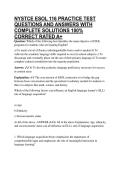
NYSTCE ESOL 116 PRACTICE TEST
QUESTIONS AND ANSWERS WITH
COMPLETE SOLUTIONS 100%
CORRECT RATED A+
Question: Which of the following best identifies the main objective of ESOL
programs for students who are learning English?
a) To reach a level of fluency indistinguishable from a native speaker b) To
cultivate the academic language skills required to excel in school subjects c) To
discourage and eventually phase out the use of their primary language d) To ensure
complete cultural assimilation into the majority population
Answer: ✓✓ b) To develop academic language proficiency necessary for success
in content areas
Explanation: ✓✓ The core mission of ESOL instruction is to bridge the gap
between basic conversation and the specialized vocabulary needed for students to
thrive in subjects like math, science, and history.
Which of the following factors can influence an English language learner's (ELL)
rate of language acquisition?
a) Age
b) Ethnicity
c) Socioeconomic status
d) All of the above -ANSWER ✔✔d) All of the above Explanation: Age, ethnicity,
and socioeconomic status can all influence an ELL's rate of language acquisition.
1. Which language acquisition theory emphasizes the importance of
comprehensible input and emphasizes the role of meaningful interaction in
language learning?
,a) Behaviorist theory
b) Cognitive theory
c) Sociocultural theory
d) Input hypothesis theory -ANSWER ✔✔d) Input hypothesis theory Explanation:
The input hypothesis theory, proposed by Stephen Krashen, posits that language
acquisition occurs through exposure to comprehensible input and meaningful
interaction.
4. What is the term used to describe the smallest unit of sound in a language that
can change the meaning of a word?
a) Morpheme
b) Phoneme
c) Syntax
d) Semantics -ANSWER ✔✔b) Phoneme Explanation: A phoneme is the smallest
unit of sound in a language that can change the meaning of a word (e.g., /b/ and /p/
in the words "bat" and "pat").
Which of the following language development theories suggests that language
acquisition is facilitated by a universal grammar and an innate language acquisition
device?
a) Behaviorist theory
b) Sociocultural theory
c) Cognitive theory
d) Universal grammar theory -ANSWER ✔✔d) Universal grammar theory
Explanation: Universal grammar theory, proposed by Noam Chomsky, suggests
that humans are born with an innate language acquisition device and a set of
linguistic principles shared across all languages.
, In the sentence "She eats apples," what part of speech is "eats"?
a) Verb
b) Noun
c) Adjective
d) Adverb -ANSWER ✔✔a) Verb Explanation: "Eats" is a verb in the sentence,
indicating the action performed by the subject "she."
Which of the following is an effective strategy for promoting oral language
development in English language learners (ELLs)?
a) Using only English in the classroom
b) Providing opportunities for authentic language use
c) Correcting ELLs' errors immediately
d) Encouraging ELLs to use their native language in class -ANSWER ✔✔b)
Providing opportunities for authentic language use Explanation: Authentic
language use, such as engaging in real conversations and completing meaningful
tasks, helps ELLs develop oral language skills.
What is the term for grouping students by English language proficiency level and
providing instruction tailored to their specific language needs?
a) Inclusion
b) Mainstreaming
c) Differentiation
QUESTIONS AND ANSWERS WITH
COMPLETE SOLUTIONS 100%
CORRECT RATED A+
Question: Which of the following best identifies the main objective of ESOL
programs for students who are learning English?
a) To reach a level of fluency indistinguishable from a native speaker b) To
cultivate the academic language skills required to excel in school subjects c) To
discourage and eventually phase out the use of their primary language d) To ensure
complete cultural assimilation into the majority population
Answer: ✓✓ b) To develop academic language proficiency necessary for success
in content areas
Explanation: ✓✓ The core mission of ESOL instruction is to bridge the gap
between basic conversation and the specialized vocabulary needed for students to
thrive in subjects like math, science, and history.
Which of the following factors can influence an English language learner's (ELL)
rate of language acquisition?
a) Age
b) Ethnicity
c) Socioeconomic status
d) All of the above -ANSWER ✔✔d) All of the above Explanation: Age, ethnicity,
and socioeconomic status can all influence an ELL's rate of language acquisition.
1. Which language acquisition theory emphasizes the importance of
comprehensible input and emphasizes the role of meaningful interaction in
language learning?
,a) Behaviorist theory
b) Cognitive theory
c) Sociocultural theory
d) Input hypothesis theory -ANSWER ✔✔d) Input hypothesis theory Explanation:
The input hypothesis theory, proposed by Stephen Krashen, posits that language
acquisition occurs through exposure to comprehensible input and meaningful
interaction.
4. What is the term used to describe the smallest unit of sound in a language that
can change the meaning of a word?
a) Morpheme
b) Phoneme
c) Syntax
d) Semantics -ANSWER ✔✔b) Phoneme Explanation: A phoneme is the smallest
unit of sound in a language that can change the meaning of a word (e.g., /b/ and /p/
in the words "bat" and "pat").
Which of the following language development theories suggests that language
acquisition is facilitated by a universal grammar and an innate language acquisition
device?
a) Behaviorist theory
b) Sociocultural theory
c) Cognitive theory
d) Universal grammar theory -ANSWER ✔✔d) Universal grammar theory
Explanation: Universal grammar theory, proposed by Noam Chomsky, suggests
that humans are born with an innate language acquisition device and a set of
linguistic principles shared across all languages.
, In the sentence "She eats apples," what part of speech is "eats"?
a) Verb
b) Noun
c) Adjective
d) Adverb -ANSWER ✔✔a) Verb Explanation: "Eats" is a verb in the sentence,
indicating the action performed by the subject "she."
Which of the following is an effective strategy for promoting oral language
development in English language learners (ELLs)?
a) Using only English in the classroom
b) Providing opportunities for authentic language use
c) Correcting ELLs' errors immediately
d) Encouraging ELLs to use their native language in class -ANSWER ✔✔b)
Providing opportunities for authentic language use Explanation: Authentic
language use, such as engaging in real conversations and completing meaningful
tasks, helps ELLs develop oral language skills.
What is the term for grouping students by English language proficiency level and
providing instruction tailored to their specific language needs?
a) Inclusion
b) Mainstreaming
c) Differentiation


