
https://www.stuvia.com/user/docstudent96 4/3/2026 https://www.stuvia.com/user/docstudent96
OpenStax Biology 2e Instructor Answer Guide
Biology 2e
Unit 4: Evolutionary Processes
Chapter 20: Phylogenies and the History of Life
Visual Connection Questions
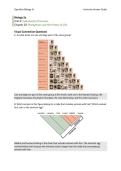
1. At what levels are cats and dogs part of the same group?
Cats and dogs are part of the same group at five levels: both are in the domain Eukarya, the
kingdom Animalia, the phylum Chordata, the class Mammalia, and the order Carnivora.
2. Which animals in this figure belong to a clade that includes animals with hair? Which evolved
first, hair or the amniotic egg?
Rabbits and humans belong in the clade that includes animals with hair. The amniotic egg
evolved before hair because the Amniota clade is larger than the clade that encompasses
animals with hair.
https://www.stuvia.com/user/docstudent96 https://www.stuvia.com/user/docstudent96 https://www.stuvia.com/user/docstudent96
,https://www.stuvia.com/user/docstudent96 4/3/2026 https://www.stuvia.com/user/docstudent96
OpenStax Biology 2e Instructor Answer Guide
3. What is the largest clade in this diagram?
The largest clade encompasses the entire tree.
Review Questions
4. What is used to determine phylogeny?
c. evolutionary history
5. What do scientists in the field of systematics accomplish?
b. organize and classify organisms
6. Which statement about the taxonomic classification system is correct?
d. Subspecies are the most specific category of classification.
7. On a phylogenetic tree, which term refers to lineages that diverged from the same place?
a. sister taxa
8. Which statement about analogies is correct?
c. They are derived by similar environmental constraints.
9. What do scientists use to apply cladistics?
a. homologous traits
10. What is true about organisms that are a part of the same clade?
b. They evolved from a shared ancestor.
https://www.stuvia.com/user/docstudent96 https://www.stuvia.com/user/docstudent96 https://www.stuvia.com/user/docstudent96
,https://www.stuvia.com/user/docstudent96 4/3/2026 https://www.stuvia.com/user/docstudent96
OpenStax Biology 2e Instructor Answer Guide
11. Why do scientists apply the concept of maximum parsimony?
a. to decipher accurate phylogenies
12. The transfer of genes by a mechanism not involving reproduction is called:
c. horizontal gene transfer
13. Particles that transfer genetic material from one species to another, especially in marine
prokaryotes:
d. gene transfer agents
14. What does the trunk of the classic phylogenetic tree represent?
a. single common ancestor
15. Which phylogenetic model proposes that all three domains of life evolved from a pool of
primitive prokaryotes?
c. ring of life
Critical Thinking Questions
16. How does a phylogenetic tree relate to the passing of time?
The phylogenetic tree shows the order in which evolutionary events took place and in what
order certain characteristics and organisms evolved in relation to others. It does not relate to
time.
17. Some organisms that appear very closely related on a phylogenetic tree may not actually be
closely related. Why is this?
In most cases, organisms that appear closely related actually are; however, there are cases
where organisms evolved through convergence and appear closely related but are not.
18. List the different levels of the taxonomic classification system.
domain, kingdom, phylum, class, order, family, genus, species
19. Dolphins and fish have similar body shapes. Is this feature more likely a homologous or
analogous trait?
Dolphins are mammals and fish are not, which means that their evolutionary paths
(phylogenies) are quite separate. Dolphins probably adapted to have a similar body plan after
returning to an aquatic lifestyle, and, therefore, this trait is probably analogous.
20. Why is it so important for scientists to distinguish between homologous and analogous
characteristics before building phylogenetic trees?
Phylogenetic trees are based on evolutionary connections. If an analogous similarity were used
on a tree, this would be erroneous and, furthermore, would cause the subsequent branches to
be inaccurate.
https://www.stuvia.com/user/docstudent96 https://www.stuvia.com/user/docstudent96 https://www.stuvia.com/user/docstudent96
, https://www.stuvia.com/user/docstudent96 4/3/2026 https://www.stuvia.com/user/docstudent96
OpenStax Biology 2e Instructor Answer Guide
21. Describe maximum parsimony.
Maximum parsimony hypothesizes that events occurred in the simplest, most obvious way, and
the pathway of evolution probably includes the fewest major events that coincide with the
evidence at hand.
22. Compare three different ways that eukaryotic cells may have evolved.
Some hypotheses propose that mitochondria were acquired first, followed by the development
of the nucleus. Others propose that the nucleus evolved first and that this new eukaryotic cell
later acquired the mitochondria. Still others hypothesize that prokaryotes descended from
eukaryotes by the loss of genes and complexity.
23. Describe how aphids acquired the ability to change color.
Aphids have acquired the ability to make the carotenoids on their own. DNA analysis has
demonstrated that this ability is due to the transfer of fungal genes into the insect by HGT,
presumably as the insect consumed fungi for food.
This file is copyright 2018, Rice University. All Rights Reserved.
https://www.stuvia.com/user/docstudent96 https://www.stuvia.com/user/docstudent96 https://www.stuvia.com/user/docstudent96
OpenStax Biology 2e Instructor Answer Guide
Biology 2e
Unit 4: Evolutionary Processes
Chapter 20: Phylogenies and the History of Life
Visual Connection Questions
1. At what levels are cats and dogs part of the same group?
Cats and dogs are part of the same group at five levels: both are in the domain Eukarya, the
kingdom Animalia, the phylum Chordata, the class Mammalia, and the order Carnivora.
2. Which animals in this figure belong to a clade that includes animals with hair? Which evolved
first, hair or the amniotic egg?
Rabbits and humans belong in the clade that includes animals with hair. The amniotic egg
evolved before hair because the Amniota clade is larger than the clade that encompasses
animals with hair.
https://www.stuvia.com/user/docstudent96 https://www.stuvia.com/user/docstudent96 https://www.stuvia.com/user/docstudent96
,https://www.stuvia.com/user/docstudent96 4/3/2026 https://www.stuvia.com/user/docstudent96
OpenStax Biology 2e Instructor Answer Guide
3. What is the largest clade in this diagram?
The largest clade encompasses the entire tree.
Review Questions
4. What is used to determine phylogeny?
c. evolutionary history
5. What do scientists in the field of systematics accomplish?
b. organize and classify organisms
6. Which statement about the taxonomic classification system is correct?
d. Subspecies are the most specific category of classification.
7. On a phylogenetic tree, which term refers to lineages that diverged from the same place?
a. sister taxa
8. Which statement about analogies is correct?
c. They are derived by similar environmental constraints.
9. What do scientists use to apply cladistics?
a. homologous traits
10. What is true about organisms that are a part of the same clade?
b. They evolved from a shared ancestor.
https://www.stuvia.com/user/docstudent96 https://www.stuvia.com/user/docstudent96 https://www.stuvia.com/user/docstudent96
,https://www.stuvia.com/user/docstudent96 4/3/2026 https://www.stuvia.com/user/docstudent96
OpenStax Biology 2e Instructor Answer Guide
11. Why do scientists apply the concept of maximum parsimony?
a. to decipher accurate phylogenies
12. The transfer of genes by a mechanism not involving reproduction is called:
c. horizontal gene transfer
13. Particles that transfer genetic material from one species to another, especially in marine
prokaryotes:
d. gene transfer agents
14. What does the trunk of the classic phylogenetic tree represent?
a. single common ancestor
15. Which phylogenetic model proposes that all three domains of life evolved from a pool of
primitive prokaryotes?
c. ring of life
Critical Thinking Questions
16. How does a phylogenetic tree relate to the passing of time?
The phylogenetic tree shows the order in which evolutionary events took place and in what
order certain characteristics and organisms evolved in relation to others. It does not relate to
time.
17. Some organisms that appear very closely related on a phylogenetic tree may not actually be
closely related. Why is this?
In most cases, organisms that appear closely related actually are; however, there are cases
where organisms evolved through convergence and appear closely related but are not.
18. List the different levels of the taxonomic classification system.
domain, kingdom, phylum, class, order, family, genus, species
19. Dolphins and fish have similar body shapes. Is this feature more likely a homologous or
analogous trait?
Dolphins are mammals and fish are not, which means that their evolutionary paths
(phylogenies) are quite separate. Dolphins probably adapted to have a similar body plan after
returning to an aquatic lifestyle, and, therefore, this trait is probably analogous.
20. Why is it so important for scientists to distinguish between homologous and analogous
characteristics before building phylogenetic trees?
Phylogenetic trees are based on evolutionary connections. If an analogous similarity were used
on a tree, this would be erroneous and, furthermore, would cause the subsequent branches to
be inaccurate.
https://www.stuvia.com/user/docstudent96 https://www.stuvia.com/user/docstudent96 https://www.stuvia.com/user/docstudent96
, https://www.stuvia.com/user/docstudent96 4/3/2026 https://www.stuvia.com/user/docstudent96
OpenStax Biology 2e Instructor Answer Guide
21. Describe maximum parsimony.
Maximum parsimony hypothesizes that events occurred in the simplest, most obvious way, and
the pathway of evolution probably includes the fewest major events that coincide with the
evidence at hand.
22. Compare three different ways that eukaryotic cells may have evolved.
Some hypotheses propose that mitochondria were acquired first, followed by the development
of the nucleus. Others propose that the nucleus evolved first and that this new eukaryotic cell
later acquired the mitochondria. Still others hypothesize that prokaryotes descended from
eukaryotes by the loss of genes and complexity.
23. Describe how aphids acquired the ability to change color.
Aphids have acquired the ability to make the carotenoids on their own. DNA analysis has
demonstrated that this ability is due to the transfer of fungal genes into the insect by HGT,
presumably as the insect consumed fungi for food.
This file is copyright 2018, Rice University. All Rights Reserved.
https://www.stuvia.com/user/docstudent96 https://www.stuvia.com/user/docstudent96 https://www.stuvia.com/user/docstudent96


