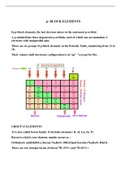
p- BLOCK ELEMENTS
In p-block elements, the last electron enters in the outermost p-orbital .
A p-subshell has three degenerate p-orbitals, each of which can accommodate 2
electrons with antiparallel spin.
There are six groups of p-block elements in the Periodic Table, numbering from 13 to
18.
Their valence shell electronic configuration is ns2 np1 – 6 (except for He).
GROUP 13 ELEMENTS
It is also called boron family. It includes elements: B, Al, Ga, In, Tl.
Boron is a fairly rare element, mainly occurs as :
Orthoboric acid[H3BO3], Borax[ Na2B4O7·10H2O]and Kernite [Na2B4O7·4H2O].
There are two isotopic forms of boron 10B (19%) and 11B (81%).
,Aluminium is the most abundant metal and the third most abundant element in the
earth’s crust (8.3% by mass) after oxygen (45.5%) and Si (27.7%).
♦ Bauxite, Al2O3. 2H2O and cryolite, Na3AlF6 are the important minerals of
aluminium.
ELECTRONIC CONFIGURATION
ATOMIC RADII :
Group 13 elements have smaller size than those of alkaline earth metals due to
greater effective nuclear charge, Zeff.
‟ Atomic radii increases on going down the group with an deviation at gallium (Ga).
Unexpected decrease in the atomic size of Ga is due to the presence of electrons in d-
orbitals which do not screen the attraction of nucleus effectively.
IONISATION ENTHALPY (IE):
The first ionisation enthalpy values of group 13 elements are lower than the
corresponding alkaline earth metals, due to the fact that removal of electron is easy.
[ns2 npl configuration] .
On moving down the group, IE decreases from B to Al, but the next element Ga has
slightly higher ionisation enthalpy than A1 due to the poor shielding of intervening d-
electrons. It again decreases in In and then increases in the last element i.e Tl
OXIDATION STATES :
♦ The elements of group 13 have to two electrons in the s- orbital and one electron in
the p-orbital of the valence shell.
♦ These elements are expected to show a uniform oxidation state of +3.
♦Boron and aluminium which show an oxidation state of +3 only
♦But gallium, indium and thallium due to inert pair effect show oxidation state of
both +1 and +3 .
, ♦ As we move down the group, the stability of +3 oxidation state decreases
while that of +1 oxidation state increases.
The ns2 electron pair in gallium ,indium and thallium tends to remain paired. This is
due to poor or ineffective shielding of the ns2 electrons of the valence shell by
intervening d and f electrons.
♦The order of stability of +1 oxidation states increases in the order :
Al < Ga < In < Tl.
INERT PAIR EFFECT:
It is reluctance of the s-electrons of the valence shell to take part in bonding.
It occurs due to poor shielding of the ns2 – electrons by the intervening d and f –
electrons. It increases down the group and thus, the lower elements of the group
exhibit lower oxidation states.
In trivalent state, the number of electrons around the central atom in a molecule of
these elements will be only 6 and thus behave as electron deficient molecules.
They have a strong tendency to accept a pair of electrons to achieve the stable inert
gas configuration and thus behave as Lewis acid.
BCl3 easily accepts a lone pair of electrons from ammonia to form the adduct
BCl3.NH3
Boron and aluminium halides are Lewis acid but only aluminium halides exist as
dimer whereas boron halides exist only as monomers.
Reason : Boron atom is so small that it cannot accommodate 4 large size halogen
atoms around it.