

(NR668 - Pharmacological Terms and Definitions in Medicine: 2026 Test Preparation)
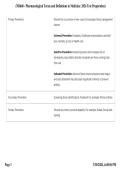
Primary Prevention Prevent the occurrence of new cases For example: Stress management
classes
Universal Prevention: Examples; Childhood immunizations, seat belt
laws, helmets, access to health care.
Selective Prevention: Aimed at persons with increased risk of
developing a psychiatric disorder. Examples are those coming back
from war
Indicated Prevention: Aimed at those whose symptoms have begun
and early treatment may decrease magnitude of illness or prevent
entirely.
Secondary Prevention Screening (Early identification), Treatment For example: Phone hotlines.
Tertiary Prevention Prevent recurrence, prevent disability. For example: Rehab, Social skills
training
Page 1 3/30/2026, 4:48:56 PM
, (NR668 - Pharmacological Terms and Definitions in Medicine: 2026 Test Preparation)
Types of Crisis Maturational Crisis: Normal occurring events in life related to one’s
continual growth and development.
Adventitious (Social) Crisis: Disaster scenario that impacts one’s well
being without warning (For example; Typhoon, War, Earthquake).
Situational Crisis: These are unexpected events that disturb one’s
psychological well being. (For example; an unexpected death or loss
of employment).
Page 2 3/30/2026, 4:48:56 PM
, (NR668 - Pharmacological Terms and Definitions in Medicine: 2026 Test Preparation)
Regulating bodies Board of Nursing: State regulations, Scope of practice, prescriptive
authority, Nurse Practice Act governed by the BON.
NLNAC: National League for Accrediting Commission: Evaluates
nursing programs to grant accreditation.
CCNE: Commission on Nursing Education: Accreditation of nursing
programs with focus on nursing standards.
Joint Commission: Not for profit organization that certifies health care
organizations in the US in regards to specific performance standards.
HIPAA: Exceptions: (Law enforcement, Employers, Life insurers,
workers compensation, schools, state agencies).
ANA: Code of ethics and Standards of practice.
ANCC: Certification of standards in our profession.
Page 3 3/30/2026, 4:48:56 PM
, (NR668 - Pharmacological Terms and Definitions in Medicine: 2026 Test Preparation)
Quality improvement Plan-Do-Study-Act: Identifying a goal, forming a theory, defining what
successful metrics would look like and putting forth the plan into
action. The “Do” involves implementation. The “Study” involves
monitoring for the plan for successful outcomes and the “Act” involves
adjusting the methods to achieve future desired results. The cycle
repeats itself for future gains.
Root Cause Analysis: Method utilized to evaluate adverse events. Goal
includes identification of underlying problem that caused the error and
analyze why the error occurred. Goal is to prevent future harm. In
other words, what happened, why did it happen and what can be done
to prevent it from happening again. The key question “Why?” leads to
the root cause.
Page 4 3/30/2026, 4:48:56 PM
Primary Prevention Prevent the occurrence of new cases For example: Stress management
classes
Universal Prevention: Examples; Childhood immunizations, seat belt
laws, helmets, access to health care.
Selective Prevention: Aimed at persons with increased risk of
developing a psychiatric disorder. Examples are those coming back
from war
Indicated Prevention: Aimed at those whose symptoms have begun
and early treatment may decrease magnitude of illness or prevent
entirely.
Secondary Prevention Screening (Early identification), Treatment For example: Phone hotlines.
Tertiary Prevention Prevent recurrence, prevent disability. For example: Rehab, Social skills
training
Page 1 3/30/2026, 4:48:56 PM
, (NR668 - Pharmacological Terms and Definitions in Medicine: 2026 Test Preparation)
Types of Crisis Maturational Crisis: Normal occurring events in life related to one’s
continual growth and development.
Adventitious (Social) Crisis: Disaster scenario that impacts one’s well
being without warning (For example; Typhoon, War, Earthquake).
Situational Crisis: These are unexpected events that disturb one’s
psychological well being. (For example; an unexpected death or loss
of employment).
Page 2 3/30/2026, 4:48:56 PM
, (NR668 - Pharmacological Terms and Definitions in Medicine: 2026 Test Preparation)
Regulating bodies Board of Nursing: State regulations, Scope of practice, prescriptive
authority, Nurse Practice Act governed by the BON.
NLNAC: National League for Accrediting Commission: Evaluates
nursing programs to grant accreditation.
CCNE: Commission on Nursing Education: Accreditation of nursing
programs with focus on nursing standards.
Joint Commission: Not for profit organization that certifies health care
organizations in the US in regards to specific performance standards.
HIPAA: Exceptions: (Law enforcement, Employers, Life insurers,
workers compensation, schools, state agencies).
ANA: Code of ethics and Standards of practice.
ANCC: Certification of standards in our profession.
Page 3 3/30/2026, 4:48:56 PM
, (NR668 - Pharmacological Terms and Definitions in Medicine: 2026 Test Preparation)
Quality improvement Plan-Do-Study-Act: Identifying a goal, forming a theory, defining what
successful metrics would look like and putting forth the plan into
action. The “Do” involves implementation. The “Study” involves
monitoring for the plan for successful outcomes and the “Act” involves
adjusting the methods to achieve future desired results. The cycle
repeats itself for future gains.
Root Cause Analysis: Method utilized to evaluate adverse events. Goal
includes identification of underlying problem that caused the error and
analyze why the error occurred. Goal is to prevent future harm. In
other words, what happened, why did it happen and what can be done
to prevent it from happening again. The key question “Why?” leads to
the root cause.
Page 4 3/30/2026, 4:48:56 PM


