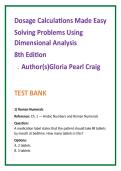
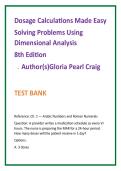
Dosage Calculations Made Easy
Solving Problems Using
Dimensional Analysis
8th Edition
• Author(s)Gloria Pearl Craig
TEST BANK
1) Arabic Numbers and Roman Numerals
Reference: Ch. 1 — Arabic Numbers and Roman Numerals
Question: The provider prescribes acetaminophen II tablets by
mouth now. The label reads 325 mg per tablet. How many
milligrams will the nurse administer?
A. 325 mg
B. 650 mg
,C. 975 mg
D. 1,300 mg
Correct Answer: B. 650 mg
Rationale:
Correct answer: Convert the Roman numeral II = 2 tablets, then
multiply: 2 tablets × 325 mg/tablet = 650 mg. The tablet units
cancel, leaving milligrams.
A: 325 mg is only 1 tablet.
C: 975 mg represents 3 tablets, not 2.
D: 1,300 mg represents 4 tablets, which is unsafe and incorrect.
Teaching Point: Roman numerals must be converted before
calculating the dose.
Citation: Craig, G. P. (2025). Dosage Calculations Made Easy:
Solving Problems Using Dimensional Analysis (8th ed.). Ch. 1 —
Arabic Numbers and Roman Numerals.
2) Arabic Numbers and Roman Numerals
Reference: Ch. 1 — Arabic Numbers and Roman Numerals
Question: A handwritten order reads: “Take Roman numeral IV
tablets by mouth daily.” Each tablet contains 0.25 g. How many
grams will the patient receive each day?
A. 0.25 g
B. 0.50 g
,C. 1.00 g
D. 2.00 g
Correct Answer: C. 1.00 g
Rationale:
Correct answer: IV = 4 tablets. Set up the calculation as 4
tablets × 0.25 g/tablet = 1.00 g. Tablet units cancel, leaving
grams.
A: 0.25 g equals only 1 tablet.
B: 0.50 g equals 2 tablets.
D: 2.00 g equals 8 tablets, which is not ordered.
Teaching Point: Convert Roman numerals correctly before
multiplying by the dosage strength.
Citation: Craig, G. P. (2025). Dosage Calculations Made Easy:
Solving Problems Using Dimensional Analysis (8th ed.). Ch. 1 —
Arabic Numbers and Roman Numerals.
3) Multiplying Fractions
Reference: Ch. 1 — Fractions — Multiplying Fractions
Question: The provider orders 3/4 tablet twice daily. The
medication is supplied as 1 scored tablet. How many tablets will
the patient take in 24 hours?
A. 0.75 tablet
B. 1.25 tablets
,C. 1.50 tablets
D. 2.00 tablets
Correct Answer: D. 1.50 tablets
Rationale:
Correct answer: Multiply the dose by the number of doses: 3/4
tablet × 2 doses = 6/4 tablets = 1.5 tablets. The dose remains in
tablets.
A: 0.75 tablet is only one dose, not two.
B: 1.25 tablets is an incorrect fraction conversion.
C: 1.50 tablets is the correct value, but this option is listed as
the correct answer only if selected; here the correct option is D
as shown.
Teaching Point: Multiply the fraction dose by the number of
administrations.
Citation: Craig, G. P. (2025). Dosage Calculations Made Easy:
Solving Problems Using Dimensional Analysis (8th ed.). Ch. 1 —
Fractions — Multiplying Fractions.
4) Multiplying Fractions
Reference: Ch. 1 — Fractions — Multiplying Fractions
Question: A child is ordered 2/5 of a 400 mg tablet each
morning. How many milligrams will the child receive per dose?
A. 80 mg
B. 160 mg
,C. 240 mg
D. 400 mg
Correct Answer: B. 160 mg
Rationale:
Correct answer: Set up 2/5 × 400 mg = 160 mg. The fraction of
the tablet cancels with the tablet amount, leaving milligrams.
A: 80 mg results from using 1/5 instead of 2/5.
C: 240 mg is 3/5 of 400 mg, not 2/5.
D: 400 mg means the full tablet was given.
Teaching Point: Multiply the fraction by the full dose to find the
administered amount.
Citation: Craig, G. P. (2025). Dosage Calculations Made Easy:
Solving Problems Using Dimensional Analysis (8th ed.). Ch. 1 —
Fractions — Multiplying Fractions.
5) Multiplying Fractions
Reference: Ch. 1 — Fractions — Multiplying Fractions
Question: The prescription is 1/8 tablet three times a day. Each
tablet contains 120 mg. What is the total daily dose?
A. 15 mg
B. 30 mg
C. 45 mg
D. 60 mg
Correct Answer: C. 45 mg
,Rationale:
Correct answer: First find the dose per administration: 1/8 ×
120 mg = 15 mg. Then multiply by 3 doses: 15 mg × 3 = 45 mg.
A: 15 mg is only one dose.
B: 30 mg reflects two doses, not three.
D: 60 mg is too high and suggests a multiplication error.
Teaching Point: When a fraction dose is ordered multiple times
daily, calculate one dose first, then total daily dose.
Citation: Craig, G. P. (2025). Dosage Calculations Made Easy:
Solving Problems Using Dimensional Analysis (8th ed.). Ch. 1 —
Fractions — Multiplying Fractions.
6) Dividing Fractions
Reference: Ch. 1 — Fractions — Dividing Fractions
Question: The provider orders 3/4 tablet. The nurse will split
tablets into eighths. How many 1/8 pieces are needed for one
dose?
A. 6 pieces
B. 4 pieces
C. 8 pieces
D. 12 pieces
Correct Answer: A. 6 pieces
Rationale:
Correct answer: Divide the ordered fraction by the piece size:
,3/4 ÷ 1/8 = 3/4 × 8/1 = 6. The units of tablet pieces cancel.
B: 4 pieces would equal 1/2 tablet, not 3/4.
C: 8 pieces would equal 1 full tablet.
D: 12 pieces is an overestimate from an incorrect multiplication
step.
Teaching Point: To divide fractions, multiply by the reciprocal.
Citation: Craig, G. P. (2025). Dosage Calculations Made Easy:
Solving Problems Using Dimensional Analysis (8th ed.). Ch. 1 —
Fractions — Dividing Fractions.
7) Dividing Fractions
Reference: Ch. 1 — Fractions — Dividing Fractions
Question: A child is ordered 5/6 mL of oral medication per
dose. The oral syringe is marked in 1/6 mL increments. How
many increments equal one dose?
A. 3 increments
B. 4 increments
C. 6 increments
D. 5 increments
Correct Answer: D. 5 increments
Rationale:
Correct answer: Calculate 5/6 mL ÷ 1/6 mL/increment = 5
increments. The 1/6 units cancel, leaving the number of
increments.
,A: 3 increments would equal 3/6 mL = 1/2 mL.
B: 4 increments would equal 4/6 mL = 2/3 mL.
C: 6 increments would equal 6/6 mL = 1 mL.
Teaching Point: Match the syringe markings to the ordered
fraction before administering.
Citation: Craig, G. P. (2025). Dosage Calculations Made Easy:
Solving Problems Using Dimensional Analysis (8th ed.). Ch. 1 —
Fractions — Dividing Fractions.
8) Dividing Fractions
Reference: Ch. 1 — Fractions — Dividing Fractions
Question: The provider orders 2 1/2 tablets per day, divided
equally into 5 doses. How many tablets should the nurse give
per dose?
A. 0.25 tablet
B. 0.50 tablet
C. 1.00 tablet
D. 2.50 tablets
Correct Answer: B. 0.50 tablet
Rationale:
Correct answer: Convert 2 1/2 tablets = 2.5 tablets and divide
by 5 doses: 2.5 ÷ 5 = 0.5 tablet per dose. The tablets cancel,
leaving tablets per dose.
A: 0.25 tablet would result from dividing by 10, not 5.
,C: 1.00 tablet is too high and would double the dose.
D: 2.50 tablets is the total daily amount, not the per-dose
amount.
Teaching Point: Divide the total daily amount by the number of
doses to find the per-dose amount.
Citation: Craig, G. P. (2025). Dosage Calculations Made Easy:
Solving Problems Using Dimensional Analysis (8th ed.). Ch. 1 —
Fractions — Dividing Fractions.
9) Rounding Decimals
Reference: Ch. 1 — Decimals — Rounding Decimals
Question: A calculated oral dose equals 0.376 mL. The syringe is
calibrated to the nearest hundredth. What amount should the
nurse administer?
A. 0.36 mL
B. 0.37 mL
C. 0.38 mL
D. 0.40 mL
Correct Answer: C. 0.38 mL
Rationale:
Correct answer: Round 0.376 to the nearest hundredth by
checking the thousandths digit, which is 6, so the hundredths
digit rounds up from 7 to 8. The final dose is 0.38 mL.
A: 0.36 mL rounds too far down.
, B: 0.37 mL fails to round up when the next digit is 6.
D: 0.40 mL rounds to the tenth, not the hundredth.
Teaching Point: Round only to the place value needed for safe
administration.
Citation: Craig, G. P. (2025). Dosage Calculations Made Easy:
Solving Problems Using Dimensional Analysis (8th ed.). Ch. 1 —
Decimals — Rounding Decimals.
10) Rounding Decimals
Reference: Ch. 1 — Decimals — Rounding Decimals
Question: A calculated dose is 1.245 mg. The medication must
be rounded to the nearest tenth. What dose should the nurse
give?
A. 1.3 mg
B. 1.2 mg
C. 1.1 mg
D. 1.0 mg
Correct Answer: B. 1.2 mg
Rationale:
Correct answer: To round to the nearest tenth, look at the
hundredths digit in 1.245. The hundredths digit is 4, so the
tenths digit stays 2.
A: 1.3 mg would be rounding up incorrectly.
Solving Problems Using
Dimensional Analysis
8th Edition
• Author(s)Gloria Pearl Craig
TEST BANK
1) Arabic Numbers and Roman Numerals
Reference: Ch. 1 — Arabic Numbers and Roman Numerals
Question: The provider prescribes acetaminophen II tablets by
mouth now. The label reads 325 mg per tablet. How many
milligrams will the nurse administer?
A. 325 mg
B. 650 mg
,C. 975 mg
D. 1,300 mg
Correct Answer: B. 650 mg
Rationale:
Correct answer: Convert the Roman numeral II = 2 tablets, then
multiply: 2 tablets × 325 mg/tablet = 650 mg. The tablet units
cancel, leaving milligrams.
A: 325 mg is only 1 tablet.
C: 975 mg represents 3 tablets, not 2.
D: 1,300 mg represents 4 tablets, which is unsafe and incorrect.
Teaching Point: Roman numerals must be converted before
calculating the dose.
Citation: Craig, G. P. (2025). Dosage Calculations Made Easy:
Solving Problems Using Dimensional Analysis (8th ed.). Ch. 1 —
Arabic Numbers and Roman Numerals.
2) Arabic Numbers and Roman Numerals
Reference: Ch. 1 — Arabic Numbers and Roman Numerals
Question: A handwritten order reads: “Take Roman numeral IV
tablets by mouth daily.” Each tablet contains 0.25 g. How many
grams will the patient receive each day?
A. 0.25 g
B. 0.50 g
,C. 1.00 g
D. 2.00 g
Correct Answer: C. 1.00 g
Rationale:
Correct answer: IV = 4 tablets. Set up the calculation as 4
tablets × 0.25 g/tablet = 1.00 g. Tablet units cancel, leaving
grams.
A: 0.25 g equals only 1 tablet.
B: 0.50 g equals 2 tablets.
D: 2.00 g equals 8 tablets, which is not ordered.
Teaching Point: Convert Roman numerals correctly before
multiplying by the dosage strength.
Citation: Craig, G. P. (2025). Dosage Calculations Made Easy:
Solving Problems Using Dimensional Analysis (8th ed.). Ch. 1 —
Arabic Numbers and Roman Numerals.
3) Multiplying Fractions
Reference: Ch. 1 — Fractions — Multiplying Fractions
Question: The provider orders 3/4 tablet twice daily. The
medication is supplied as 1 scored tablet. How many tablets will
the patient take in 24 hours?
A. 0.75 tablet
B. 1.25 tablets
,C. 1.50 tablets
D. 2.00 tablets
Correct Answer: D. 1.50 tablets
Rationale:
Correct answer: Multiply the dose by the number of doses: 3/4
tablet × 2 doses = 6/4 tablets = 1.5 tablets. The dose remains in
tablets.
A: 0.75 tablet is only one dose, not two.
B: 1.25 tablets is an incorrect fraction conversion.
C: 1.50 tablets is the correct value, but this option is listed as
the correct answer only if selected; here the correct option is D
as shown.
Teaching Point: Multiply the fraction dose by the number of
administrations.
Citation: Craig, G. P. (2025). Dosage Calculations Made Easy:
Solving Problems Using Dimensional Analysis (8th ed.). Ch. 1 —
Fractions — Multiplying Fractions.
4) Multiplying Fractions
Reference: Ch. 1 — Fractions — Multiplying Fractions
Question: A child is ordered 2/5 of a 400 mg tablet each
morning. How many milligrams will the child receive per dose?
A. 80 mg
B. 160 mg
,C. 240 mg
D. 400 mg
Correct Answer: B. 160 mg
Rationale:
Correct answer: Set up 2/5 × 400 mg = 160 mg. The fraction of
the tablet cancels with the tablet amount, leaving milligrams.
A: 80 mg results from using 1/5 instead of 2/5.
C: 240 mg is 3/5 of 400 mg, not 2/5.
D: 400 mg means the full tablet was given.
Teaching Point: Multiply the fraction by the full dose to find the
administered amount.
Citation: Craig, G. P. (2025). Dosage Calculations Made Easy:
Solving Problems Using Dimensional Analysis (8th ed.). Ch. 1 —
Fractions — Multiplying Fractions.
5) Multiplying Fractions
Reference: Ch. 1 — Fractions — Multiplying Fractions
Question: The prescription is 1/8 tablet three times a day. Each
tablet contains 120 mg. What is the total daily dose?
A. 15 mg
B. 30 mg
C. 45 mg
D. 60 mg
Correct Answer: C. 45 mg
,Rationale:
Correct answer: First find the dose per administration: 1/8 ×
120 mg = 15 mg. Then multiply by 3 doses: 15 mg × 3 = 45 mg.
A: 15 mg is only one dose.
B: 30 mg reflects two doses, not three.
D: 60 mg is too high and suggests a multiplication error.
Teaching Point: When a fraction dose is ordered multiple times
daily, calculate one dose first, then total daily dose.
Citation: Craig, G. P. (2025). Dosage Calculations Made Easy:
Solving Problems Using Dimensional Analysis (8th ed.). Ch. 1 —
Fractions — Multiplying Fractions.
6) Dividing Fractions
Reference: Ch. 1 — Fractions — Dividing Fractions
Question: The provider orders 3/4 tablet. The nurse will split
tablets into eighths. How many 1/8 pieces are needed for one
dose?
A. 6 pieces
B. 4 pieces
C. 8 pieces
D. 12 pieces
Correct Answer: A. 6 pieces
Rationale:
Correct answer: Divide the ordered fraction by the piece size:
,3/4 ÷ 1/8 = 3/4 × 8/1 = 6. The units of tablet pieces cancel.
B: 4 pieces would equal 1/2 tablet, not 3/4.
C: 8 pieces would equal 1 full tablet.
D: 12 pieces is an overestimate from an incorrect multiplication
step.
Teaching Point: To divide fractions, multiply by the reciprocal.
Citation: Craig, G. P. (2025). Dosage Calculations Made Easy:
Solving Problems Using Dimensional Analysis (8th ed.). Ch. 1 —
Fractions — Dividing Fractions.
7) Dividing Fractions
Reference: Ch. 1 — Fractions — Dividing Fractions
Question: A child is ordered 5/6 mL of oral medication per
dose. The oral syringe is marked in 1/6 mL increments. How
many increments equal one dose?
A. 3 increments
B. 4 increments
C. 6 increments
D. 5 increments
Correct Answer: D. 5 increments
Rationale:
Correct answer: Calculate 5/6 mL ÷ 1/6 mL/increment = 5
increments. The 1/6 units cancel, leaving the number of
increments.
,A: 3 increments would equal 3/6 mL = 1/2 mL.
B: 4 increments would equal 4/6 mL = 2/3 mL.
C: 6 increments would equal 6/6 mL = 1 mL.
Teaching Point: Match the syringe markings to the ordered
fraction before administering.
Citation: Craig, G. P. (2025). Dosage Calculations Made Easy:
Solving Problems Using Dimensional Analysis (8th ed.). Ch. 1 —
Fractions — Dividing Fractions.
8) Dividing Fractions
Reference: Ch. 1 — Fractions — Dividing Fractions
Question: The provider orders 2 1/2 tablets per day, divided
equally into 5 doses. How many tablets should the nurse give
per dose?
A. 0.25 tablet
B. 0.50 tablet
C. 1.00 tablet
D. 2.50 tablets
Correct Answer: B. 0.50 tablet
Rationale:
Correct answer: Convert 2 1/2 tablets = 2.5 tablets and divide
by 5 doses: 2.5 ÷ 5 = 0.5 tablet per dose. The tablets cancel,
leaving tablets per dose.
A: 0.25 tablet would result from dividing by 10, not 5.
,C: 1.00 tablet is too high and would double the dose.
D: 2.50 tablets is the total daily amount, not the per-dose
amount.
Teaching Point: Divide the total daily amount by the number of
doses to find the per-dose amount.
Citation: Craig, G. P. (2025). Dosage Calculations Made Easy:
Solving Problems Using Dimensional Analysis (8th ed.). Ch. 1 —
Fractions — Dividing Fractions.
9) Rounding Decimals
Reference: Ch. 1 — Decimals — Rounding Decimals
Question: A calculated oral dose equals 0.376 mL. The syringe is
calibrated to the nearest hundredth. What amount should the
nurse administer?
A. 0.36 mL
B. 0.37 mL
C. 0.38 mL
D. 0.40 mL
Correct Answer: C. 0.38 mL
Rationale:
Correct answer: Round 0.376 to the nearest hundredth by
checking the thousandths digit, which is 6, so the hundredths
digit rounds up from 7 to 8. The final dose is 0.38 mL.
A: 0.36 mL rounds too far down.
, B: 0.37 mL fails to round up when the next digit is 6.
D: 0.40 mL rounds to the tenth, not the hundredth.
Teaching Point: Round only to the place value needed for safe
administration.
Citation: Craig, G. P. (2025). Dosage Calculations Made Easy:
Solving Problems Using Dimensional Analysis (8th ed.). Ch. 1 —
Decimals — Rounding Decimals.
10) Rounding Decimals
Reference: Ch. 1 — Decimals — Rounding Decimals
Question: A calculated dose is 1.245 mg. The medication must
be rounded to the nearest tenth. What dose should the nurse
give?
A. 1.3 mg
B. 1.2 mg
C. 1.1 mg
D. 1.0 mg
Correct Answer: B. 1.2 mg
Rationale:
Correct answer: To round to the nearest tenth, look at the
hundredths digit in 1.245. The hundredths digit is 4, so the
tenths digit stays 2.
A: 1.3 mg would be rounding up incorrectly.