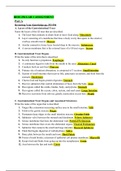
NSG 3370 STUDY GUIDE – QUESTION AND ANSWERS WITH EXPLANATIONS
NSG 3370 STUDY GUIDE – QUESTION AND ANSWERS WITH EXPLANATIONS 1. During pregnancy, dyspnea accompanied by increased respiratory rate, cough, rales, or respiratory distress raises concerns of: peripartum cardiomyopathy Explanation: Dyspnea accompanied by increased respiratory rate, cough, rales, or respiratory distress raises concerns of possible infection, asthma, pulmonary embolus, or peripartum cardiomyopathy. 2. The middle section of the thoracic cavity containing the esophagus, trachea, heart, and great vessels is the: mediastinum Explanation: The middle section of the thoracic cavity containing the esophagus, trachea, heart, and great vessels is the mediastinum. The right and left pleural cavities, are on either side of the mediastinum and those contain the lungs. The visceral pleura encloses the lung. The pericardium surrounds the heart. 3. A patient is unable to identify the smell of an orange. This inability could reflect an abnormality in cranial nerves: CN I Explanation: Cranial Nerve I is the olfactory nerve responsible for the sense of smell. To test the sense of smell, the examiner presents the patient with familiar and nonirritating odors. A person should normally perceive odor on each side and correctly identify the source. Cranial Nerves II and III assess vision and pupillary reaction. Cranial Nerve VIII tests the hearing and balance. 4. A transient ischemic attack is: a transient episode of neurologic dysfunction by focal brain, spinal cord, or retinal ischemia, without acute infarction Explanation: TIA is now defined as “a transient episode of neurological dysfunction caused by focal brain, spinal cord, or retinal ischemia, without acute infarction.” Ischemic stroke is “an infarction of central nervous system tissue” that may be symptomatic or silent. The other terms are not related to the new definitions. 5. The term asteatosis refers to: skin that is dry, flaky, rough, and often itchy Explanation: Physiologic changes of aging include loss of elastic turgor, and wrinkling. Skin that appears dry, flaky, rough, and itchy is termed asteatosis. Sun exposure can cause damage to the skin resembling an appearance as weather beaten, thickened, yellowed, and deeply furrowed. Seborrheic keratosis appear as raised, yellowish lesions that feel greasy, velvety, or warty. Painful vesicular lesions in a dermatomal distribution may suggest herpes zoster. 6. An enlarged liver with a smooth tender edge may suggest: right-sided heart failure. Explanation: An enlarged liver with a smooth, tender edge suggests inflammation, as in hepatitis, or venous congestion, as in right-sided heart failure. Cirrhosis, hematochromatosis (increased amount of iron in the blood), and lymphoma produce an enlarged liver with a firm, nontender edge. An enlarged liver that is firm or hard and has an irregular edge or surface suggests hepatocellular carcinoma. 7. New onset hypertension with proteinuria or end-organ damage is: preeclampsia Explanation: Chronic hypertension occurs when systolic BP (SBP) >140 mm Hg or diastolic BP (DBP) >90 mm Hg documented prior to pregnancy, before 20 weeks, or beyond 12 weeks postpartum. Gestational hypertension refers to elevated blood pressure detected after 20 weeks gestation in the absence of proteinuria. Pre-eclampsia occurs in a woman who was previously normotensive but now has new onset hypertension with either proteinuria or end-organ damage. Primary hypertension, formerly known as essential hypertension, is a disorder which is associated with elevated blood pressure and an unidentifiable cause. 8. The psoas muscle group and muscles of the abdominal wall assist with: flexion Explanation: The psoas muscle group and muscles of the abdominal wall assist with flexion. The deep intrinsic muscles of the back assist with extension. The abdominal muscles and intrinsic muscles of the back assist with rotation. Lateral bending uses the abdominal muscles and intrinsic muscles of the back. 9. "Preterm small for gestational age" (SGA) infants are prone to: hypocalcemia Explanation: "Preterm appropriate for gestational age" (AGA) infants are prone to respiratory distress syndrome, apnea, patent ductus arteriosus with left-to-right shunt, and infection. "Preterm small for gestational age" (SGA) infants are more likely to experience asphyxia, hypoglycemia, and hypocalcemia. 10. Swelling noted 1-2 inches below the knee joint and on the medial surface of the knee would be suggestive of: anserine bursitis Explanation: Swelling 1-2 inches below the knee joint and on the medial surface would be suggestive of anserine bursitis. Swelling over the tibial tubercle suggests infrapatellar bursitis. Swelling over the patella suggests prepatellar bursitis. Semimembranous bursitis would be suggested by swelling on the posterior and medial surface of the knee. 11. A patient states that the only way he can sleep at night is to use several pillows or to sleep upright in a recliner. This sleep pattern is most consistent with: obstructive lung disease Explanation: With obstructive lung disease, the patient experiences orthopnea, dyspnea that occurs when the patient lies down but improves with sitting. Therefore, the patient would use several pillows or sleep upright in a recliner. Orthopnea is seen in obstructive lung disease, mitral stenosis, and heart failure. Paroxysmal nocturnal dyspnea describe episodes of sudden dyspnea that cause the patient to awaken from sleep where the patient must sit up, walk, or stand for it to resolve. Coughing and wheezing may also occur. Angina pectoris commonly creates chest pain or shortness of breath. Jugular venous pressure reflects right atrial pressure and volume status. In cases of cardiac or pulmonary dysfunction, jugular venous pressures usually raise. 12. A positive obturator sign would elicit pain in the: right hypogastric area Explanation: Assessment of the obturator sign is performed by flexing. By flexing the patient's right thigh at the hip with the knees bent, rotating the leg internally at the hip. If this causes increased pain in the right epigastric area, then the obturator sign is positive. Hypogastric pain occurs as the obturator muscle rubs an inflamed appendix. 13. The lateral bone that serves as a strut between the scapula and the sternum is known as the: clavicle Explanation: The lateral bone that serves as a strut between the scapula and the sternum is known as the clavicle. The humerus is the long bone of the upper arm. The acromion process is an extension of the spine of the scapula and located at the highest point of the shoulder. The thick curved extension of the superior border of the scapula is referred to as the coracoid process.
Written for
- Institution
-
South University
- Course
-
NSG 3370
Document information
- Uploaded on
- April 26, 2021
- Number of pages
- 71
- Written in
- 2020/2021
- Type
- Exam (elaborations)
- Contains
- Questions & answers