

1
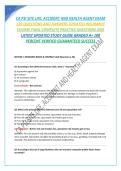
CA PSI SITE LIFE, ACCIDENT AND HEALTH AGENT EXAM
120 QUESTIONS AND ANSWERS UPDATED INSURANCE
COURSE FINAL COMPLETE PRACTICE QUESTIONS AND
LATEST UPDATED STUDY GUIDE GRADED A+ 100
PERCENT VERIFIED GUARANTEED SUCCESS
SECTION 1: INSURANCE BASICS & CONTRACT LAW (Questions 1-20)
Q1: According to the California Insurance Code, what is "insurance"?
A) A guarantee against loss
B) A contract
C) An investment vehicle
D) A savings plan
Correct Answer-: B) A contract
Rationale: The California Insurance Code defines insurance as a contract whereby one party (the insurer)
agrees to indemnify another party (the insured) against loss, damage, or liability arising from a
contingent or unknown event. This fundamental definition establishes the contractual nature of all
insurance relationships .
Q2: What is the primary difference between pure risk and speculative risk?
A) Pure risk only applies to life insurance, speculative risk to auto insurance
B) Pure risk only involves loss, speculative risk involves gain or loss
C) Pure risk is always moral, speculative risk is always physical
D) There is no difference; they are synonyms
Correct Answer-: B) Pure risk only involves loss, speculative risk involves gain or loss
Rationale: Pure risk presents only the possibility of loss or no loss (e.g., illness, death, property damage)
and is insurable. Speculative risk offers the possibility of gain or loss (e.g., gambling, investing) and is not
insurable. This distinction is foundational to insurance underwriting .
Q3: According to the Law of Large Numbers, why can insurance companies predict future losses
accurately?
,2
A) Because every policy is identical
B) Because a large number of exposures reduces variability
C) Because the market is always in equilibrium
D) Because agents control all variables
Correct Answer-: B) Because a large number of exposures reduces variability
Rationale: The Law of Large Numbers states that as the number of independent, similar exposure units
increases, the actual loss experience will more closely approximate the expected loss experience. This
statistical principle enables insurers to predict future losses with reasonable accuracy .
Q4: What element of a contract refers to one party's promise in exchange for the other party's
promise?
A) Offer
B) Acceptance
C) Consideration
D) Legal capacity
Correct Answer-: C) Consideration
Rationale: Consideration is the value exchanged that makes a contract binding. In insurance contracts,
the insured's consideration is the premium payment, while the insurer's consideration is the promise to
pay covered claims .
Q5: A contract of adhesion is best described as:
A) A contract where both parties negotiate all terms equally
B) A contract where one party writes the terms and the other accepts on a "take-it-or-leave-it" basis
C) A contract that can be cancelled at any time
D) A contract that only benefits the insured
Correct Answer-: B) A contract where one party writes the terms and the other accepts on a "take-it-
or-leave-it" basis
Rationale: Insurance policies are contracts of adhesion because the insurer drafts the policy language,
and the applicant has no opportunity to negotiate terms. Any ambiguities in such contracts are
interpreted in favor of the insured .
Q6: An aleatory contract is characterized by:
A) Equal exchange of value between parties
B) Unequal exchange of value where one party's performance depends on an uncertain event
C) Both parties being legally bound from the start
D) A fixed guarantee of returns
,3
Correct Answer-: B) Unequal exchange of value where one party's performance depends on an
uncertain event
Rationale: In an aleatory contract, the insured pays relatively small premiums compared to the
potentially large death benefit, but the insurer's obligation to pay is contingent upon the occurrence of
the insured event. This distinguishes insurance from commutative contracts where value exchanged is
equal .
Q7: An insurance policy is considered a unilateral contract because:
A) Both parties are legally bound from the outset
B) Only one party (the insurer) makes an enforceable promise
C) Neither party is bound until a loss occurs
D) The contract can be modified by either party
Correct Answer-: B) Only one party (the insurer) makes an enforceable promise
Rationale: Insurance is unilateral because only the insurer makes a legally enforceable promise to pay
claims. The insured may stop paying premiums at any time without legal penalty, though coverage will
cease .
Q8: What are the four elements required for a valid contract?
A) Offer, acceptance, consideration, competent parties
B) Offer, acceptance, premium, delivery
C) Application, underwriting, acceptance, delivery
D) Proposal, negotiation, execution, performance
Correct Answer-: A) Offer, acceptance, consideration, competent parties
Rationale: A valid contract requires: (1) competent parties with legal capacity, (2) legal purpose, (3) offer
and acceptance (agreement), and (4) consideration. For insurance, additional elements include insurable
interest and good faith .
Q9: What is a "representation" in an insurance contract?
A) A promise guaranteed to be true
B) A statement made by the applicant believed to be true but not guaranteed
C) The insurance company's financial statement
D) The policy's face amount
Correct Answer-: B) A statement made by the applicant believed to be true but not guaranteed
, 4
Rationale: Representations are statements made by the applicant on the application that they believe to
be true. Unlike warranties, representations are not guaranteed to be absolutely true, but material
misrepresentations can void the contract .
Q10: What type of hazard refers to intentional conduct by the insured to cause a loss?
A) Physical hazard
B) Moral hazard
C) Morale hazard
D) Catastrophic hazard
Correct Answer-: B) Moral hazard
Rationale: Moral hazard arises when an insured acts deliberately to cause a loss to collect insurance
proceeds. This contrasts with morale hazard (carelessness or indifference) and physical hazard
(characteristics of the risk itself) .
Q11: Which of the following is NOT a classification of risk?
A) Standard
B) Preferred
C) Substandard
D) Non-nicotine
Correct Answer-: D) Non-nicotine
Rationale: Risk classifications for underwriting include preferred (lowest risk), standard (average risk),
and substandard (higher risk). "Non-nicotine" is a rating factor that may qualify an applicant for
preferred rates but is not itself a risk classification category .
Q12: In the insurance context, what is a "hazard"?
A) The cause of a potential loss
B) A condition that may increase the likelihood or severity of a loss
C) The financial impact of a loss
D) The insurance company's exposure
Correct Answer-: B) A condition that may increase the likelihood or severity of a loss
Rationale: A hazard is any condition that creates or increases the chance of loss. Examples include
physical hazards (building construction), moral hazards (dishonesty), and morale hazards (carelessness).
The peril is the actual cause of loss .
Q13: What is the definition of "premium"?
CA PSI SITE LIFE, ACCIDENT AND HEALTH AGENT EXAM
120 QUESTIONS AND ANSWERS UPDATED INSURANCE
COURSE FINAL COMPLETE PRACTICE QUESTIONS AND
LATEST UPDATED STUDY GUIDE GRADED A+ 100
PERCENT VERIFIED GUARANTEED SUCCESS
SECTION 1: INSURANCE BASICS & CONTRACT LAW (Questions 1-20)
Q1: According to the California Insurance Code, what is "insurance"?
A) A guarantee against loss
B) A contract
C) An investment vehicle
D) A savings plan
Correct Answer-: B) A contract
Rationale: The California Insurance Code defines insurance as a contract whereby one party (the insurer)
agrees to indemnify another party (the insured) against loss, damage, or liability arising from a
contingent or unknown event. This fundamental definition establishes the contractual nature of all
insurance relationships .
Q2: What is the primary difference between pure risk and speculative risk?
A) Pure risk only applies to life insurance, speculative risk to auto insurance
B) Pure risk only involves loss, speculative risk involves gain or loss
C) Pure risk is always moral, speculative risk is always physical
D) There is no difference; they are synonyms
Correct Answer-: B) Pure risk only involves loss, speculative risk involves gain or loss
Rationale: Pure risk presents only the possibility of loss or no loss (e.g., illness, death, property damage)
and is insurable. Speculative risk offers the possibility of gain or loss (e.g., gambling, investing) and is not
insurable. This distinction is foundational to insurance underwriting .
Q3: According to the Law of Large Numbers, why can insurance companies predict future losses
accurately?
,2
A) Because every policy is identical
B) Because a large number of exposures reduces variability
C) Because the market is always in equilibrium
D) Because agents control all variables
Correct Answer-: B) Because a large number of exposures reduces variability
Rationale: The Law of Large Numbers states that as the number of independent, similar exposure units
increases, the actual loss experience will more closely approximate the expected loss experience. This
statistical principle enables insurers to predict future losses with reasonable accuracy .
Q4: What element of a contract refers to one party's promise in exchange for the other party's
promise?
A) Offer
B) Acceptance
C) Consideration
D) Legal capacity
Correct Answer-: C) Consideration
Rationale: Consideration is the value exchanged that makes a contract binding. In insurance contracts,
the insured's consideration is the premium payment, while the insurer's consideration is the promise to
pay covered claims .
Q5: A contract of adhesion is best described as:
A) A contract where both parties negotiate all terms equally
B) A contract where one party writes the terms and the other accepts on a "take-it-or-leave-it" basis
C) A contract that can be cancelled at any time
D) A contract that only benefits the insured
Correct Answer-: B) A contract where one party writes the terms and the other accepts on a "take-it-
or-leave-it" basis
Rationale: Insurance policies are contracts of adhesion because the insurer drafts the policy language,
and the applicant has no opportunity to negotiate terms. Any ambiguities in such contracts are
interpreted in favor of the insured .
Q6: An aleatory contract is characterized by:
A) Equal exchange of value between parties
B) Unequal exchange of value where one party's performance depends on an uncertain event
C) Both parties being legally bound from the start
D) A fixed guarantee of returns
,3
Correct Answer-: B) Unequal exchange of value where one party's performance depends on an
uncertain event
Rationale: In an aleatory contract, the insured pays relatively small premiums compared to the
potentially large death benefit, but the insurer's obligation to pay is contingent upon the occurrence of
the insured event. This distinguishes insurance from commutative contracts where value exchanged is
equal .
Q7: An insurance policy is considered a unilateral contract because:
A) Both parties are legally bound from the outset
B) Only one party (the insurer) makes an enforceable promise
C) Neither party is bound until a loss occurs
D) The contract can be modified by either party
Correct Answer-: B) Only one party (the insurer) makes an enforceable promise
Rationale: Insurance is unilateral because only the insurer makes a legally enforceable promise to pay
claims. The insured may stop paying premiums at any time without legal penalty, though coverage will
cease .
Q8: What are the four elements required for a valid contract?
A) Offer, acceptance, consideration, competent parties
B) Offer, acceptance, premium, delivery
C) Application, underwriting, acceptance, delivery
D) Proposal, negotiation, execution, performance
Correct Answer-: A) Offer, acceptance, consideration, competent parties
Rationale: A valid contract requires: (1) competent parties with legal capacity, (2) legal purpose, (3) offer
and acceptance (agreement), and (4) consideration. For insurance, additional elements include insurable
interest and good faith .
Q9: What is a "representation" in an insurance contract?
A) A promise guaranteed to be true
B) A statement made by the applicant believed to be true but not guaranteed
C) The insurance company's financial statement
D) The policy's face amount
Correct Answer-: B) A statement made by the applicant believed to be true but not guaranteed
, 4
Rationale: Representations are statements made by the applicant on the application that they believe to
be true. Unlike warranties, representations are not guaranteed to be absolutely true, but material
misrepresentations can void the contract .
Q10: What type of hazard refers to intentional conduct by the insured to cause a loss?
A) Physical hazard
B) Moral hazard
C) Morale hazard
D) Catastrophic hazard
Correct Answer-: B) Moral hazard
Rationale: Moral hazard arises when an insured acts deliberately to cause a loss to collect insurance
proceeds. This contrasts with morale hazard (carelessness or indifference) and physical hazard
(characteristics of the risk itself) .
Q11: Which of the following is NOT a classification of risk?
A) Standard
B) Preferred
C) Substandard
D) Non-nicotine
Correct Answer-: D) Non-nicotine
Rationale: Risk classifications for underwriting include preferred (lowest risk), standard (average risk),
and substandard (higher risk). "Non-nicotine" is a rating factor that may qualify an applicant for
preferred rates but is not itself a risk classification category .
Q12: In the insurance context, what is a "hazard"?
A) The cause of a potential loss
B) A condition that may increase the likelihood or severity of a loss
C) The financial impact of a loss
D) The insurance company's exposure
Correct Answer-: B) A condition that may increase the likelihood or severity of a loss
Rationale: A hazard is any condition that creates or increases the chance of loss. Examples include
physical hazards (building construction), moral hazards (dishonesty), and morale hazards (carelessness).
The peril is the actual cause of loss .
Q13: What is the definition of "premium"?


