
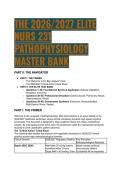
THE 2026/2027 ELITE
NURS 231
PATHOPHYSIOLOGY
MASTER BANK
PART 0: THE NAVIGATOR
● PART I: THE PRIMER
○ The "Welcome to the Big Leagues" Hook
○ The 2026/2027 Critical Action Cheat Sheet
● PART II: THE ELITE TEST BANK
○ Questions 1–28: Foundational Syntax & Application (Cellular Adaptation,
Neoplasia, Immunity)
○ Questions 29–58: Professional Simulation (Cardiovascular, Pulmonary, Neural,
Gastrointestinal, Renal)
○ Questions 59–88: Grandmaster Synthesis (Endocrine, Musculoskeletal,
Multi-System Shock, Sepsis)
PART I: THE PRIMER
Welcome to the vanguard of pathophysiology. Rote memorization is an active liability in the
2026/2027 healthcare landscape, where clinical complexity demands high-speed cognitive
processing. This document is designed to forge academic theory into sharp, professional
intuition. By intercepting novice errors here, the practitioner builds the mechanistic framework
required to avert catastrophic patient outcomes.
The "Critical Action" Cheat Sheet
The following table isolates the absolute non-negotiable standards for 2026/2027 clinical
practice across major pathophysiological domains.
Clinical Domain 2026/2027 Regulatory Redline First Principles
Pathophysiological Rationale
Sepsis (SSC 2026) Administer 30 mL/kg isotonic Sepsis causes profound
crystalloid within 3 hours. microvascular dilation.
Target MAP ≥ 65 mmHg. Draw Crystalloids fill the expanded
,Clinical Domain 2026/2027 Regulatory Redline First Principles
Pathophysiological Rationale
lactate; >2 mmol/L defines vascular compartment;
shock. vasopressors restore the
required hydrostatic perfusion
gradient.
Stroke (ASA 2026) Tenecteplase (TNK) is a TNK provides rapid bolus
primary IV thrombolytic. Do not reperfusion. Permissive
lower systolic BP <140 mmHg hypertension is mechanically
post-EVT. required to push collateral
blood flow through the stunned
ischemic penumbra.
Heart Failure (AHA 2026) Categorize EF: HFrEF (≤40%), Myocardial remodeling is
HFimpEF (improved >40%), structural, not just functional.
HFmrEF (41-49%), HFpEF "Improved" EF (HFimpEF)
(≥50%). requires continued blockade of
the
renin-angiotensin-aldosterone
system (RAAS) to prevent
fibrotic regression.
COPD (GOLD 2026) A single moderate/severe Acute respiratory inflammation
exacerbation shifts the patient triggers systemic cytokine
to Group E. storms, massively increasing
the risk of acute plaque rupture
and major cardiovascular
events within 30 days.
CKD Anemia (KDIGO 2026) Withhold iron therapy if serum The fibrotic kidney cannot
ferritin >700 ng/mL or TSAT produce erythropoietin (EPO).
≥40%. Flooding the system with iron
beyond saturation limits results
in unbound, highly toxic free
iron that destroys hepatic and
cardiac tissue.
PART II: THE ELITE TEST BANK
Questions 1–28: Foundational Syntax & Application
Q1: A 65-year-old client with chronic, uncontrolled hypertension develops left ventricular wall
thickening. Echocardiography confirms the absence of increased cell quantity but a massive
increase in intracellular organelles. Which cellular adaptation BEST defines this state? A)
Pathologic hyperplasia driven by rapid mitotic division of cardiomyocytes. B) Pathologic
hypertrophy driven by increased protein synthesis and myofilament accumulation. C)
Compensatory metaplasia of the endocardium to resist mechanical stress. D) Ischemic
dysplasia leading to disorganized cellular architecture.
● The Answer: B (Pathologic hypertrophy driven by increased protein synthesis and
myofilament accumulation.)
● Distractor Analysis:
, ○ A is incorrect: Cardiac myocytes are terminally differentiated and incapable of
mitotic division (hyperplasia).
○ C is incorrect: Metaplasia is the substitution of one mature cell type for another,
which does not account for overall gross organ enlargement.
○ D is incorrect: Dysplasia involves deranged cell growth and is a precursor to
neoplasia, not a response to pure hemodynamic overload.
The Mentor's Analysis: The distinction between hypertrophy and hyperplasia is a fundamental
binary. Hypertrophy is an increase in individual cell volume; hyperplasia is an increase in cell
number. When the myocardium faces immense systemic vascular resistance, it cannot build a
larger army of cells; it must build a stronger arsenal of proteins within the existing cells.
Professional Intuition: If a cell is terminally differentiated, its only survival mechanism against
stress is volumetric swelling.
Q2: A 45-year-old client with chronic gastroesophageal reflux disease (GERD) undergoes an
endoscopy. The biopsy reveals that the normal stratified squamous epithelium of the lower
esophagus has been replaced by ciliated columnar epithelium. What is the MOST
APPROPRIATE pathophysiological classification? A) Dysplasia B) Neoplasia C) Metaplasia D)
Anaplasia
● The Answer: C (Metaplasia)
● Distractor Analysis:
○ A is incorrect: Dysplasia is disorganized, chaotic cellular growth with varying sizes
and shapes, not a clean swap of mature cell lines.
○ B is incorrect: Neoplasia indicates autonomous, uncoordinated new growth
(tumors).
○ D is incorrect: Anaplasia is a total lack of cellular differentiation, a hallmark of
high-grade malignancy.
The Mentor's Analysis: Metaplasia is a calculated, reversible biological retreat. The tissue
swaps out a delicate, friction-resistant cell type (squamous) for a robust, acid-resistant one
(columnar) to survive a hostile microenvironment. Professional Intuition: Metaplasia is an
organized survival tactic; dysplasia is the loss of organizational control.
Q3: During the acute vascular phase of inflammation, a client exhibits pronounced localized
swelling (tumor) and heat (calor) at a laceration site. Which biochemical mediators are
PRIMARILY responsible for initiating these specific vascular changes? A) Neutrophils and
Macrophages B) Histamine and Nitric Oxide C) IgG and Complement C3b D) Selectins and
Integrins
● The Answer: B (Histamine and Nitric Oxide)
● Distractor Analysis:
○ A is incorrect: These are the cellular responders that arrive later, not the immediate
vascular mediators.
○ C is incorrect: These are opsonins that tag pathogens for phagocytosis.
○ D is incorrect: These are adhesion molecules that allow leukocytes to stick to the
endothelium during margination.
The Mentor's Analysis: Inflammation is commanded by chemical blueprints. Histamine causes
endothelial cell contraction, creating gaps that allow fluid to leak (edema), while Nitric Oxide
drives profound vasodilation, increasing local blood flow (heat and redness). Professional
Intuition: Trace the gross physical symptom directly back to its molecular architect.
Q4: A 22-year-old client presents with acute systemic anaphylaxis after a bee sting. The
practitioner prepares to administer epinephrine. Based on first principles of drug absorption in a
shock state, which administration route is the MOST APPROPRIATE? A) Intravenous (IV) push
, B) Subcutaneous (SC) injection into the abdomen C) Intramuscular (IM) injection into the vastus
lateralis D) Intramuscular (IM) injection into the deltoid
● The Answer: C (Intramuscular (IM) injection into the vastus lateralis)
● Distractor Analysis:
○ A is incorrect: IV epinephrine in an awake patient can trigger lethal ventricular
arrhythmias and is reserved for cardiac arrest or refractory shock.
○ B is incorrect: SC absorption is disastrously delayed (Tmax ~34 min) due to intense
peripheral vasoconstriction in the dermal beds during shock. * D is incorrect: The
deltoid is a small muscle with inferior perfusion compared to the vastus lateralis.
The Mentor's Analysis: Anaphylaxis requires immediate systemic distribution of a
catecholamine. The vastus lateralis represents a massive, highly vascularized muscle bed that
guarantees rapid uptake (Tmax ~8 min). Professional Intuition: In any shock state, peripheral
tissues clamp down. You must target the largest, deepest vascular depot available.
Q5: A client is diagnosed with Goodpasture's syndrome, characterized by autoantibodies
directly attacking the fixed basement membranes of the lungs and kidneys. This pathology is a
classic manifestation of which hypersensitivity reaction? A) Type I (IgE-Mediated) B) Type II
(Tissue-Specific) C) Type III (Immune Complex-Mediated) D) Type IV (Cell-Mediated)
● The Answer: B (Type II (Tissue-Specific))
● Distractor Analysis:
○ A is incorrect: Type I is allergic/anaphylactic, driven by mast cell degranulation.
○ C is incorrect: Type III involves soluble antigen-antibody complexes circulating in
the plasma that deposit randomly in tissues later. * D is incorrect: Type IV is a
delayed, T-cell mediated response (e.g., contact dermatitis).
The Mentor's Analysis: The absolute differentiator between Type II and Type III is the
geographical location of the antigen. If the antigen is bolted to the floor (fixed on a cell surface
or matrix), it is Type II. If it is floating in the plasma, it is Type III. Professional Intuition: Target
location dictates the pathology.
Q6: A client's laboratory report indicates a complete absence of adaptive immune memory.
Which cell line is PRIMARILY deficient in this individual? A) Natural Killer (NK) Cells B)
Neutrophils C) B and T Lymphocytes D) Macrophages
● The Answer: C (B and T Lymphocytes)
● Distractor Analysis:
○ A is incorrect: NK cells are innate, non-specific assassins with no memory capacity.
○ B is incorrect: Neutrophils are rapid-response, germline-encoded phagocytes.
○ D is incorrect: Macrophages are innate antigen-presenting cells that initiate the
response but do not retain memory.
The Mentor's Analysis: Only the adaptive immune system possesses the capacity for memory
via somatic recombination and subsequent clonal expansion. The innate system is incredibly
fast but entirely amnesic. Professional Intuition: Memory requires lymphocytes. Without B and
T cells, every single pathogen encounter is experienced as the first.
Q7: A client presents with profound peripheral edema secondary to severe, end-stage liver
failure and hypoalbuminemia. Which alteration in Starling forces is MOST responsible for this
fluid shift? A) Increased Capillary Hydrostatic Pressure B) Decreased Capillary Colloidal Oncotic
Pressure C) Increased Interstitial Hydrostatic Pressure D) Decreased Capillary Permeability
● The Answer: B (Decreased Capillary Colloidal Oncotic Pressure)
● Distractor Analysis:
○ A is incorrect: Hydrostatic pressure is driven by blood volume and cardiac output
(e.g., heart failure), not albumin synthesis.
NURS 231
PATHOPHYSIOLOGY
MASTER BANK
PART 0: THE NAVIGATOR
● PART I: THE PRIMER
○ The "Welcome to the Big Leagues" Hook
○ The 2026/2027 Critical Action Cheat Sheet
● PART II: THE ELITE TEST BANK
○ Questions 1–28: Foundational Syntax & Application (Cellular Adaptation,
Neoplasia, Immunity)
○ Questions 29–58: Professional Simulation (Cardiovascular, Pulmonary, Neural,
Gastrointestinal, Renal)
○ Questions 59–88: Grandmaster Synthesis (Endocrine, Musculoskeletal,
Multi-System Shock, Sepsis)
PART I: THE PRIMER
Welcome to the vanguard of pathophysiology. Rote memorization is an active liability in the
2026/2027 healthcare landscape, where clinical complexity demands high-speed cognitive
processing. This document is designed to forge academic theory into sharp, professional
intuition. By intercepting novice errors here, the practitioner builds the mechanistic framework
required to avert catastrophic patient outcomes.
The "Critical Action" Cheat Sheet
The following table isolates the absolute non-negotiable standards for 2026/2027 clinical
practice across major pathophysiological domains.
Clinical Domain 2026/2027 Regulatory Redline First Principles
Pathophysiological Rationale
Sepsis (SSC 2026) Administer 30 mL/kg isotonic Sepsis causes profound
crystalloid within 3 hours. microvascular dilation.
Target MAP ≥ 65 mmHg. Draw Crystalloids fill the expanded
,Clinical Domain 2026/2027 Regulatory Redline First Principles
Pathophysiological Rationale
lactate; >2 mmol/L defines vascular compartment;
shock. vasopressors restore the
required hydrostatic perfusion
gradient.
Stroke (ASA 2026) Tenecteplase (TNK) is a TNK provides rapid bolus
primary IV thrombolytic. Do not reperfusion. Permissive
lower systolic BP <140 mmHg hypertension is mechanically
post-EVT. required to push collateral
blood flow through the stunned
ischemic penumbra.
Heart Failure (AHA 2026) Categorize EF: HFrEF (≤40%), Myocardial remodeling is
HFimpEF (improved >40%), structural, not just functional.
HFmrEF (41-49%), HFpEF "Improved" EF (HFimpEF)
(≥50%). requires continued blockade of
the
renin-angiotensin-aldosterone
system (RAAS) to prevent
fibrotic regression.
COPD (GOLD 2026) A single moderate/severe Acute respiratory inflammation
exacerbation shifts the patient triggers systemic cytokine
to Group E. storms, massively increasing
the risk of acute plaque rupture
and major cardiovascular
events within 30 days.
CKD Anemia (KDIGO 2026) Withhold iron therapy if serum The fibrotic kidney cannot
ferritin >700 ng/mL or TSAT produce erythropoietin (EPO).
≥40%. Flooding the system with iron
beyond saturation limits results
in unbound, highly toxic free
iron that destroys hepatic and
cardiac tissue.
PART II: THE ELITE TEST BANK
Questions 1–28: Foundational Syntax & Application
Q1: A 65-year-old client with chronic, uncontrolled hypertension develops left ventricular wall
thickening. Echocardiography confirms the absence of increased cell quantity but a massive
increase in intracellular organelles. Which cellular adaptation BEST defines this state? A)
Pathologic hyperplasia driven by rapid mitotic division of cardiomyocytes. B) Pathologic
hypertrophy driven by increased protein synthesis and myofilament accumulation. C)
Compensatory metaplasia of the endocardium to resist mechanical stress. D) Ischemic
dysplasia leading to disorganized cellular architecture.
● The Answer: B (Pathologic hypertrophy driven by increased protein synthesis and
myofilament accumulation.)
● Distractor Analysis:
, ○ A is incorrect: Cardiac myocytes are terminally differentiated and incapable of
mitotic division (hyperplasia).
○ C is incorrect: Metaplasia is the substitution of one mature cell type for another,
which does not account for overall gross organ enlargement.
○ D is incorrect: Dysplasia involves deranged cell growth and is a precursor to
neoplasia, not a response to pure hemodynamic overload.
The Mentor's Analysis: The distinction between hypertrophy and hyperplasia is a fundamental
binary. Hypertrophy is an increase in individual cell volume; hyperplasia is an increase in cell
number. When the myocardium faces immense systemic vascular resistance, it cannot build a
larger army of cells; it must build a stronger arsenal of proteins within the existing cells.
Professional Intuition: If a cell is terminally differentiated, its only survival mechanism against
stress is volumetric swelling.
Q2: A 45-year-old client with chronic gastroesophageal reflux disease (GERD) undergoes an
endoscopy. The biopsy reveals that the normal stratified squamous epithelium of the lower
esophagus has been replaced by ciliated columnar epithelium. What is the MOST
APPROPRIATE pathophysiological classification? A) Dysplasia B) Neoplasia C) Metaplasia D)
Anaplasia
● The Answer: C (Metaplasia)
● Distractor Analysis:
○ A is incorrect: Dysplasia is disorganized, chaotic cellular growth with varying sizes
and shapes, not a clean swap of mature cell lines.
○ B is incorrect: Neoplasia indicates autonomous, uncoordinated new growth
(tumors).
○ D is incorrect: Anaplasia is a total lack of cellular differentiation, a hallmark of
high-grade malignancy.
The Mentor's Analysis: Metaplasia is a calculated, reversible biological retreat. The tissue
swaps out a delicate, friction-resistant cell type (squamous) for a robust, acid-resistant one
(columnar) to survive a hostile microenvironment. Professional Intuition: Metaplasia is an
organized survival tactic; dysplasia is the loss of organizational control.
Q3: During the acute vascular phase of inflammation, a client exhibits pronounced localized
swelling (tumor) and heat (calor) at a laceration site. Which biochemical mediators are
PRIMARILY responsible for initiating these specific vascular changes? A) Neutrophils and
Macrophages B) Histamine and Nitric Oxide C) IgG and Complement C3b D) Selectins and
Integrins
● The Answer: B (Histamine and Nitric Oxide)
● Distractor Analysis:
○ A is incorrect: These are the cellular responders that arrive later, not the immediate
vascular mediators.
○ C is incorrect: These are opsonins that tag pathogens for phagocytosis.
○ D is incorrect: These are adhesion molecules that allow leukocytes to stick to the
endothelium during margination.
The Mentor's Analysis: Inflammation is commanded by chemical blueprints. Histamine causes
endothelial cell contraction, creating gaps that allow fluid to leak (edema), while Nitric Oxide
drives profound vasodilation, increasing local blood flow (heat and redness). Professional
Intuition: Trace the gross physical symptom directly back to its molecular architect.
Q4: A 22-year-old client presents with acute systemic anaphylaxis after a bee sting. The
practitioner prepares to administer epinephrine. Based on first principles of drug absorption in a
shock state, which administration route is the MOST APPROPRIATE? A) Intravenous (IV) push
, B) Subcutaneous (SC) injection into the abdomen C) Intramuscular (IM) injection into the vastus
lateralis D) Intramuscular (IM) injection into the deltoid
● The Answer: C (Intramuscular (IM) injection into the vastus lateralis)
● Distractor Analysis:
○ A is incorrect: IV epinephrine in an awake patient can trigger lethal ventricular
arrhythmias and is reserved for cardiac arrest or refractory shock.
○ B is incorrect: SC absorption is disastrously delayed (Tmax ~34 min) due to intense
peripheral vasoconstriction in the dermal beds during shock. * D is incorrect: The
deltoid is a small muscle with inferior perfusion compared to the vastus lateralis.
The Mentor's Analysis: Anaphylaxis requires immediate systemic distribution of a
catecholamine. The vastus lateralis represents a massive, highly vascularized muscle bed that
guarantees rapid uptake (Tmax ~8 min). Professional Intuition: In any shock state, peripheral
tissues clamp down. You must target the largest, deepest vascular depot available.
Q5: A client is diagnosed with Goodpasture's syndrome, characterized by autoantibodies
directly attacking the fixed basement membranes of the lungs and kidneys. This pathology is a
classic manifestation of which hypersensitivity reaction? A) Type I (IgE-Mediated) B) Type II
(Tissue-Specific) C) Type III (Immune Complex-Mediated) D) Type IV (Cell-Mediated)
● The Answer: B (Type II (Tissue-Specific))
● Distractor Analysis:
○ A is incorrect: Type I is allergic/anaphylactic, driven by mast cell degranulation.
○ C is incorrect: Type III involves soluble antigen-antibody complexes circulating in
the plasma that deposit randomly in tissues later. * D is incorrect: Type IV is a
delayed, T-cell mediated response (e.g., contact dermatitis).
The Mentor's Analysis: The absolute differentiator between Type II and Type III is the
geographical location of the antigen. If the antigen is bolted to the floor (fixed on a cell surface
or matrix), it is Type II. If it is floating in the plasma, it is Type III. Professional Intuition: Target
location dictates the pathology.
Q6: A client's laboratory report indicates a complete absence of adaptive immune memory.
Which cell line is PRIMARILY deficient in this individual? A) Natural Killer (NK) Cells B)
Neutrophils C) B and T Lymphocytes D) Macrophages
● The Answer: C (B and T Lymphocytes)
● Distractor Analysis:
○ A is incorrect: NK cells are innate, non-specific assassins with no memory capacity.
○ B is incorrect: Neutrophils are rapid-response, germline-encoded phagocytes.
○ D is incorrect: Macrophages are innate antigen-presenting cells that initiate the
response but do not retain memory.
The Mentor's Analysis: Only the adaptive immune system possesses the capacity for memory
via somatic recombination and subsequent clonal expansion. The innate system is incredibly
fast but entirely amnesic. Professional Intuition: Memory requires lymphocytes. Without B and
T cells, every single pathogen encounter is experienced as the first.
Q7: A client presents with profound peripheral edema secondary to severe, end-stage liver
failure and hypoalbuminemia. Which alteration in Starling forces is MOST responsible for this
fluid shift? A) Increased Capillary Hydrostatic Pressure B) Decreased Capillary Colloidal Oncotic
Pressure C) Increased Interstitial Hydrostatic Pressure D) Decreased Capillary Permeability
● The Answer: B (Decreased Capillary Colloidal Oncotic Pressure)
● Distractor Analysis:
○ A is incorrect: Hydrostatic pressure is driven by blood volume and cardiac output
(e.g., heart failure), not albumin synthesis.


